
Part Eight: The Third Test
England v New Zealand
After their victories against Scotland and Ireland, New Zealand met England at Crystal Palace. In a one-sided contest, New Zealand scored five tries to none. Duncan McGregor scored four of the tries, Fred Newton the other. None of the tries were converted, so the score finished 15 – 0 in the All Blacks’ favour.
All-round sportsman C.B. Fry stated: “The notion that these men beat us because of our physical degeneracy is nonsense. They beat us by organisation and by tactics.”
In the Empire News ‘The Impressionist’ wrote: “It is my firm opinion that as a side the New Zealanders form the finest I have ever seen. It is a treat, yea an education to watch them. Gallant little Wales may be depended upon to make a great effort next Saturday. I hope to be present to see the struggle.”
Part Nine: The Build-Up to the Wales Match
Throughout October 1905, the Welsh Match Committee observed the New Zealanders and analysed their style of play. They soon realised that they would have to develop new tactics to overcome the tourists’ unorthodox style.
On 20 November 1905, the Committee held the first of two trials. The ‘Probables’ adopted the New Zealand formation, utilising seven forwards instead of eight, However, they were beaten 18–9 by the ‘Possibles’ and their traditional Welsh formation.
Despite this setback, the Committee persisted with the experiment and the ‘Probables’ won the second trial match 33–11. A final training session was held on 12 December 1905 dedicated to drop kicking (worth four points, a point more than a try) and perfecting the new scrum technique.
Part Ten: The Haka
While the Welsh players concentrated on their new tactics, the administrators considered how they should respond to the New Zealand Haka. A selector, Tom Williams, suggested that the appropriate Welsh response to the New Zealanders’ cultural challenge should be the singing of the Welsh national anthem, Hen Wlad Fy Nhadau.
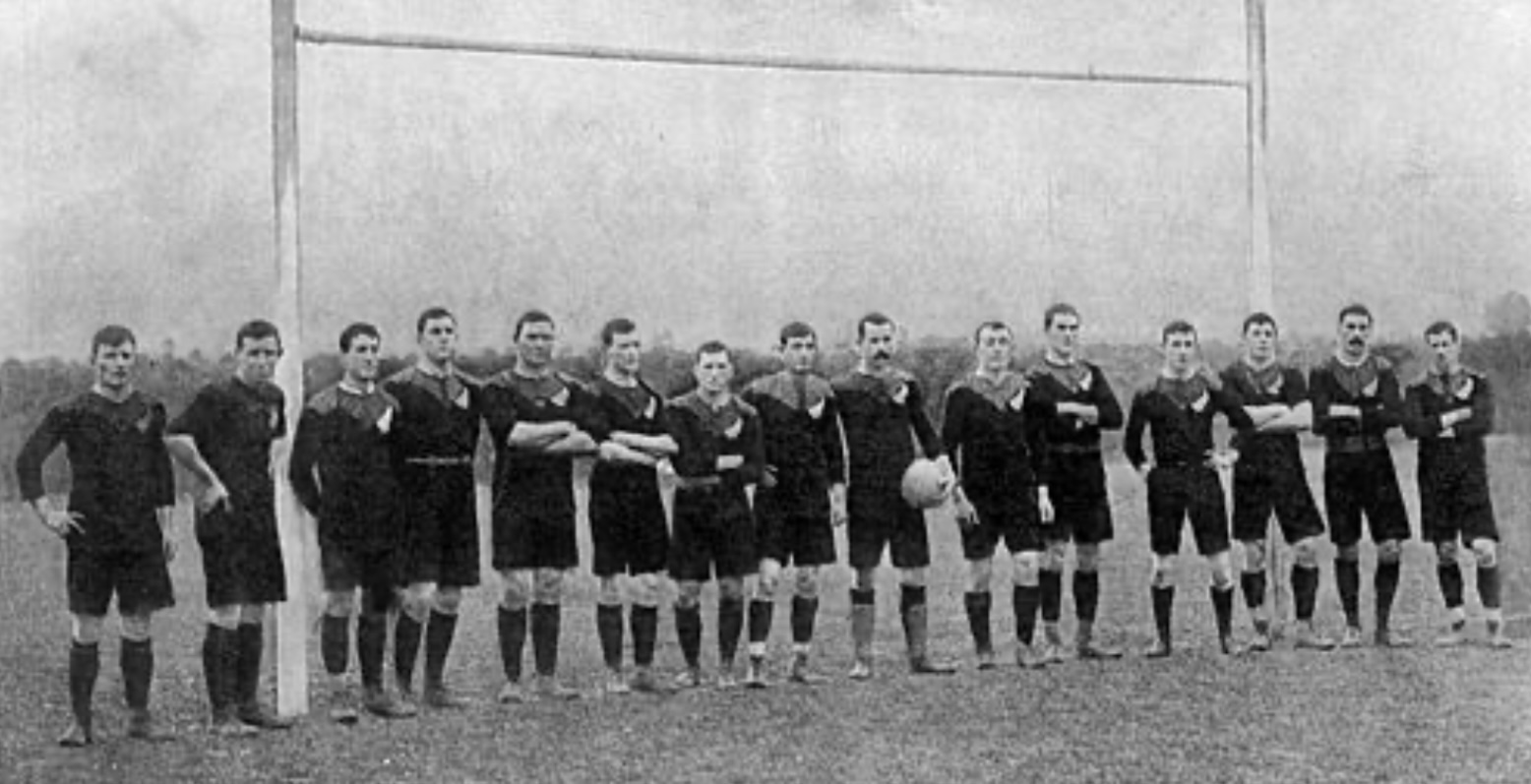
A debate ensued in the Welsh newspapers and the idea attracted a great deal of support. Nevertheless, no official plan was created, and no one was certain how the crowd would react after the New Zealanders had performed their Haka (pictured).

Part Eleven: The Press
The consensus amongst the media in London was that Wales had no chance against the all-conquering All Blacks. This article, published in The Times on the morning of the match, 16 December 1905, was typical.
“Time has stolen the dash from two or three of the best (Welsh players) – and the missing eighth man (the tactic to play only seven forwards) is likely to be badly missed before the Cardiff game comes to its conclusion in the inevitable defeat of Wales.”

Part Twelve: The Crowd
Additional trains were provided for the travelling spectators. Large queues formed before the Arms Park gates were opened at 11am and those gates were closed again at 1.30pm with the ground full.
Many would-be spectators, locked out of the ground, climbed trees in order to glimpse the match. In addition, taxi drivers parked outside the ground and charged people for the privilege of standing on their cabs to get a view over the stand.

Part Thirteen: Pre-Match Build-Up
Crowds throughout Britain and Ireland offered hostility or indifference to the New Zealand Haka. However, the Welsh public, informed and aware of its cultural significance, offered the Haka due respect.
As the Haka concluded, Welsh winger Teddy Morgan (pictured) led an immediate response by singing Hen Wlad Fy Nhadau. Morgan encouraged his teammates to join in, and the crowd soon added their impassioned voices.
“Imagine some 40,000 people singing their national anthem with all the fervour of which the Celtic heart is capable. It was the most impressive incident I have ever witnessed on a football field. It gave a semi-religious solemnity to this memorable contest, intensely thrilling, even awe-inspiring. It was a wonderful revelation of the serious spirit in which the Welsh take their football.” – New Zealand captain Dave Gallaher’s remark on experiencing the Welsh crowd singing their anthem at a sporting occasion for the first time.
The singing of Hen Wlad Fy Nhadau is the first recorded instance of a national anthem being sung before an international sporting fixture – anthems were normally reserved for royalty and formal state occasions.
Witnesses, including the New Zealand players and London press, noted the impact of the anthem on the players, crowd and themselves. For decades to come, match reports, player interviews and memoirs all cited the anthem as a factor in the Welsh victory.
Soon, the singing of national anthems would become a formal part of proceedings in a variety of sports and, eventually, a standard practice across the sporting world.

Part Fourteen: The Match
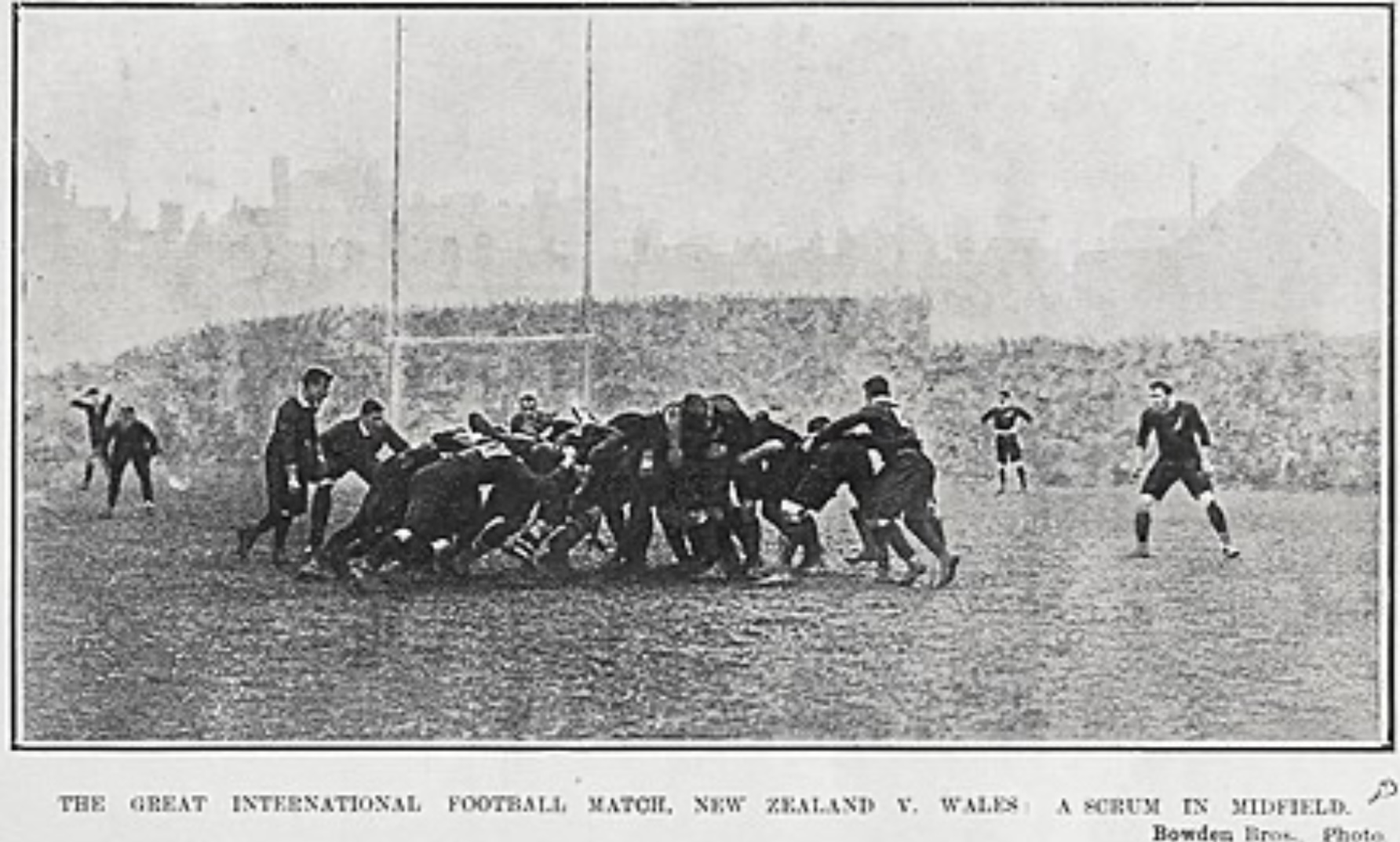
Hodges kicked off for Wales. Seeling made a break for New Zealand, and was brought down by the Welsh defence, resulting in the first scrum. The All Blacks adopted their usual formation of seven packed forwards. However, Wales abandoned the British system of eight forwards – they packed down with seven men, including four in the front row. This meant whichever side New Zealand tried to gain the loose-head advantage, Wales had a man outside.
Wales dominated the first half. Indeed, New Zealand only breeched the Welsh 25 in the minutes before half time. In the opening fifteen minutes, the All Blacks conceded a string of penalties. The best chance fell to Wales, but that chance faded when Willie Llewellyn, yards from the try line, failed to hold a difficult pass from Jack Williams.
On twenty-three minutes another scrum was called and Dicky Owen called the move he’d devised in training. Wales won the ball. Owen ran down the blindside with the backline of Bush, Nicholls and Llewellyn following him in support. This initial move drew Gallaher, Hunter and most of the New Zealand backs to the blindside. Then Owen switched play. He threw a long pass back to the openside. Cliff Pritchard picked up the ball from his bootlaces. He drew the covering tackle of Deans before passing to Gabe who beat McGregor. Finally, Gabe passed to Morgan who sprinted twenty-five yards past the covering full-back Gillett to touch down in the left corner. The try went unconverted. Half-time: Wales 3 – 0 New Zealand.
New Zealand rallied in the second half and dominated the attacking play. However, their kicking game was not up to its usual standard, and they had issues with the strong Welsh scrum.
Billy Wallace crossed the try line, but only after he’d placed a foot in touch. A forward pass from Deans put McGregor in the clear, and he was rightly called back.
The All Blacks pressed through a series of scrums on the Welsh goal line, but the Welsh forwards refused to yield. With the mist descending, Deans made a break and sprinted thirty yards to the try line. Inches from the try line, Morgan and Gabe tackled Deans. The referee, John Dallas, arrived and said no try. He estimated that Deans was a good six to twelve inches short of scoring. Some reports suggested that Deans made an illegal double movement, and was still short. Deans, however, insisted that he had scored, then been pulled back. New Zealand’s best chance had gone. Final score: Wales 3 – 0 New Zealand.

Part Fifteen: The Cultural Impact
At the sound of the final whistle, the crowd rushed on to the field and carried the Welsh players on their shoulders. Later, Gallaher led his team into the Welsh changing room, where he offered his congratulations, and the players exchanged jerseys. He also conceded that on the day, “the best team won”.
The victory over New Zealand cemented rugby’s place in the Welsh national psyche. It laid the foundations for the first Golden Age of Welsh Rugby. As the century unfolded, despite the devastation of two world wars, more Golden Ages followed. Welsh rugby enjoyed feasts of success and endured famines of defeat. Peaks and troughs. It has always been so.
As ever, thank you for your interest and support.
Hannah xxx
For Authors
#1 for value with 565,000 readers, The Fussy Librarian has helped my books to reach #1 on 36 occasions.
A special offer from my publisher and the Fussy Librarian. https://authors.thefussylibrarian.com/?ref=goylake
Don’t forget to use the code goylake20 to claim your discount 🙂


 Hannah Howe