Categories
Dear Reader

Dear Reader #140

Dear Reader,

This week, I made great progress with the writing of Operation Rose, Eve’s War Heroines of SOE book seven, and Fruit, book four in my Olive Tree Spanish Civil War saga. Covid slowed me down over recent months, but this week was much more like it.

In this month’s issue of Mom’s Favorite Reads…

Crime and thriller author Shawn Reilly Simmons interviewed by Wendy H Jones. Plus, Author Features, Nature, Photography, Poetry, Short Stories, Young Writers, National Batman Day, and so much more!

You discover all sorts when you look through parish records.

My 3 x great grandmother Lucy Sarah Glissan was born in Stepney, London in 1842. In 1851 with her sisters Amelia, 13, and Mary Ann, 6, she was living in 28 Church Road, St-George-in-the-East, London in the shadow of this impressive Anglican church. Lucy’s parents were John Glissan, a surgeon/chemist/dentist and Sarah Glissan née Foreman, a nurse/chemist/dentist.

In 1861 my 3 x great grandmother Lucy Sarah Glissan, 19, was living with her sisters, Amelia, 23, and Sarah Ann, 16, in 2 Charles Street, St George-in-the-East, London. All three were unmarried tailoresses.

A baby also lived with the sisters, William, their ‘brother’. A problem: their mother, Sarah, was a widow of seven years and past childbearing age. To save face, the sisters had lied to the enumerator. So, which one of them gave birth to William?

The answer: my 3 x great grandmother Lucy Sarah Glissan. Shortly after the census was taken, Lucy Sarah married William’s father, Richard Stokes. Sadly, shortly after that William died. The couple produced seven more children including my direct ancestor William Richard Fredrick Stokes.

Lucy Sarah Glissan married Richard Stokes, who later ran a furniture-making business, at St Mary’s, Stepney on 27 May 1861. Both were nineteen, and literate. By 1870 80% of males were literate compared to 75% of females, up from 66% and 50% in thirty years. Lucy Sarah’s younger sister, Mary Ann, who witnessed the wedding, was also literate.

Roath Village School, Cardiff, 1899 (National Museum of Wales).

Lucy Sarah Glissan gave birth to eight children in twenty years 1861 – 1881. Her first and eighth child both died in infancy. The other six prospered. In the Victorian era the average number of children per family was six.

Family portrait, (not the Glissans) 1893.

The Glissan sisters were close, so we should take a moment to explore Amelia and Mary Ann’s lives. Amelia married Charles Samuel, a mariner from Antwerp. The couple did not have any children. When Amelia died in 1894, Charles fell on hard times and entered the workhouse. Mary Ann married James Reynolds, a gun maker/engineer. The couple produced only one child, who died young.

Lucy Sarah died on 9 October 1888 at Red Lion Street, Shoreditch.

***

My 4 x great grandfather John Glissan was born in 1803 in Ireland. In 1824 Apothecaries Hall in Dublin recognised him as an apothecary with a licence to trade. A few years later, John moved to London where he found employment assisting John William Keys Parkinson, son of James Parkinson, the doctor who gave his name to Parkinson’s Disease.

Photographed in 1912 this is 1 Hoxton Square, London, the home and office of Parkinson and Son, surgeons and apothecaries. In the late 1820s my 4 x great grandfather John Glissan assisted the son, James, and added the skills of dentist and surgeon to his trade of apothecary. Picture: Wellcome Trust.

17 September 1829 a report in the London Courier detailing the evidence John Glissan, a surgeon, gave to an inquest into the death of Henry Kellard, a pauper.

In the early 1830s my 4 x great grandfather John Glissan left Parkinson and Son and set up his own business as a surgeon/chemist/dentist. Initially, he struggled and was forced to go on the road as a traveller, selling his medicines. In 1834 he was declared insolvent. Life for him in London was tough.
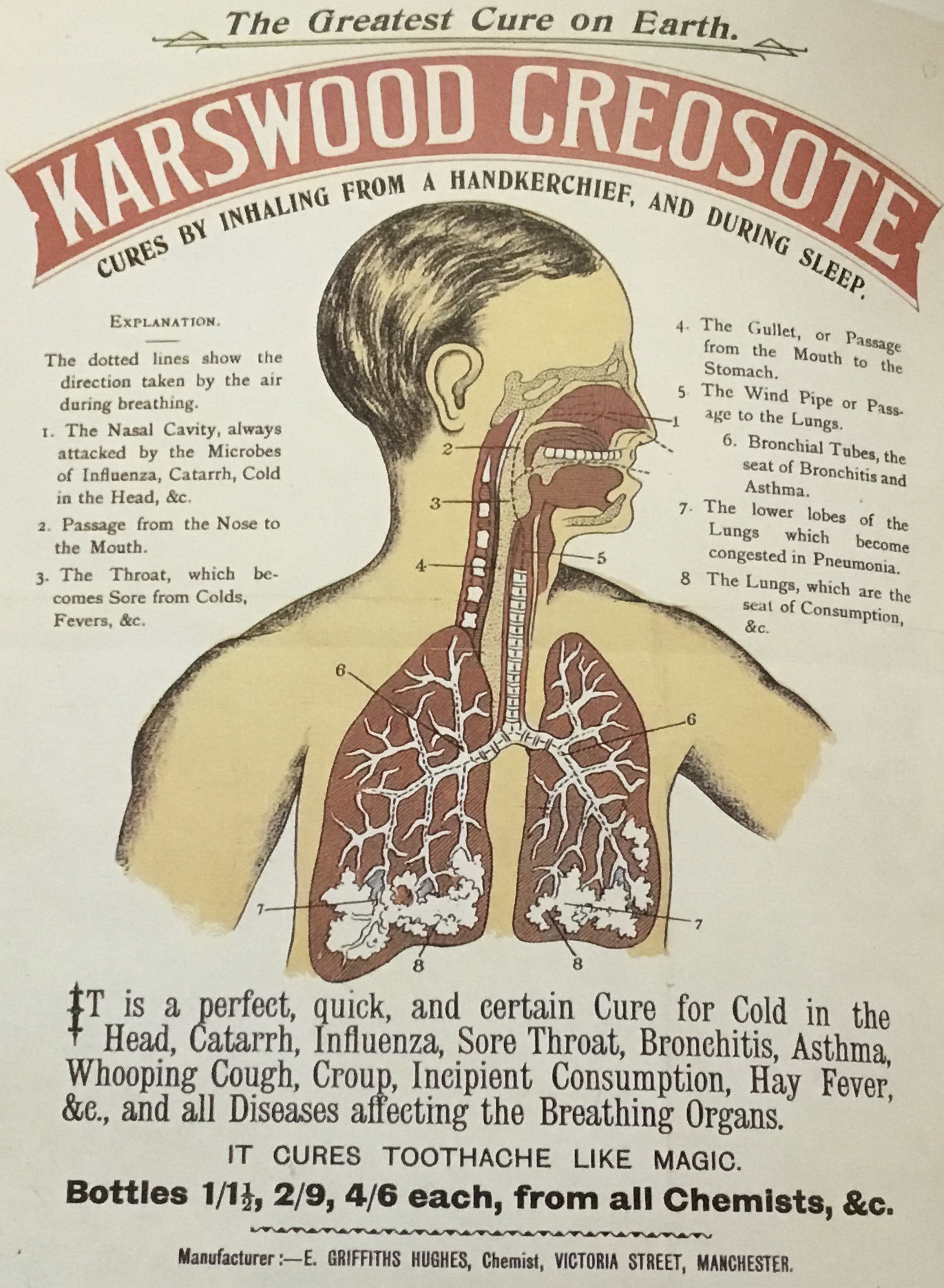
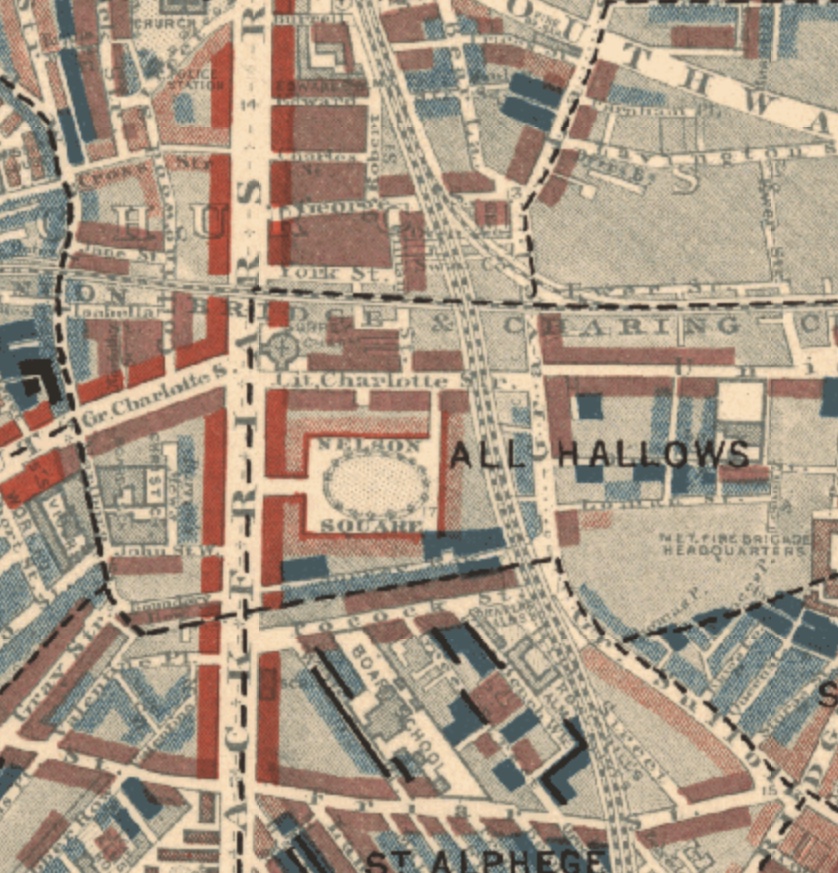
In early June 1833, at nine o’clock in the evening, Susannah Griffiths left her lodgings at 12 Dyer Street, London. She walked along George Street to the junction of Blackfriars Road, one of the most fashionable roads in nineteenth century London. She made her way to 147 Blackfriars Road and the shop owned by my 4 x great grandfather John Glissan. There, Susannah purchased a quantity of arsenic.
Returning home, Susannah set her needlework to one side and wrote a note, quoting Shakespeare’s Macbeth, “Canst thou not minister to a mind diseas’d, Pluck from the memory a rooted sorrow, Raze out the written troubles of the brain.” She added, “I have taken poison.” Then she placed the note under her pillow and swallowed the arsenic.

Susannah was educated. She understood Shakespeare. I imagine that she was a sensitive soul. A coroner’s inquest held at Christ Church Workhouse absolved John Glissan of any blame and concluded that Susannah died whilst being of unsound mind.

Two days after the newspaper report on Susannah’s tragic suicide, this mysterious message appeared in the Morning Advertiser. I’m not sure what to make of the note. There were no follow up messages, so I’m not sure what my ancestor John made of it either.

17 November 1833. If gout was your problem, my 4 x great grandfather John Glissan, a surgeon/dentist/chemist, was your man. In the 1830s, John appeared in many newspapers advertisements promoting potions for all manner of ailments.

16 February 1834. Another advertisement featuring John Glissan. This advert ran on a regular basis in the Weekly True Sun.

Top of the Pops, 16 February 1834. Note that female singers dominated. Madame Vestris (pictured) was Lucia Elizabeth Vestris (née Elizabetta Lucia Bartolozzi; 3 March 1797 – 8 August 1856) an actress and a contralto opera singer. She was also a theatre producer and manager.

For the first thirty years of his life John Glissan concentrated on learning the skills of a chemist, surgeon and dentist, and on establishing his business. In 1834, life offered a new challenge. More about that next time.

As ever, thank you for your interest and support.

Hannah

For Authors

#1 for value with 565,000 readers, The Fussy Librarian has helped my books to reach #1 on 32 occasions.

A special offer from my publisher and the Fussy Librarian. https://authors.thefussylibrarian.com/?ref=goylake

Don’t forget to use the code goylake20 to claim your discount 🙂

Categories
Dear Reader

Dear Reader #137

Dear Reader,

After a break since Christmas 2021, my blog is back. A week before Christmas, I became ill with Covid. That illness continued well into January. Since then, I have been catching up with my writing schedule, hence the break. 

I hope you will enjoy this blog post and future content.

My latest translations, the Italian version of Operation Locksmith and the Portuguese version of Damaged: Sam Smith Mystery Series book nineteen.

In this month’s issue of Mom’s Favorite Reads…

An exclusive interview with Jennifer Shahade two-time USA Women’s Chess Champion, poker champion, author and podcaster. Plus, Author Features, Nature, Photography, Poetry, Recipes, Short Stories, Jazz Appreciation Month, and so much more!

My Recent Genealogical Research

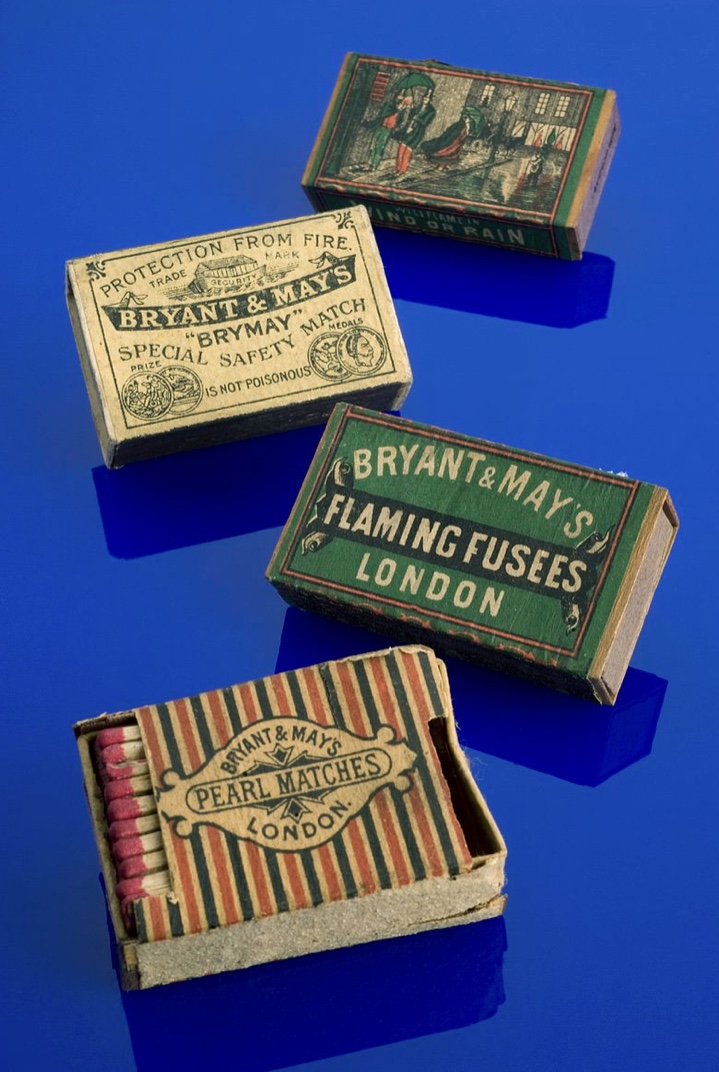
My 3 x great grandmother Sarah Ann Cottrell was born on 24 June 1848 in St Leonard’s, Shoreditch. Aged twelve she worked as a matchbox maker, on piece rates. Sarah Ann’s father, Mathew, was a fishmonger, a decent trade, so her matchboxes brought in bonus pennies to support her mother and five siblings.

Picture: Wellcome Trust

My 4 x great grandfather Mathew Cottrell was a fishmonger at Billingsgate Market. Here’s the market as Mathew would have seen it plus a description, both from the Illustrated London News, 7 August 1852.

In 1852, my 4 x great grandfather Mathew Cottrell was a fishmonger at Billingsgate Market so it seems fair to assume that his wife, Sarah, was adept at preparing fish dishes. Here’s some advice from A Mother’s Handbook, published the same year.

“Fish should be garnished with horseradish, or hard boiled eggs, cut in rings, and laid around the dish, or pastry, and served with no other vegetable but potatoes. This, or soup, is generally eaten at the commencement of a dinner.”

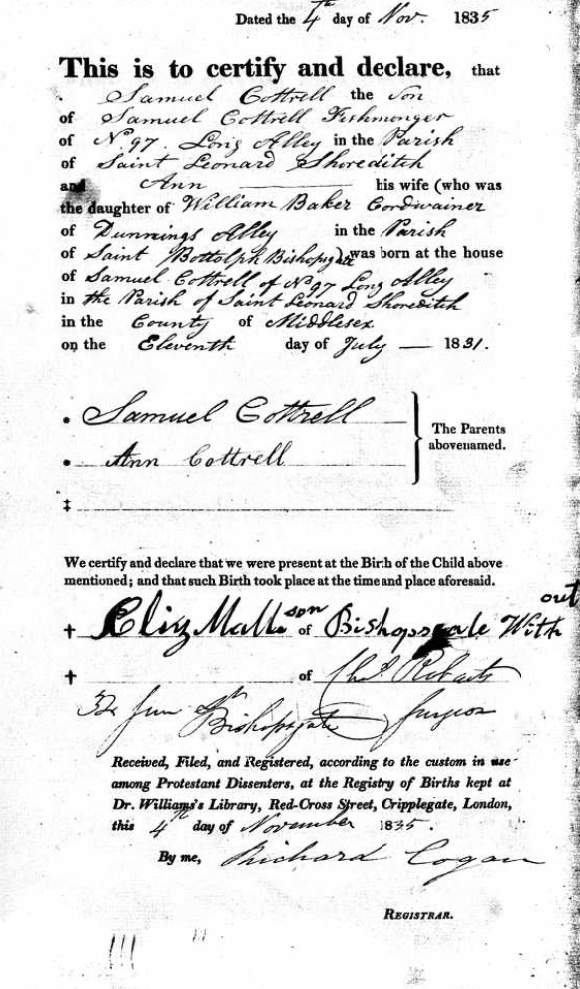
My 5 x great grandfather Samuel Cottrell was born on 11 July 1796 in Finsbury. After his marriage to Ann Baker he moved to Billingsgate where he worked as a fishmonger. Samuel and Ann were nonconformists, protestant dissenters. He lived in Dunnings Alley, a hotbed of dissent.

Somehow, Samuel and Ann avoided every census in the 1800s. However, the nonconformists kept detailed records, including details of Samuel’s family. These records confirm that a midwife was in attendance for all of Ann’s births along with, on occasion, a surgeon.

My 5 x great grandfather Samuel Cottrell lived a long life, 84 years. However, he struggled during his final two years. Unable to move freely, in 1878 he spent a month in Homerton Workhouse Infirmary. He signed himself out.

Two years later, Samuel spent two years in Bow Road Infirmary, pictured. Shortly after he left, a ‘Mad Russian’ murdered one of the inmates, slicing him with a knife. Within ten days Samuel was back in Homerton. He spent a further six months there, dying on 1 September 1880.

They kept stealing his shoes. My 6 x great grandfather John Cottrell was a boot maker. The Old Bailey website lists three occasions 1830 – 1832 when boys aged ten, twelve and seventeen stole his shoes. The court offered mercy to the ten year old, but the other two were transported for seven years.

St Mary Woolnoth, London. My 7 x great grandfather John Cottrell was born there on 6 Nov 1747 and baptised there on 29 Nov 1747. He ran a business as a chandler. He served on several coroner’s inquest juries and, like my Howe ancestors, was an Overseer of the Poor.

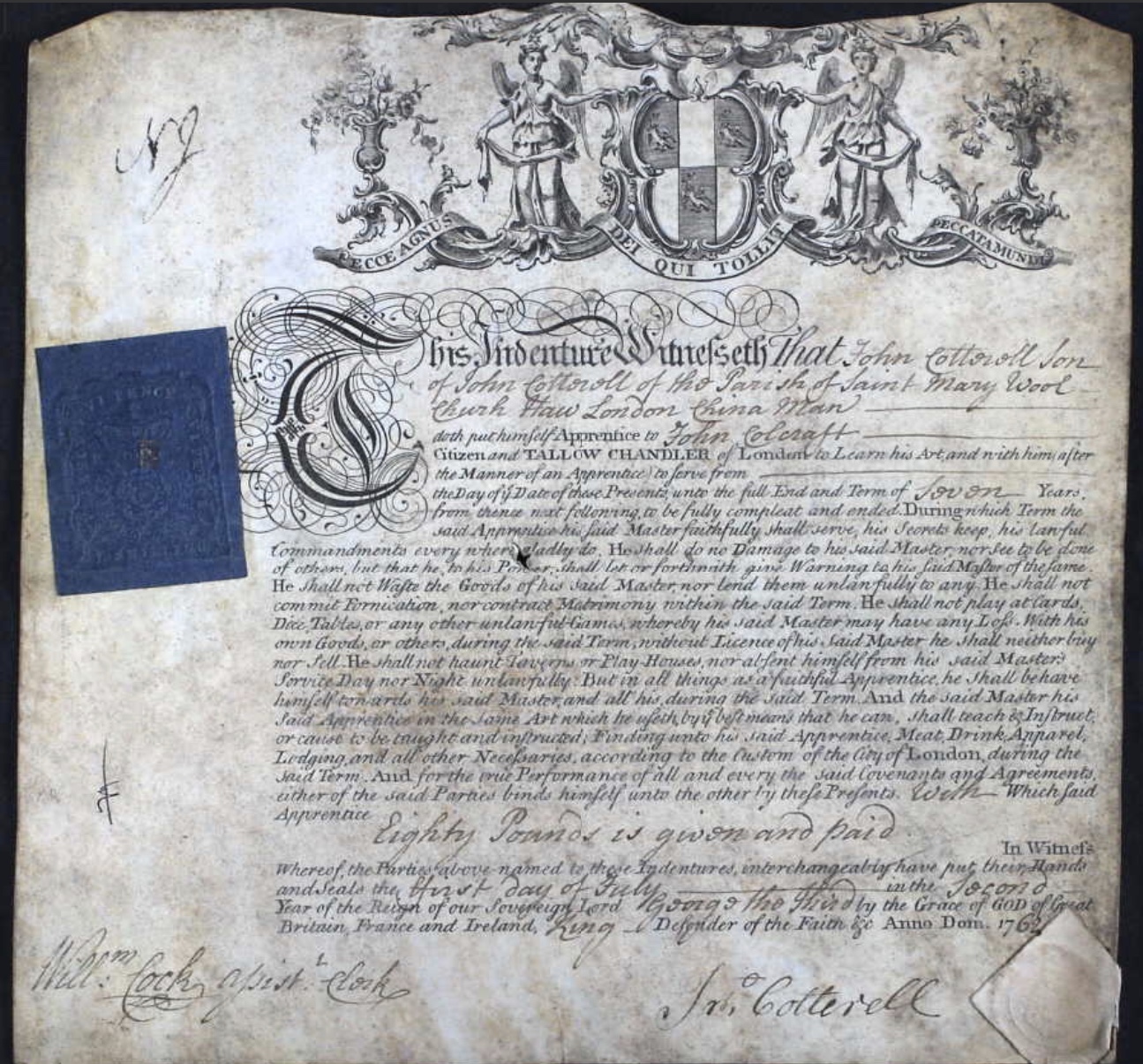
1 July 1762. An indenture belonging to my 7 x great grandfather John Cotterell. His father, also John, paid John Coleratt £80 (£8,200 today) so that he could learn the trade of tallow chandler. These indentures were standard in the 18th and 19th centuries with the names and trades added as applicable.

Apprentices were forbidden from playing cards, dice, entering taverns or playhouses, fornicating or marrying. Usually, these indentures covered a period of seven years. Little wonder that some apprentices broke the agreement and absconded.

John served his apprenticeship and in 1775 established a business on 55 Fore Street, Moorfield, selling food and household items.

As a ‘respectable member of the community’ my 7 x great grandfather John Cotterell served on five Coroner’s juries, in 1776,  1779, 1781, 1783 and 1785, each time investigating suspicious deaths in the community. 

In 1785 on ‘Friday this 20th. Day of May by Seven of the Clock in the After noon twenty-four able and sufficient Men of said Liberty’ gathered at John’s house to investigate the death of Robert Jurquet. The jury concluded that being of unsound mind, with a razor, Robert Jurquet took his own life.

My 7 x great grandfather John Cotterell’s elder brother, William, was sword bearer of the City of London. The office was created in the 14th century when it was recorded that the Lord Mayor should have, at his own expense, someone to bear his sword before him: 

‘a man well-bred’, one ‘who knows how in all places, in that which unto such service pertains, to support the honour of his Lord and of the City.’

Picture: George III receiving the Civic (Pearl) Sword from the Lord Mayor of London on his way to St Paul’s Cathedral, an event William probably attended.

As ever, thank you for your interest and support.

Hannah

For Authors

#1 for value with 565,000 readers, The Fussy Librarian has helped my books to reach #1 on 32 occasions.

A special offer from my publisher and the Fussy Librarian. https://authors.thefussylibrarian.com/?ref=goylake

Don’t forget to use the code goylake20 to claim your discount 🙂

Categories
Dear Reader

Dear Reader #136

Dear Reader,

Preparing a new series, Women at War, three novels set in France in 1944. Research ongoing, writing will start later this year.

My direct ancestors Robert Gadsden and William Gadsden were grocers.

Robert was born on 30 November 1714 in Hanslope, Buckinghamshire. On 18 October 1743 he married Elizabeth Richardson in Newport Pagnell, Buckinghamshire, but the marriage did not produce any children. Elizabeth died young and, on 18 July 1755 in Newport Pagnell, Robert married for a second time. His new bride was another Elizabeth, Elizabeth Crips, a widow. This marriage produced seven children, including their first born, my direct ancestor William.

Grocery stores in the 1700s sold a wide variety of items including sugar, tobacco, spices, coffee, tea, rice, chocolate and dried fruit. They featured local produce and items like those listed above from abroad. Earlier and later generations of Gadsdens were traders who travelled far and wide, to America and Africa, for example. Its tempting to think that Robert and William developed their stores from these overseas connections. However, instead of travelling they focused on selling their goods from their local stores.

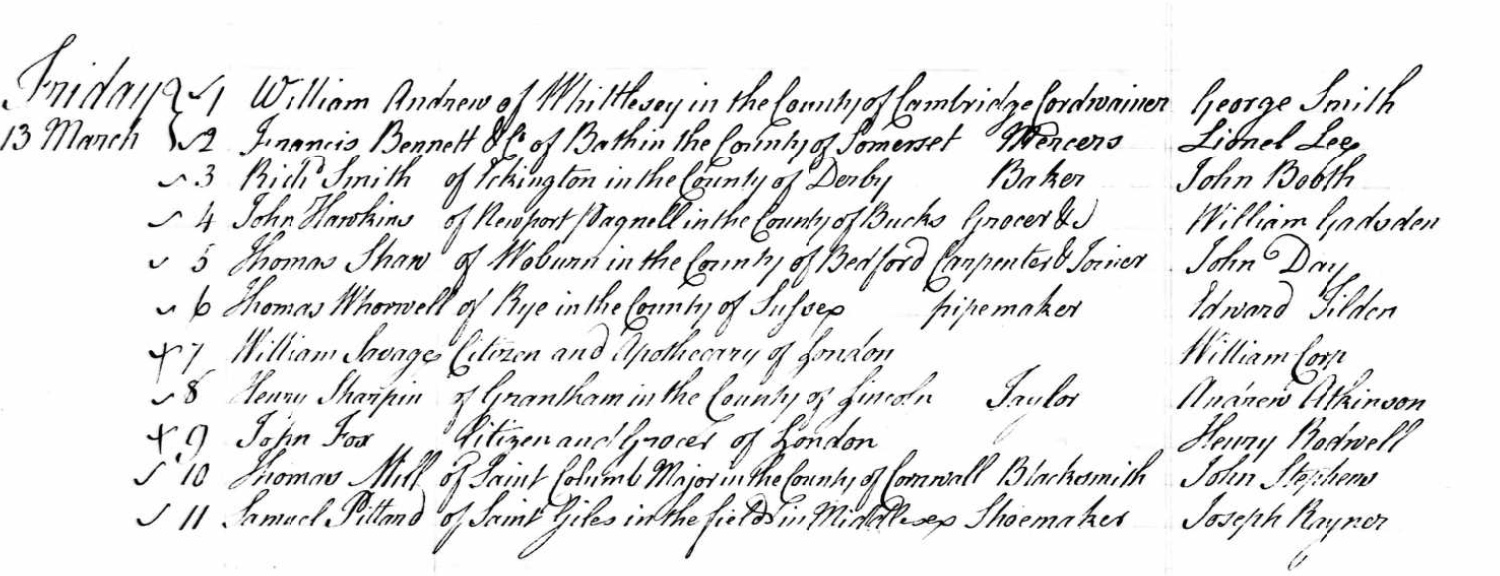
Robert died on 21 July 1768 in Newport Pagnell. William was only twelve and so too young to take over the family business. Instead, he had to learn the trade as an apprentice. He commenced his apprenticeship on 13 March 1772 in Newport Pagnell.

William’s apprenticeship

William was born on 3 August 1756 in Newport Pagnell and baptised five days later. After his apprenticeship he married twenty-year-old Elizabeth Chibnall, also in Newport Pagnell. The couple produced nine children, including my direct ancestor William and the baby of the family, Robert. Both were to feature in trials at the Old Bailey.

It would appear that William, born 1756, ran a steady business as a grocer. Maybe on account of the land tax introduced in 1798 he moved his family and business to London. He settled in Shoreditch and died there on 14 July 1819, a death that triggered a tragic chain of events.

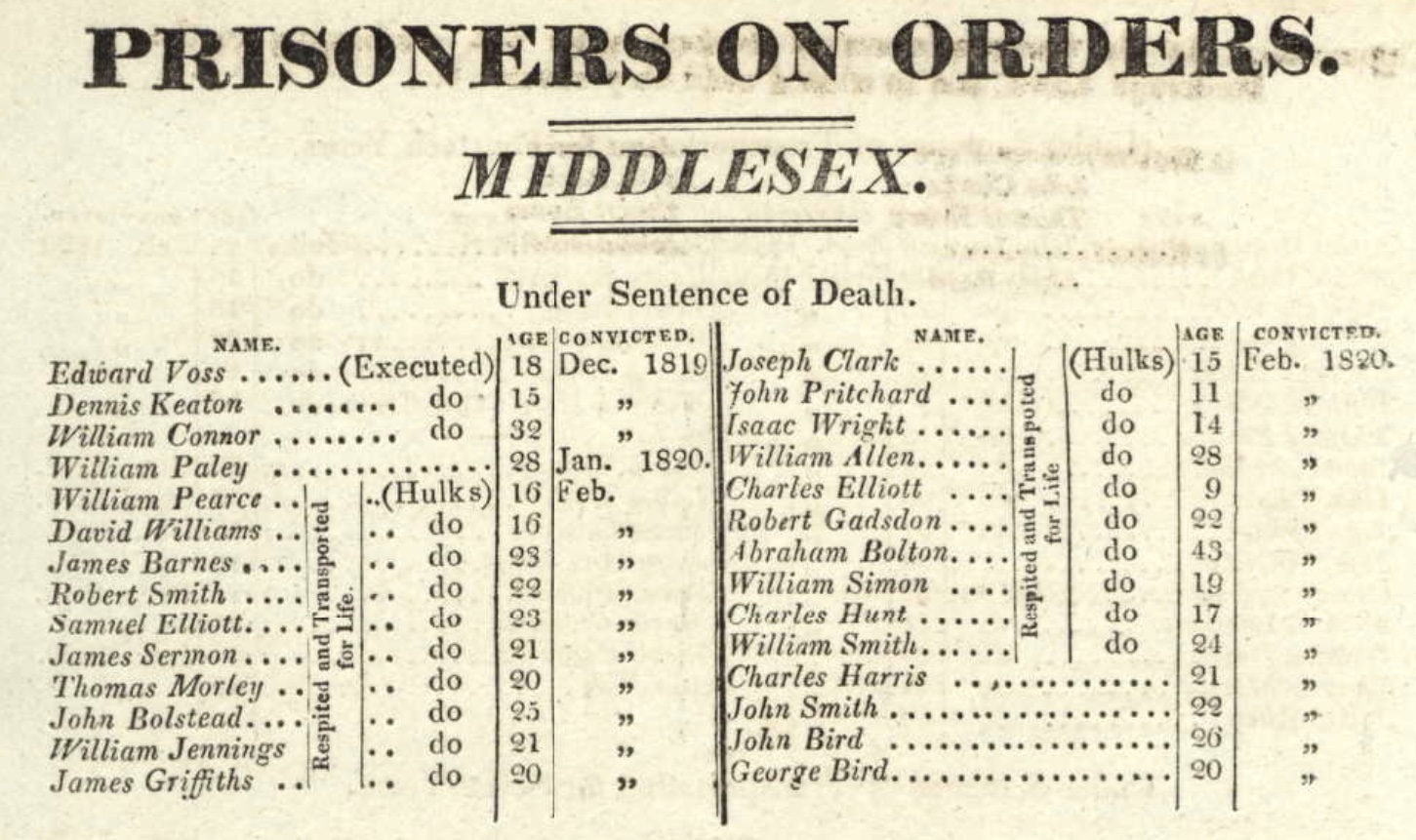
On 17 February 1820 twenty-two-year-old Robert Gadsden was indicted for feloniously breaking and entering the dwelling-house of John West, Esq. This incident occurred at one o’clock in the afternoon, on 29 January 1820 at St. Marylebone. John West’s wife, Harriet, was present when Robert allegedly stole a shawl, value twenty shillings, the goods of Sarah Griffiths.

Sarah Griffiths gave evidence: “I am servant to Mr. John West who lives in Baker Street, Portman Square, St. Marylebone. On the 29th of January, about one o’clock, I was in the house; Mrs. West, and five of the servants were at home. My shawl laid on a table in the housekeeper’s room, opposite the window which looks into the area – it was about a quarter of a yard from the window – the sash was down; nobody was in the room. I was upstairs, heard an alarm, came down, missed it, and found the prisoner in custody.”

William Ledger gave evidence: “I am servant to Mr. West. I had been out to fetch some water, and as I returned I saw the prisoner down the area – he was a stranger. I watched him, saw him lay a bundle of wood on the ledge of the window, lift up the sash, and with a stick that had a hook to it, he drew out the shawl off the table, put it under his jacket, and walked on into the passage of the house. I ran downstairs, secured him in the passage, and saw him throw the shawl down.”

Finally, Richard Coates gave evidence: “I am a constable. I was sent for, and took the prisoner at Mr. West’s, with the shawl.”

The shawl was produced in court and sworn to. Then Robert spoke in his defence: “I went to see if they wanted any wood; the shawl laid on the window-ledge, and I carried it into the passage. He took me, and it fell from my hand.”

Verdict: Guilty.

Sentence: Death.

The shock deeply upset Robert’s mother, Elizabeth, and she died less than a week later, on 23 February 1820.

Robert condemned. Look at the ages of those sentenced to hang for petty crimes.

Sentenced to hang, Robert appealed. On 11 April 1820 he found himself on the prison hulk Bellerophon moored at Woolwich. With his appeal successful, he was transferred to the Caledonia, which set sail in July 1820 for Hobart Town, Van Diemen’s Land.

Initially transported for life, Robert gained a full pardon on 13 July 1840. However, before that the authorities granted him parole. On 1 April 1829 in Hobart, Robert married Elizabeth Lewis. A daughter, Elizabeth, arrived a year later. Sadly, she died before her fourth birthday.

Van Diemen’s Land 1828

After his pardon, Robert remained in Hobart. He died there in 1870. While he was in Australia, maybe Robert corresponded with his brother, William. If he did, maybe William reflected on his appearance at the Old Bailey. However, before exploring that case, some details about William.

William Gadsden was born on 10 December 1790. On 14 May 1810 he married Maria Beadle at Saint Matthew, Bethnal Green, London. The couple produced five children including my direct ancestor Sarah.

William broke the link with the grocery trade and made a living as a willow cutter, a silk weaver and latterly as a stone mason. His appearance at the Old Bailey occurred on 15 January 1817 as a witness.

The trial featured James Taylor, 17, and John Blake, 18. They were accused of stealing one pair of boots, value one shilling.

John Burton, owner of the boots, stated: “I live at Hackney. On the 17th of December, between two and four o’clock in the afternoon, I lost the boots from my tool-house, adjoining my dwelling-house; my yard door was on the latch, and so was the tool-house door; I missed the boots after four o’clock. I went next day to inquire if any jack-ass boys had been seen about, and found that the prisoners had been our way, selling catsup. I went to town, and found the two prisoners at the Bull’s Head, Kingsland’s Road; they were taken into custody.”

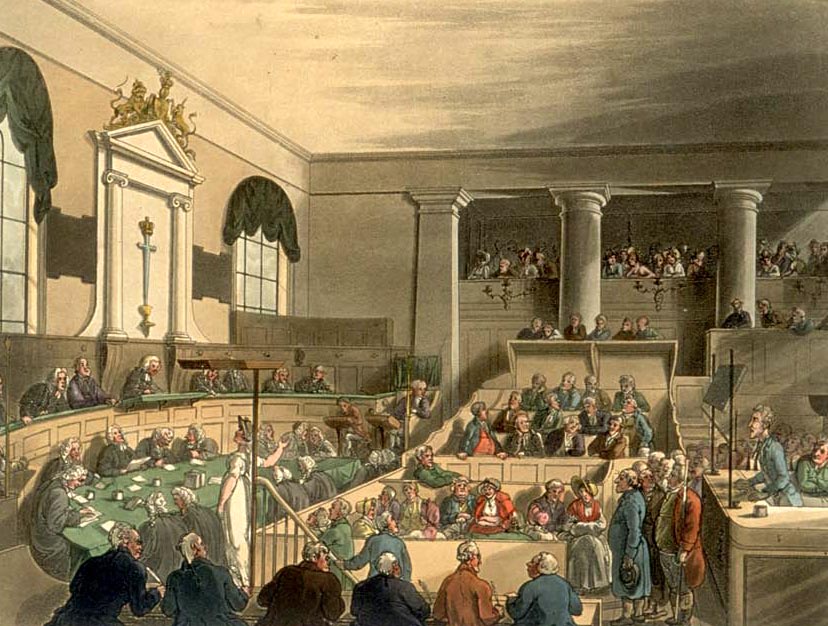
The Old Bailey, early nineteenth century

James Ingram gave evidence: “I am a smith; I was at the Bull’s Head, in Kingsland Road; about half-past five o’clock in the afternoon, the prisoner, Taylor, came into the house with a pair of boots, he asked me if I knew anybody that would buy them; I told him I would go and see; I took them out of his hand, and went to Saunders’ Gardens, which is close to the house, and offered them to Gadsden for twelve shillings. He offered me ten shillings for them; I went to Taylor, and he said I might let him have them – I did, and gave the money to Taylor, and he gave me a shilling for my trouble; he told me if Blake should come in, and ask what I sold them for, to say six shillings. In about a quarter of an hour Blake came in, and said, if he had been there at the time they should not have been sold for that money. I was quartered at the Bull’s Head.”

William Gadsden said: “I gave ten shillings for the boots. I gave them up to Armstrong.”

John Armstrong: “On the 17th of December, Mr. Burton applied to me. I and my son, accompanied him to the Bull’s Head, in Kingsland Road, and found Ingram and Blake sitting there together, we took them. I left Ingram in Burton’s care, and took Taylor, who was there. I took Ingram to Gadsden’s house, and he gave me the boots; we took the three to the office, and I heard both Taylor and Blake say, it was the first thing they had ever done, and that it was through distress.”

Joshua Armstrong: “I was with my father, and took the prisoners; they said it was the first robbery they had ever committed.”

Verdict: both Blake and Taylor guilty.

Sentence: Transportation for seven years.

I wonder if William and Robert ever reflected on their experiences at the Old Bailey and the fateful day in January 1820 when Robert stole a shawl and set in motion a chain of events which meant that they would never see each other again.

As ever, thank you for your interest and support.

Hannah xxx

For Authors

#1 for value with 565,000 readers, The Fussy Librarian has helped my books to reach #1 on 32 occasions.

A special offer from my publisher and the Fussy Librarian. https://authors.thefussylibrarian.com/?ref=goylake

Don’t forget to use the code goylake20 to claim your discount 🙂

Categories
Dear Reader

Dear Reader #135

Dear Reader,

Cover reveal for Sugar Daddy, Sam Smith Mystery Series book twenty, due for publication later this year. This story is about an unscrupulous businessman who lures a student into prostitution and the brink of suicide. Sam isn’t impressed and sets out to nail the bastard.

My latest genealogy article for the Seaside News appears on page 48 of the magazine 🙂

My latest translation, the Italian version of Sam’s Song, available soon. And the good news is Stefania has agreed to translate more books in my Sam Smith mystery series 🙂

On 18 April 1887 my grand aunt Elizabeth Middleton was accused of ‘receiving’. It’s likely that she came into contact with stolen goods at a London market. This was common at the time. Also common for the time, the case was dismissed.

I’ve researched the Aubrey branch of my family tree back to Saunder de Sancto Alberico, aka Aubrey, of Normandy. He arrived with William the Conquerer in 1066. Earlier, he produced a son, Sir Reginald Aubrey, born c1060, who married Isabel de Clare. The de Clare family produced William the Conqueror so it’s clear that all these noble families were close.

Sir Reginald was a member of an army commanded by Bernard Newmarche. This army fought the Welsh c1093 in the Brycheiniog (Brecknock) region of Wales. After numerous battles, Newmarche granted Sir Reginald the manors of Abercynrig and Slwch. Unrest continued, so Newmarche’s forces stayed at his castle in present day Brecon until the early 1100s. By that time, through their land-grab, the Aubreys had established themselves in the Brecon Beacons.

The line continued through another Reginald to William. Marriages to other noble families, such as the Gunters, ensured that the Aubreys consolidated their position in society then prospered. William produced a son, William, who produced a son, Thomas, born c1190 in Abercynrig. A hundred years after their arrival in Brecon, the Aubreys were now one of the leading noble families.

The Aubrey Manor House

Five Thomases take us to Richard Aubrey, born c1350 in Abercynrig. Abercynrig Manor in the parish of Llanfrynach is located just over a mile north of Llanfrynach village and just over two miles southeast of Brecon. Aubrey ownership of the manor house is listed as follows:

Reginald Aubrey, born c1095

William, born c1125

William, born c1160

Thomas, born c1190

Thomas, born c1220

Thomas, born c1255

Thomas, born c1285

Thomas, born c1315

Richard, born c1350

Walter, born c1380

Morgan, born c1410

Jenkin, born c1435

Hopkin, born c1465

William, born c1480

Richard, born c1510

Dr William Aubrey, born 1529

Sir Edward Aubrey, born c1550

Sir William Aubrey, born 1583

The succession of father to son was broken in the 1550s when Richard Aubrey sold Abercynrig to his cousin Dr William Aubrey, an anti-Puritan lawyer and judge.

William Aubrey, born c1480, disinherited his sons Morgan and John, my direct ancestor Richard therefore inheriting. Morgan went to London where he established a trade in salt and silk. This made him a wealthy man. Later, he moved to Herefordshire, took over the estate of Clehonger, and established a cadet branch of the family.

Dr William Aubrey was born in 1529 at Cantref, Brecknockshire, the second son of Thomas Aubrey MD and Agnes Vaughan. He was educated at Christ’s College, Brecon, then Oxford. He entered  Oxford c1543 and obtained a degree in 1547. Two years later he was made a Bachelor of Civil Law and five years after that a Doctor of Civil Law.

Dr William Aubrey

After a distinguished career at Oxford, Dr William Aubrey became a prominent member of the group of Welsh civil lawyers who played a notable role in ecclesiastical, judicial and diplomatic affairs during Elizabeth I’s reign. 

John Aubrey, the seventeenth-century antiquary, left an account of his great-grandfather, William, praising his ‘rare skill and science in the law’, and ‘sound judgment and good experience therein.’

John described William as of ‘medium build and somewhat inclining to fatness of visage, with a grave countenance and a delicate, quick, lively and piercing black eye.’

Although he lived most of his life in London or Kent, William considered himself a Welshman. He bought land off family members and became one of the largest landowners in Brecon. Indeed, he was able to ride ‘nine miles together in his own land.’

Through his Welsh and English lands, William acquired an income of £2,500 a year, approximately £350,000 a year in today’s money. He wrote, ‘God of his goodness hath very plentifully bestowed upon me.’

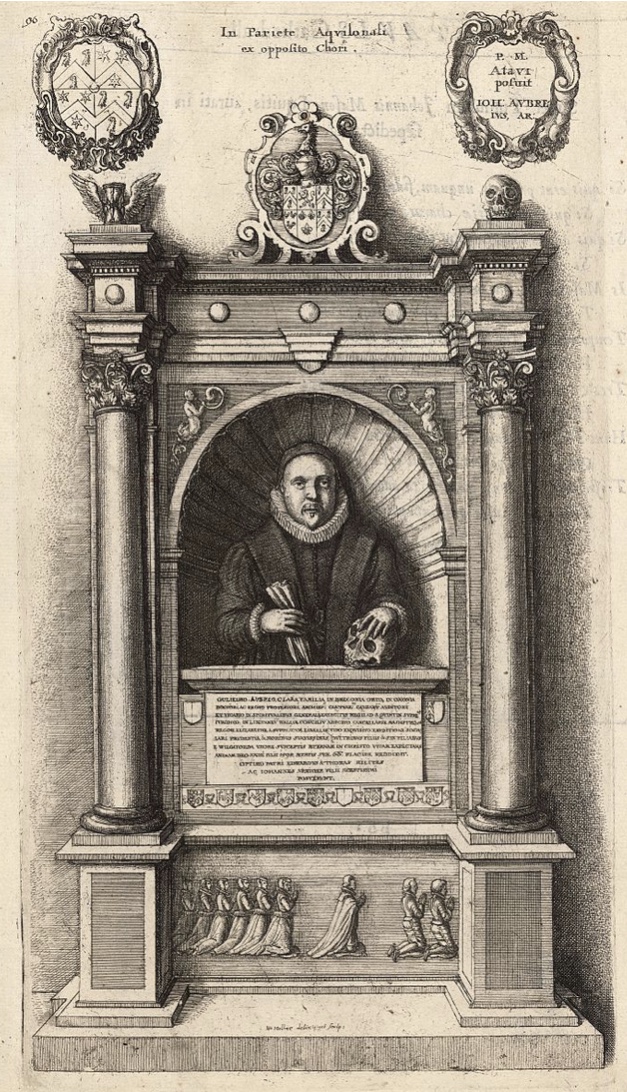
An engraving of Dr William Aubrey’s monument by Wenceslaus Hollar. William’s six daughters and wife are depicted on the bottom, along with two of his sons. It is not known why his third son was not depicted.

William married Wilgiford and the couple produced three sons and six daughters. He died on 25 June 1595 and was buried at Old St Paul’s on 24 July. It’s suggested that his chief clerk, his ‘loving and trusty servant’ Hugh Georges, proved the will on 29 July, then ran away to Ireland with the money. Antiquary and great-grandson John Aubrey stated somewhat tersely, “Georges cosened (deceived) all the legatees.”

As ever, thank you for your interest and support.

Hannah xxx

For Authors

#1 for value with 565,000 readers, The Fussy Librarian has helped my books to reach #1 on 32 occasions.

A special offer from my publisher and the Fussy Librarian. https://authors.thefussylibrarian.com/?ref=goylake

Don’t forget to use the code goylake20 to claim your discount 🙂
Categories
Dear Reader

Dear Reader #131

Dear Reader,

My latest translation, the French version of Mind Games, available soon 🙂

This week, Magnus Carlsen retained his world chess championship title with a convincing 7.5 – 3.5 victory over Ian Nepomniachtchi, four victories to zero. Carlsen won the sixth game and effectively broke Nepomniachtchi’s spirit because the other three victories were all based on Nepomniachtchi’s errors. Proof yet again that chess is the ultimate mind game.

In the festive issue of Mom’s Favorite Reads…

Holiday traditions and Christmas books.

Plus a seasonal blend of short stories, flash fiction, poetry, photography, travel, articles, activities, puzzles, recipes and so much more!

Father Christmas, delivering his presents in 1940.

My direct ancestor Thomas Stradling Esq was born c1454 in St Donats Castle, Glamorgan, Wales. The son of Henry Stradling and Elizabeth Herbert, Thomas married Janet Mathew c1473 in St Athan, Glamorgan. I was born in St Athan so the village is obviously special to me. Thomas fathered Edward, my direct ancestor, Henry and Jane. He died on 8 September 1480 in Cardiff, Glamorgan having secured the family estates and having served as Lieutenant of Ogmore lordship and castle.

Thomas Stradling Esq and Janet Mathew. Wikitree.

Thomas’ son, Sir Edward Stradling, left a more indelible mark on history. Born c1473 in Merthyr Mawr, Glamorgan, a stone’s throw from my home, Sir Edward married Elizabeth Arundel in St Athan. Politically and financially this was a fine marriage for Edward, although it did end in tragedy when Elizabeth died during childbirth on 20 February 1513 at Merthyr Mawr.

After Elizabeth’s death, Edward remarried. His second wife, and my direct ancestor, was Felice aka Ffelys, daughter of John Llwyd. There is a suggestion that Felice was one of Edward’s mistresses before their marriage. Edward had a number of mistresses. We shall explore that aspect of his life shortly.

When Edward’s father, Thomas, died in 1480 Richard III placed his guardianship with Sir James Tyrrell. This lasted until Richard III’s defeat at the Battle of Bosworth in 1485. Sir James was Elizabeth Arundel’s uncle and he probably arranged Edward and Elizabeth’s marriage. 

Medieval marriages were often political affairs with little thought given to romance. The main aims were to produce heirs and build up the family fortune. Therefore, with a lack of romance, mistresses were common. Often, knights and lords found love with these mistresses although given the circumstances the modern phrase “it’s complicated” springs to mind. Wives finding lovers was frowned upon, but human nature found its way and affairs were more common than we might suppose.

Sir Edward and Elizabeth produced six children, four sons and two daughters. With Felice, Edward produced two sons and one daughter, Elizabeth, my direct ancestor. Through various mistresses, Edward produced a further seventeen children, possibly more. At least three of these children were named Elizabeth bringing the total to four daughters named Elizabeth. Maybe Edward named them after his first wife and the repeated use of the name suggests that he held her in genuine affection?

Sir Edward Stradling and Elizabeth Arundel. Wikitree.

Sir Edward owned vast swathes of land including manors, estates and castles in Glamorgan, Somerset and Dorset. Nevertheless, with over twenty children looking for an inheritance there were problems.

On 17 June 1531, the Countess of Worcester wrote to Thomas Cromwell, the King’s councillor, expressing her concerns about the Stradling claims against her husband. She described Edward Stradling’s sons as, ‘twelve brothers, most of them bastards, and they have no living but by extortion and pillaging of the King’s subjects’.

Furthermore, in 1547 Thomas Fflemyng filed an assault complaint against seven of Edward’s sons and a daughter. Around this time Elizabeth, my direct ancestor, married Sir Edmund Morgan, Baron of Machen and Tredegar, securing her future. However, for many of the Stradling offspring, particularly the bastards, banditry and extortion became a way of life.

After the Battle of the Spurs and the Siege of Tournai in 1513, one hundred men-at-arms, including Edward Stradling, were knighted by Henry VIII in the Norte Dame Cathedral of Tournai on 2 October 1513.

Battle of the Spurs, 16 August 1513.

Sir Edward died on 8 May 1535 in St. Donats Castle. He signed his will on 27 April 1535, a clear indication that he was slipping away. He was buried in the chancel of St. Donats Church. However, Edward Stradling MP, the fifth Edward in the family, moved the bones of his grandfather Sir Edward and grandmother Elizabeth to the new Lady Chapel of St Donats. 

Edward and Elizabeth might well have married for political reasons, but the family realised, maybe through family folklore and stories, that they should be together in the end.

As ever, thank you for your interest and support.

Hannah xxx

For Authors

#1 for value with 565,000 readers, The Fussy Librarian has helped my books to reach #1 on 32 occasions.

A special offer from my publisher and the Fussy Librarian. https://authors.thefussylibrarian.com/?ref=goylake

Don’t forget to use the code goylake20 to claim your discount 🙂