Categories
1963

Social History 1963 #42

Sunday 4 August 1963

For Stephen Ward the end came quietly. The gay, glittering world of weekend parties at stately homes, of laughter from moonlit swimming pools, was now shrunk to a bare hospital room. Ward never opened his eyes to see the prison officer standing beside him, he never knew that the Old Bailey jury had found him guilty of living on immoral earnings. 

In his final letter, Stephen Ward said, “More than I can stand – the horror day after day in the streets. I think Christine and Mandy have discredited themselves. There is a good deal I could say, but I want to conduct my case with some measure of dignity and honour.”

Mandy Rice-Davies said, “The past few weeks have been hell. I did my best for Stephen at the trial. It’s the bloody police and bloody government. They all need sacking.”

Forty cabbies are up in arms about their town’s only woman taxi driver. She is 32 year old Mrs Helen Clissold who does private hire work in Weymouth, Dorset. She wants a *full* hackney carriage plate allowing her to ply for hire on the highway and at taxi ranks. The male cabbies said she could not deal with troublesome customers – drunken sailors, for instance. Helen said, “I’ve done a lot of wrestling and weight training, and I’ll have them on the flat of their backs in no time.”

The mystery of the glowing pebbles on Bradwell Beach, near a nuclear power station, has been solved – they are not radioactive. They turned out to be plankton, a minute form of marine life.

Discland: recording bosses have a penchant for changing stars’ names. One man who really needs a name change is Earl Sinks. In fact, having listened to his disc Looking for Love, I’d say a voice change wouldn’t be amiss either.

Here’s a group from London I’m tipping for the top – the Rolling Stones, whose Come On could be a capital hit.

Television highlights: Robin Hood – The Oath. Millie – starring Millicent Martin, Cleo Laine and Johnny Dankworth. Songs of Praise from Bangor, Wales.

Radio highlights: Pick of the Pops. The Jazz Scene.

Weather: warm and sunny, chance of heavy showers.

Monday 5 August 1963

Dr Ernest Claxton, 63, assistant secretary of the British Medical Association, said that Britain is facing a “Moral Dunkirk.” He added, “Only a return to absolute moral standards can save us. We must show the world that Stephen Ward and others do not represent us. Chastity is a weapon we can grasp and use. It is not only a defence against moral corruption, it can be a source of strength.”

A new moral code is to be issued for comics published in Europe. All the characters will have to be decently dressed. Heroes will not be allowed to rely on superhuman qualities alone, but will have to display “noble virtues”. Above all – justice will have to triumph over evil in the end, no matter what happens in between.

June Imray, the 26 year old television announcer with the Scottish lilt, was in hospital last night. Previously, she’d been in hospital with paratyphoid. June is one of the few BBC announcers who have been told to keep their native accent.

Personal advertisement: second woman/man’s life. Anxious. Please write 46. Love.

Boxing: Lennie “The Lion” Williams and Frankie “Tiger” Taylor will meet in a return featherweight contest at Wembley on 10 September. In their previous contest, Tiger Taylor knocked The Lion Williams out in the sixth round.

Sport swamps both networks today with a line-up of cricket, motor racing, horse racing, athletics, swimming, sailing, tennis and polo. The BBC will broadcast four and a half hours of sport, ITV four hours.

Television highlights: Panorama – Britain’s disappearing coastline. Julian Bream – film profile. Animal Care – lizards.

Radio highlights: Desert Island Discs – Ian Fleming. A Cricket Anthology. 

Weather: drizzle, thunder. Outlook – rain then bright spells. 20c, 68f.

Tuesday 6 August 1963

June Imray, the 26 year old television announcer with the Scottish lilt, was admitted to hospital because she took too many sleeping pills. “I wasn’t trying to do anything silly,” she said. “All I wanted was a good night’s sleep.” Her mother said, “June has found a lot of fame since she moved south, but she does not like living in London.” Mrs Imray added that she hoped June would return to a teaching job nearer home.

Bandits who hid in the Albert Hall after Saturday night’s Promenade concert escaped with £600 early yesterday after blowing three safes. They also took a number of tickets, but threw them away.

Due to poor weather, there was less traffic on the roads this Bank Holiday weekend. The good news is road deaths totalled 56 fewer than for the corresponding period last year.

Loudspeaker message at the Gloucestershire County Cricket ground in Bristol, “Will you please go to your car. Your dog has switched on the ignition.”

Tennis: Britain defeated Sweden 3 – 2 in the Davis Cup European Zone final, becoming the champions of Europe for the first time in thirty years. In the decisive match Mike Sangster defeated Ulf Schmidt in five sets, 7 – 5, 6 – 2, 9 – 11, 3 – 6, 6 – 3.

Wanted: Colt revolvers, duelling pistols, blunderbusses, muskets and other old weapons – £100 paid if in good condition.

Television highlights: Sons of the Navvy Man – people who build public works projects. New Vision – the creative arts: man or machine? Cricket – Lancashire v Yorkshire.

Radio highlights: Workers’ Playtime. Pop Go the Beatles.

Weather: sunshine and showers. Outlook – cloudy, light rain. 23c, 73f.

Wednesday 7 August 1963

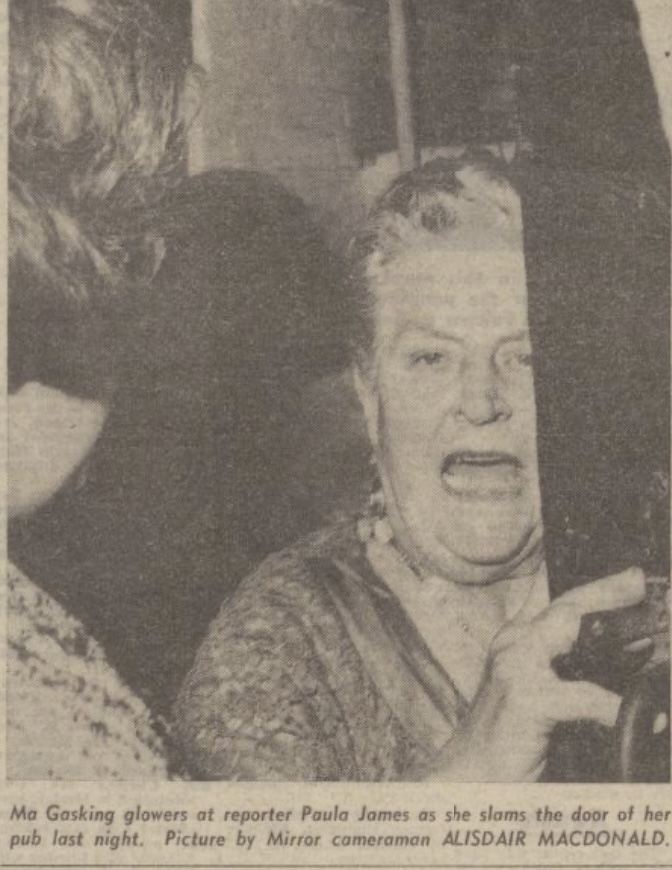
Ma Gasking, 70, has barred customers from her pub in Hollingbourne, Kent. She said, “Young couples are wasting their time coming here. They won’t get in unless I know them, and if they do get in they will drink what I say. I don’t want smart-Alec’s turning up in big cars and on motor cycles. If they do, I shall shut up all together.”

A council has designed 332 new houses so that the television set can take the place of the hearth. In Hull, the fireplaces are being moved discretely to one side. Another 2,000 homes with the same design are planned.

America launched a new attack on Europe in the “chicken war”. In thirty days, America will impose tariffs on wine, brandy, cars and electric shavers. In Brussels, a spokesman said the American move was an ultimatum, and it did not create a good atmosphere for the forthcoming “Kennedy Talks”.

More new cars on the never-never. Hire purchase debts in Britain jumped by £11,000,000 in June to £906,000,000. However, credit on used cars was lower.

A storm is brewing in Britain’s teacups. Reports from Ceylon, where one third of Britain’s tea is grown, suggest that the Minister of Finance has threatened to nationalise British owned tea plantations. Mr John Brooke, of Brooke Bond, said last night, “Some of the finest tea in the world comes from Ceylon. We already have to pay 87% tax on profits there.”

Television highlights: Stars and Garters with Kathy Kirby. Gardening Made Easy. Zoo Time.

Radio highlights: Let There Be Musicals. Play – The Lady on the Grey.

Weather: cloudy and cool. Outlook – sunshine and showers. 20c, 68f.
Thursday 8 August 1963

Since the East-West German borders were sealed in August 1961 at least 65 refugees are known to have been killed trying to escape to the West. Nearly 16,500 have escaped across the borders and the Berlin Wall.

Ma Gasking kept her bolted doors policy last night – only allowing her friends into her pub. Ma was known as The Duchess during World War Two when she kept open house for RAF pilots. Why the change? Ma explained, “I don’t want young people in my pub. They will steal my possessions.”

The War Office is to investigate the private lives of women soldiers at an army camp in Surrey where there are no men. The inquiry will focus on “unnatural friendships” between the women.

Thousands of people in Hong Kong are being inoculated against cholera, which has broken out again in the teeming colony.

A thief yesterday cracked open a safe at the Majestic Cinema, Woodford, Essex and stole £1,000. The film this week is…The Cracksman.

Personal advertisement: Dental unit with electric drill, suitable for chiropodist.

This week’s number one: Sweets For My Sweet – Searchers. New entries – Come On – Rolling Stones, Bad to Me – Billy J Kramer.

Television highlights: Aida – open air performance from Verona. Road Works Report. Space Patrol – Robot Revolution.

Radio highlights: Thanks for the Melody. Harpsichord.

Weather: drizzle. Outlook – mainly dry, perhaps some showers. 19c, 66f.

Stop Press: More than £2,500,000 has been stolen in a train ambush in Buckinghamshire. Detectives have not ruled out the possibility of a Master Mind being behind the ambush. Old-time crooks are being checked on.

Friday 9 August 1963

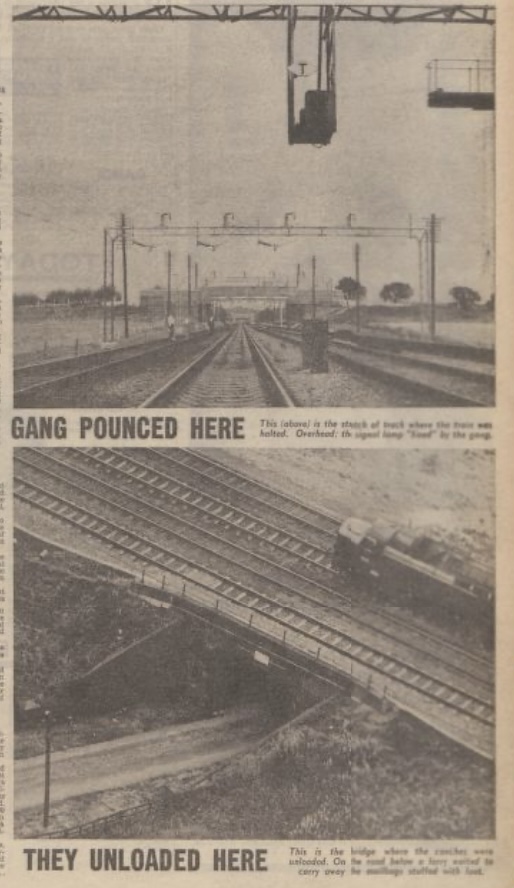
Scotland Yard was tipped off months ago that a big train raid was being planned. And now it’s happened. Twenty men were in the gang that ambushed a train in Buckinghamshire. Detectives are watching race courses and other gambling spots for evidence of big spending. A £10,000 reward has been offered for information.

At 3.15 am £2,500,000 was stolen from a mail train travelling to London. Driver Jack Mills said, “I tried to put up a fight, but I was coshed with an iron bar wrapped in cloth.” His co-driver, David Whitby, said, “They threatened to kill me. It was a terrifying experience.”

The train robbers left behind two clues – a glove used to cover the official green Go signal light, and a battery used to light up the fake red Stop signal light. This is the ninth major train robbery in the South of England in the past three years. The previous money grab record was £238,000, stolen from a Post Office van in Oxford Street, London, on 21 May 1952.

Racing driver Jack Brabham might drive Bluebird and attempt to beat the land speed record. This situation has materialised after a row between Bluebird’s driver Donald Campbell and his leading sponsor Sir Alfred Owen. However, Campbell said, “I own Bluebird and I will decide who should drive it.”

Television highlights: The Eisteddfod. Roving Report – the women of Italy. Ready, Steady, Go! – new pop show.

Radio highlights: Music While You Work. Round Europe in Song.

Weather: dry. Outlook – uncertain. 23c, 73f.
Saturday 10 August 1963

A £260,000 reward is waiting for the person who “turns in” the gang who got away with £2,500,000 in Thursday’s mail train raid. And it will be tax free. The reward is as big as the biggest football polls prize ever won – £260,000.

The BBC’s plan to give Britain around the clock radio has been put off indefinitely. The decision was made because an agreement could not be reached over the copyright and broadcasting of recorded music. In the past twelve months 2,500,000 radio sets have been sold. Meanwhile, the BBC is considering broadcasting news bulletins on the Third wavelength throughout the day.

An unmarried mother entered her baby in a baby show and won first prize. The mother, Kathleen Morgan of Slough, said, “Why shouldn’t I enter my baby? She’s lovely. Now I’m prouder of her than ever.” Miss Doris Blunden, organiser of the show said, “It is the babies that are entered, not the parents.”

The council at St Ives, Cornwall has declared war on beatniks. A spokesman said, “Dozens of them sprawl on the sand and lounge on the harbour wall. They spend as little as possible on food, nothing on soap and razor blades, and drink as much beer as possible.”

Television highlights: Juke Box Jury with Graham Hill and Barbara Windsor. The Third Man – drama series. The Morecambe and Wise Show.

Radio highlights: Desert Island Discs – Geraint Evans. Holiday Music Hall.

Weather: mostly cloudy. Outlook – rather cloudy. 20c, 68f.
Available for order and pre-order, my Swinging Sixties Mystery Series

https://books2read.com/u/bMqNPG

For Authors

#1 for value with 565,000 readers, The Fussy Librarian has helped my books to reach #1 on over thirty occasions.

A special offer from my publisher and the Fussy Librarian. https://authors.thefussylibrarian.com/?ref=goylake

Don’t forget to use the code goylake20 to claim your discount 🙂

Categories
1963

Social History 1963 #25

Thursday 2 May 1963

9,000,000,000 bangers! Britons eat about 568,000 miles of sausages every year. That would stretch right to the Moon and back, leaving plenty over for a good fry-up. Housewives spend £3 out of every £100 on sausages.

A new invasion of Britain is predicted. Heat ‘em and eat ‘em – pre-cooked dinners are all the rage in America, and soon they are expected here.

Barbara Cartland, novelist mum of a countess, has well-known views on love, marriage and families. She believes that a dutiful wife needs to take up to twenty-six vitamin tablets a day if she is to love fully.

In fashion, white is the colour for the summer of 1963. Synthetics have made whites practical, plus the detergent ads have convinced us that we can wash our whites clean.

A word of advice for parents of beatniks – accept their black stockings gracefully next autumn and be thankful that they are not wearing ginger, prune or putty stockings. Mary Quant, that way-out darling of Chelsea, showed her first mass-produced collection in London yesterday and ginger, prune and putty dominated her range.

The chequered flag has come down on the motor racing career of Sterling Moss. He has announced his retirement because his “judgement and dexterity are just not good enough”. He said, “I think it would be dangerous – endangering myself and others – if I went on racing.”

Television highlights: Perspective – roast beef of Old England. Bootsie and Snudge. Adventures of Tintin.

Radio highlights: Star Parade with June Whitfield. Science Review.

Weather: sunny intervals, scattered showers. Rather cold. Outlook – unsettled. 12c, 54f.

Friday 3 May 1963 

The last remnants of political freedom in South Africa were destroyed yesterday by the coming into force of the “No Trial” law. From now on, political suspects can be detained indefinitely by the police, without trial, without appeal to the courts, without proof of guilt.

Canada’s new Premier, Mr Lester Pearson, flew into London yesterday for a three-day official visit and talks with Prime Minister Harold MacMillan. He said he wanted to “strengthen the economic and political co-operation between our two countries.”

Elizabeth Hardaker, 20, of Shipley, Yorkshire was given a truth drug by a psychiatrist. While under the influence of the truth drug, Elizabeth told how she forged cheques for more than £2,000 to give to her boyfriend. She has been sent to a detention centre for three months.

Sales of fresh crusty loaves are soaring on Saturdays. The reason – more people are enjoying freshly buttered bread and jam with their afternoon tea. During the week, biscuits are popular, but on the weekends we have time for a real tea.

Music: top three – From Me To You – The Beatles, How Do You Do It? – Gerry and The Pacemakers, From a Jack to a King – Ned Miller.

Football: European Cup Semi-Final, Second Leg – Dundee 1 Milan 0 (Milan won 5 – 2 on aggregate). European Cup Winners’ Cup Semi-Final, Second Leg – Tottenham Hotspur 3 OFK Belgrade 1 (Spurs won 5-2 on aggregate).

Television highlights: Hobbies Club. Millicent Martin Sings. It’s a Square World with Michael Bentine.

Radio highlights: Ladies Choir. Improve Your German.

Weather: Rain, rather cold. Outlook – rain then sunny periods. 12c, 54f.

Saturday 4 May 1963 

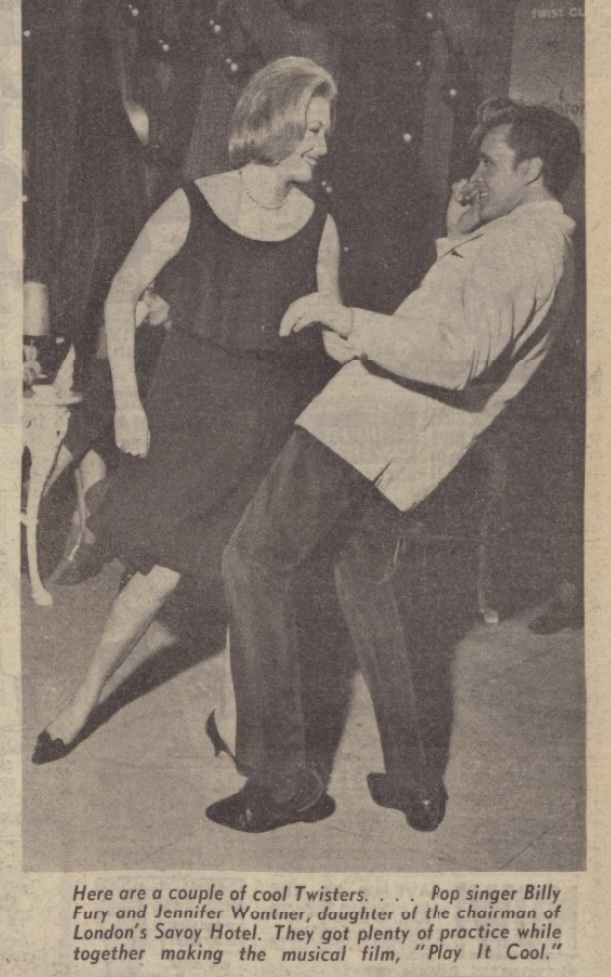
It arrived two and a half years ago and was said to be too abandoned, too uninhibited, too sexy for the British. We are talking about, of course, the Twist. It was said that no “nice” girls would do the Twist. But today, the Queen Twists. She was taught by Princess Anne, who picked it up at her dance classes.

A customs officer searched a man at London Airport and found that he was wearing a woman’s roll-on and body-belt, a court was told yesterday. The belt contained 28 bars of gold. The man, Mark Woolf, pleaded not guilty to smuggling. 

Britain’s homes, even the 1963 models, are among “the most uncomfortable in the world”, an expert told the Royal Society of Health Congress, yesterday. Improvements are needed including double-glazing, a garage, self-coloured finishes requiring no maintenance, soundproofing and draught-proofing.

A rugger playing curate brought down a man outside his church with a flying tackle. The curate, the Rev Michael Smith of St Mark’s Church, Marylebone Road, London made the tackle after a man snatched a handbag from a pew.

A Leonardo Da Vinci drawing will go on display at London’s National Gallery today. The drawing will be protected by inch-thick Perspex and a magic eye beam.

Ivor Novello Award winners – The Tornados, Steve Race, Ron Grainer, Acker Bilk and Matt Monro. 

Television highlights: The Harlem Globetrotters. Saturday Sport – the Scottish FA Cup final, Celtic v Rangers. Checkmate – detective series.

Radio highlights: FA Amateur Cup Final – Sutton United v Wimbledon. Disc Break.

Weather: becoming cloudy with rain later. Outlook – sunny spells and showers. 13c, 55f.

Sunday 5 May 1963 

‘Your publication of Lionel Crane’s article “How to spot a Possible Homo” was long overdue. I believe the public should know the facts.’ – Mrs R Crawford-Rivers, Bournemouth. ‘Surely these people are hounded enough.’ – J.B., London NW6.

Judgement in the Argyll divorce case is expected this week. It is expected that Lord Wheatley will spend an entire day, Wednesday, delivering his judgement. The Duke of Argyll has accused the Duchess of multiple counts of adultery.

The secret medical histories of 150 married women who have been taking new British birth control pills since 1960 will be published soon. The Family Planning Association has given its approval for the Pill to go on sale.

Out of every five people who get fibrosis and similar diseases in Britain three are women. A major cause is the constant companion of every woman – her handbag. Dr William Copeman, Chairman of the Empire Rheumatism Council said, “Women are more subject to fibrosis than men. And this is largely because they are placing an unnatural strain on their shoulder muscles by carrying heavy handbags and overloaded shopping baskets.”

Personal ads: Top recording star needs a secretary. Some typing. Good appearance essential. Chandau hairspray a must.

Television highlights: Football – Germany v Brazil direct from Hamburg via Eurovision. Songs of Praise from Milford Haven. Space Patrol.

Radio highlights: Your Hundred Best Tunes. The Roots of Prejudice.

Weather: sunny spells with showers, rather cold.

Monday 6 May 1963 

Advice for the youth of today from their parents…Don’t play bingo, keep out of brothels, and don’t go anywhere near Brighton. Also, avoid air-raid shelters, striptease shows and all-night jazz dances. Films to avoid – Room at the Top and Frankenstein. Plus, do not read Lady Chatterley’s Lover.

The BBC is cutting out the chimes of Big Ben. Yesterday, the chimes of the world’s most famous clock were missing from the Home Service at 8am. In their place the BBC used the impersonal pip, pip, pip of the Greenwich time signal. A BBC spokesman said, “We have dropped Big Ben for a trial period.”

Prince Philip opened the new Hillman Imp car factory last Thursday. Today, workers will go on strike. Draughtsmen at the plant in Linwood, near Glasgow are demanding an extra £1 10s a week, to match the wages of their colleagues in Cowley, Oxford.

The F-Plan aims to end tooth decay amongst children. The plan aims to add fluorides to local water supplies. Critics say the fluoride plan is tampering with pure water. The British Dental Association says that no water is pure. “More than twenty chemicals are used to treat it.”

Squid used to be thrown away by west Wales fishermen, but now the trade is booming. The reason? The growth of Chinese restaurants has entirely accounted for the demand.

Television highlights: Table Talk with Larry Adler and Erskine Childers. Tonight with Cliff Michelmore. Ballroom Dancing- World Championships from the Royal Albert Hall.

Radio highlights: Jazz Scene. Strictly For the Judies. 

Weather: sunny intervals, scattered showers. Outlook – mainly dry. 15c, 59f.

Available for pre-order, Songbird, my novel set in the winter of 1962-63

https://books2read.com/u/bMqNPG

For Authors

#1 for value with 565,000 readers, The Fussy Librarian has helped my books to reach #1 on over thirty occasions.

A special offer from my publisher and the Fussy Librarian. https://authors.thefussylibrarian.com/?ref=goylake

Don’t forget to use the code goylake20 to claim your discount 🙂

Categories
Dear Reader

Dear Reader #112

Dear Reader,

My latest translations, both in Portuguese. A very busy time with the translations and soon all my books will be available in Portuguese.

In the Victorian era ships’ manifests had a section ‘Died on the Voyage’, which doesn’t inspire much confidence 😱

A part-time, flexible hours job offer from Publishing Wales.

“Good news! We’ve extended the deadline to apply for our brand new administrative role. Help shape Publishing Wales / Cyhoeddi Cymru, as we start this exciting journey.

Job description and further details below. Apply by 9th August.”

https://www.cyhoeddi.cymru/jobs

My 6 x great grandfather John Cottrell was a cordwainer and shoe shop owner in Leather Lane, London. On 2 December 1830 at 12.30 pm a ten year old boy, John Hagan, walked into his shop and stole a pair of shoes, value 5s. Twelve days later John Hagan appeared at the Old Bailey accused of theft. The verdict: guilty.

However, John pleaded that he had no father and that his mother was in great distress. The judge, Mr Sergeant Arabin, took pity on John and respited the judgement, a rare case of leniency in an age when ‘justice’ was often cruel.

I am related to Geoffrey Howe, Baron Howe of Aberavon, CH, PC, QC, the deputy prime minister in Margaret Thatcher’s government, 1989 to 1990. Our mutual ancestor is John Howe of St Hilary, Glamorgan (1786 – 1856) ironically, a thatcher.

By 1799, the Napoleonic wars had taken their toll on Britain. The British royal treasury was running out of money to maintain the army and navy. Soldiers were starving and His Majesty’s navy had already mutinied. For Prime Minister William Pitt the Younger, the solution was simple: impose an income tax. Under the Act of 1799, all citizens who earned above £60 were to pay a graduated tax of at least one percent. Those with an income of over £200 were taxed ten percent. Some people regarded the tax as a patriotic duty while others complained. I don’t know what my 5 x great grandfather John Howe thought of the taxes, but their imposition forced him off the land into employment as a thatcher.

In 1799, not everyone was thrilled to pay their taxes.

John’s son, Edward, was also a thatcher. However, with his wife Rachel and their five children, Edward moved twenty-two miles west to Aberavon to ply his trade.

The fact that Edward employed a domestic servant suggests that he was successful in his business. However, this success did not influence his son, also Edward, who became a washman in the local tinplate and silver works. This begs the question: how did the grandson of a tinplate worker become a Conservative MP and deputy prime minister? The answer lies in understanding the Howe family and its traits.

In the 1600s and 1700s our ancestors Joseph, John and John Howe were landowners, churchwardens, Petty Constables and Overseers of the Poor, pillars of St Hilary society. In 1797, John the latter paid 2s 6d to ‘ten men in distress coming from the sea’ while in 1753 John the former made a payment of £1 17s 6d for the making and binding of Bibles, 1s for attending a coroner’s inquest and 7d for a pair of male stockings. He also awarded payments of a few pence to ‘the little boy of whom nothing else is known’.

John Howe’s account of 1753, written in his own hand.

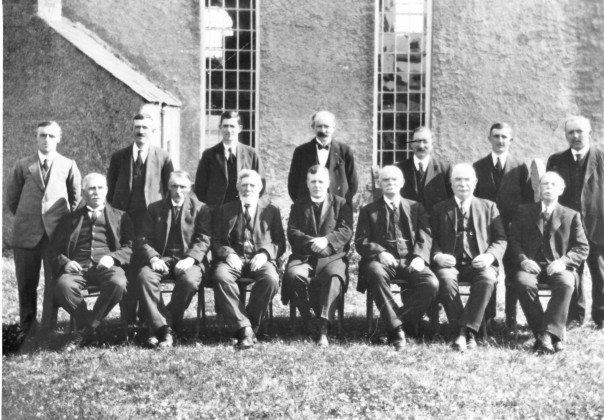
In the 1800s my 2 x great grandfather William Howe was a deacon of the local Methodist chapel and Headman of the village, in effect chairman of the village council, assisting the villagers with community problems and organising local events. Important to note that all these relatives were bilingual and immersed in Welsh culture with its distinctive, community-based, way of life.

Elders of Capel-y-Pil, c1930. William is seated, third from left.

For the Howes, a desire to serve the community as public servants ran deep. Geoffrey Howe inherited this trait. But how did he make the leap from the tinplate works to Downing Street? The words of a Labour prime minister, Tony Blair, come to mind, “Education! Education! Education!” Through education, Benjamin Edward Howe, Geoffrey’s father, transformed the family’s fortunes.

The son of Edward Howe and Hannah Evans, Benjamin Edward Howe was born on 3 December 1888 in Margam, Glamorgan, ‘a dirty little town’ according to contemporary chroniclers. That dirt was generated by the heavy industry and blast furnaces that dominated the area during the Victorian era.

In 1901, Benjamin was a scholar living with his parents and older sister Elizabeth. Many industrialists were far-sighted and opened schools in association with their factories. For example, Margam Tinplate Infants School opened in 1850. Benjamin attended the school and excelled in his studies.

Ten years later, aged twenty-two, Benjamin was a law student soon to qualify as a solicitor. From this point, his life moved on apace. On 1 May 1913 he became a member of the United Grand Lodge of Freemasons. In 1923 he married Eliza Florence Thompson and three years later the couple produced a son, Geoffrey. By 1939 Benjamin had established himself as a solicitor and the Coroner for West Glamorgan. His sister, Elizabeth, had also done well for herself; she was a headmistress.

Benjamin, a Freemason at Afan Lodge.

During the Second World War, Eliza upheld the family’s sense of civic duty by performing the role of Central Leader for Women Services for Civil Defence. Meanwhile, Geoffrey attended Abberley Hall School in Worcestershire, a co-educational preparatory day and boarding school teaching 150 pupils. The actor Sir Anthony Quayle and the author Antony Beevor also attended this school.

Benjamin died on 27 July 1958. In his will he left the equivalent of £252,000 in today’s money. By this time Geoffrey had married Elspeth Shand and established himself as a barrister-at-law.

As a child in the late 1970s I met Geoffrey Howe at a family gathering, a christening. In all truth, I have no memory of that event. I do recall that later, in the 1980s, whenever Geoffrey Howe appeared on television a member of the family, usually my father, would remind us that he was a relative, a ‘cousin’, the catch-all description for any relative who lived outside our immediate household. 

In the Victorian era and early twentieth century the Howes were Liberals, supporting the local candidates. That support drifted further left as the Labour Party and its ideas took a firm grip on the South Wales Valleys. Therefore, in family terms, Geoffrey was an outsider.

Many members of my family hated Margaret Thatcher because of the destruction she wrought on the Valleys, particularly the mining communities. However, they always maintained their respect for Geoffrey believing him to be a man of honour and principle. As events transpired with Geoffrey’s resignation on 1 November 1990 triggering Margaret Thatcher’s resignation three weeks later that family loyalty and belief were not misplaced.

I wonder what Geoffrey would make of Boris Johnson and his government. I sense that he would detest the man and all he stands for. Furthermore, he would not recognise the Johnson government as a Conservative administration.

Geoffrey Howe

Geoffrey Howe was Margaret Thatcher’s longest-serving cabinet minister, holding the posts of Chancellor of the Exchequer, Foreign Secretary, Leader of the House of Commons, Deputy Prime Minister and Lord President of the Council. In many ways, he embodied 400 years of Howe history. 

Obituarists stated that Geoffrey Howe was ‘warm and well liked by colleagues’ and was ‘one of the kindest and nicest men in politics’. While Andrew Rawnsley of The Observer noted that fellow politicians regarded Geoffrey Howe as ‘one of the most honest and decent practitioners of their profession.’

I have never voted Tory and cannot envisage a situation where I would vote Tory. Nevertheless, I am proud to regard Geoffrey Howe as an ancestor.

As ever, thank you for your interest and support.

Hannah xxx

Bestselling psychological and historical mysteries from £0.99. Paperbacks, brand new in mint condition 🙂
https://hannah-howe.com/store/

Categories
Dear Reader

Dear Reader #47

Dear Reader,

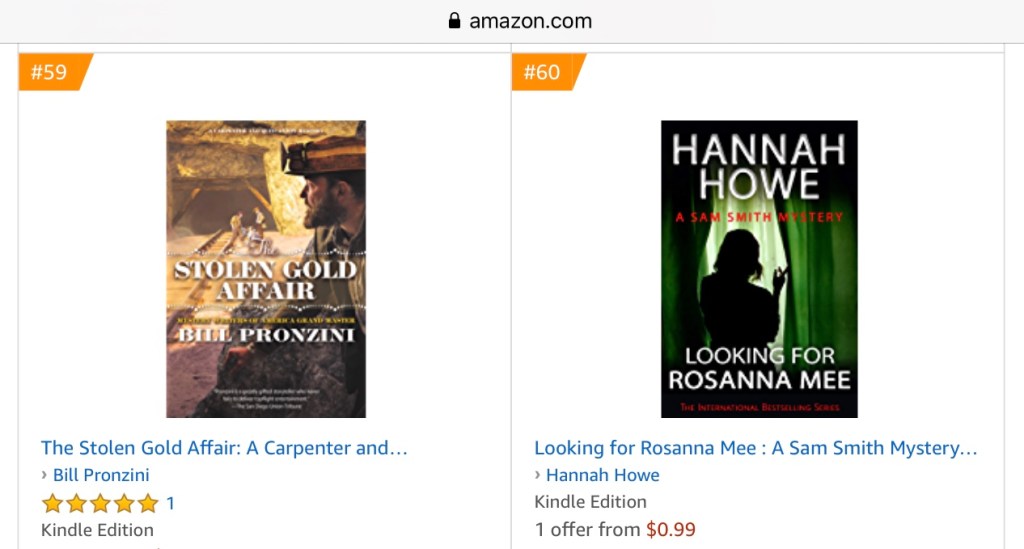
This is exciting, Looking for Rosanna Mee, which is published in September, is a Hot 💯 new release sitting alongside the legendary Bill Pronzini 🙂

https://www.amazon.com/Looking-Rosanna-Mee-Smith-Mystery-ebook/dp/B086C624BC/

I suspect this will be my book statistic of the week, my sales on Kobo are up exactly 1,000% (!) 🙂

https://www.kobo.com/us/en/search?query=hannah%20howe&fcsearchfield=Author

A busy week with audiobooks with five in production: Smoke and Mirrors, Stardust, Digging in the Dirt, Boston and The Devil and Ms Devlin, all in the Sam Smith Mystery Series. It’s always fascinating to hear how narrators interpret your words and it’s always great to work with other creative people.

Here’s some we made earlier https://hannah-howe.com/audio-books/

My Author of the Week, Val Tobin

As part of the Authors Give Back sale where authors support readers during this difficult time Val Tobin is offering her books for free and at 60% off the recommended retail price.

Nothing is more glorious than finding a book that keeps you turning pages to discover what happens next. Val Tobin’s stories will do just that. Take a journey with characters who will inspire you, intrigue you, and entice you to read just one more chapter.

https://www.smashwords.com/profile/view/valtobin

The Chocolate Egg and the Router

Earlier this week, I lost my Internet connection. An engineer was due today, so yesterday evening I decided to tidy the living room to make space for him. And guess what I found? In a corner inaccessible to man or beast, the router plug was sitting on the floor. I plugged it in and within ten minutes our Internet was restored.

So, how did the plug get on to the floor? As unlikely as it sounds it seems that one of my children reached for an Easter egg, knocked a small 5.1 music speaker off the shelf, the speaker landed on the plug and knocked it out of the socket. Throughout this a light remained on the router – it’s fed by two sockets – and the corner is inaccessible except for the plug sockets so no one thought to look there.

I told the engineer there was no need to call because I’d fixed the problem. Doubtless, he was impressed. However, I didn’t tell him how I did it 😉

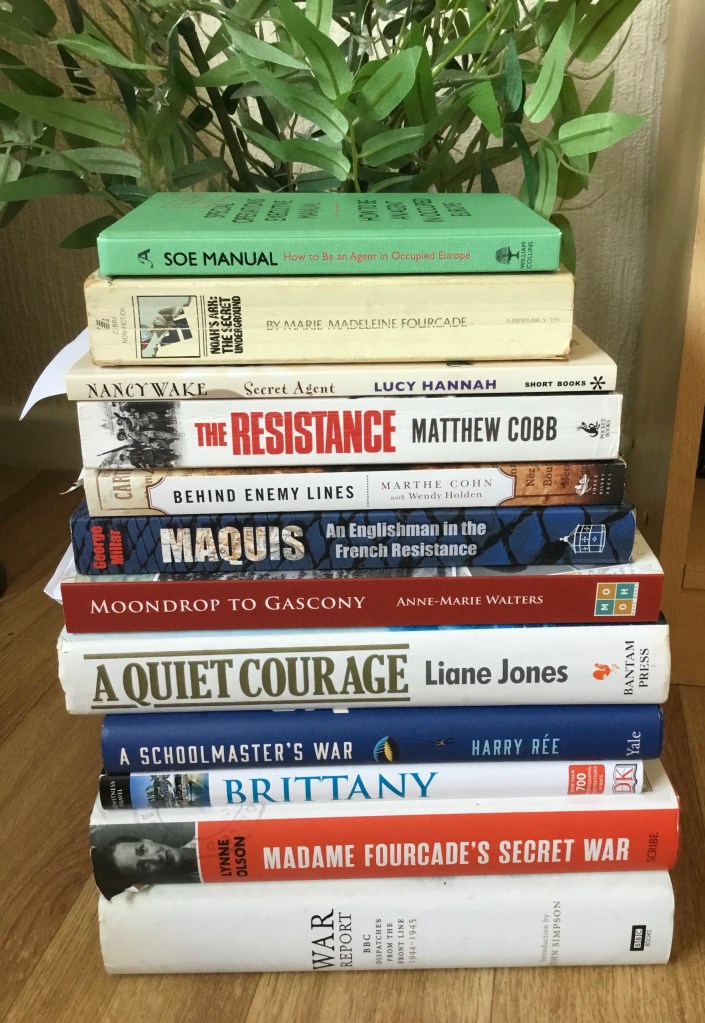
My current reading list for Eve’s War

Madame Fourcade was an amazing woman. Forget de Gaulle, Madame Fourcade was the real leader of the French Resistance. She was the one who rolled up her sleeves and got stuck in when it came to fighting the fascists.

Most of my Eve’s War series is set in Brittany, hence the need to top up my knowledge of that region.

After the war, Ann-Marie Walters established a career in literature and her book is the best written account of an SOE agent’s experiences in France.

“I’m very nervous, but patient. It’s a funny mixture really and you need that for radio work. You need the patience to do the coding and decoding. You need the resourcefulness of nervousness to be able to decide to go on if you think somebody’s listening in (the Gestapo used to listen in to transmissions in vans disguised as Red Cross vehicles) or to cut off and ask for another sked (transmission schedule).” – Yvonne Cormeau.

Yvonne was the ‘fastest finger in France‘. She transmitted Morse code messages at a rate of twenty words a minute (the average was twelve words a minute) and she sent more messages than any other female SOE wireless operator.

https://hannah-howe.com/eves-war/yvonne-cormeau/

In 1944, SOE agent Anne-Marie Walters, pictured below, had a narrow escape when travelling by train to Condom via Tarbes. A Gestapo officer approached to search her cases, which contained small arms and demolition equipment. However, a young woman with two babies, unknown to Anne-Marie, but sensing danger, created a fuss over the Gestapo searching her bags. In the commotion, the Gestapo officer didn’t search Anne-Marie’s cases. When he left the carriage, the young woman offered Anne-Marie a smile of understanding. In that moment she had saved Anne-Marie’s life.

On another occasion, Anne-Marie found herself at a bus stop facing a snap search. While one fascist inspected her (false) documents another searched her handbag and pulled out a crumpled ball of toilet paper. Anne-Marie blushed at the sight and the fascist returned the toilet paper to her handbag. That toilet paper contained thirty coded messages. The BBC broadcast these messages at set times during the day. They carried instructions for the Resistance, informing them of arms drops via parachute, details of other networks and most famously of all the timing of the D-Day invasion. The code for that message was the first stanza of Paul Verlaine’s poem “Chanson d’automne”. The first part of the stanza, Les sanglots longs des violons de l’automne (“the long sobs of the violins of autumn”) indicated that the invasion would begin within 24 hours; the second, Blessent mon cœur d’une langueur monotone (“wound my heart with a monotonous languor”) was the specific call to action.

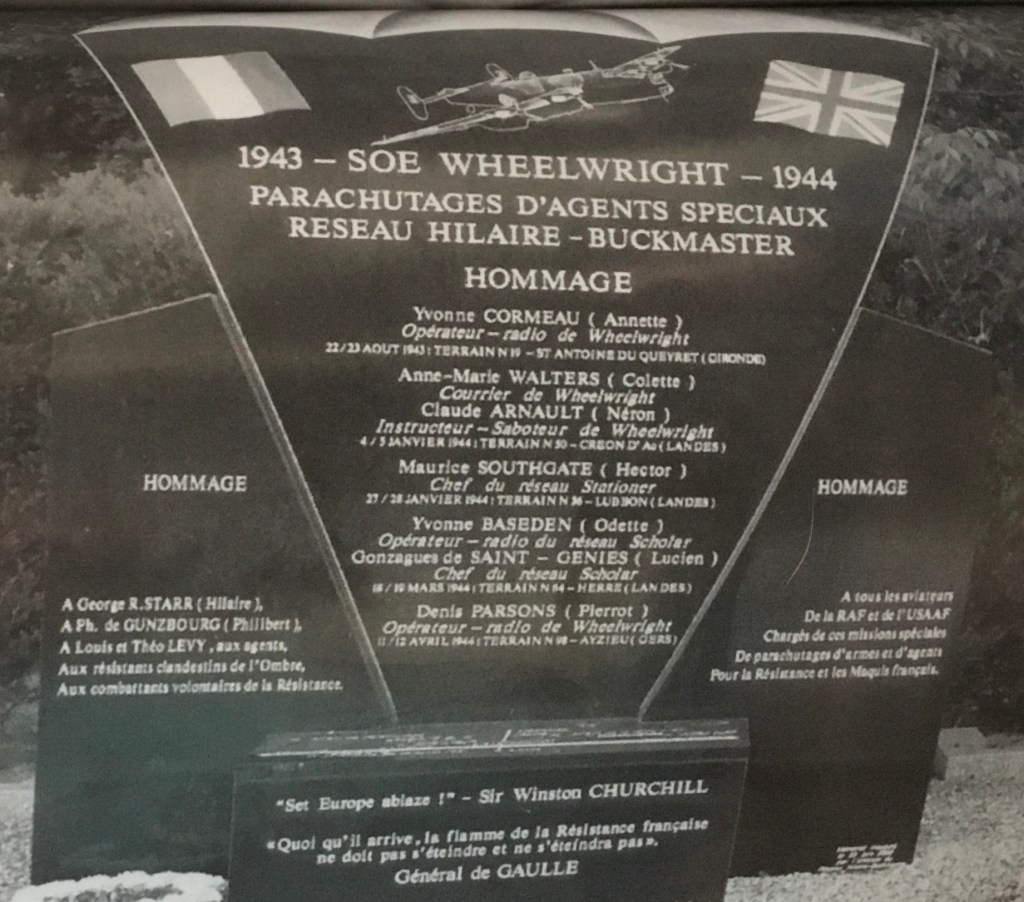
A memorial to the SOE agents of the Wheelwright network in Lapeyrade, Landes. Yvonne Cormeau, Anne-Marie Walters and Yvonne Baseden have featured on my website.

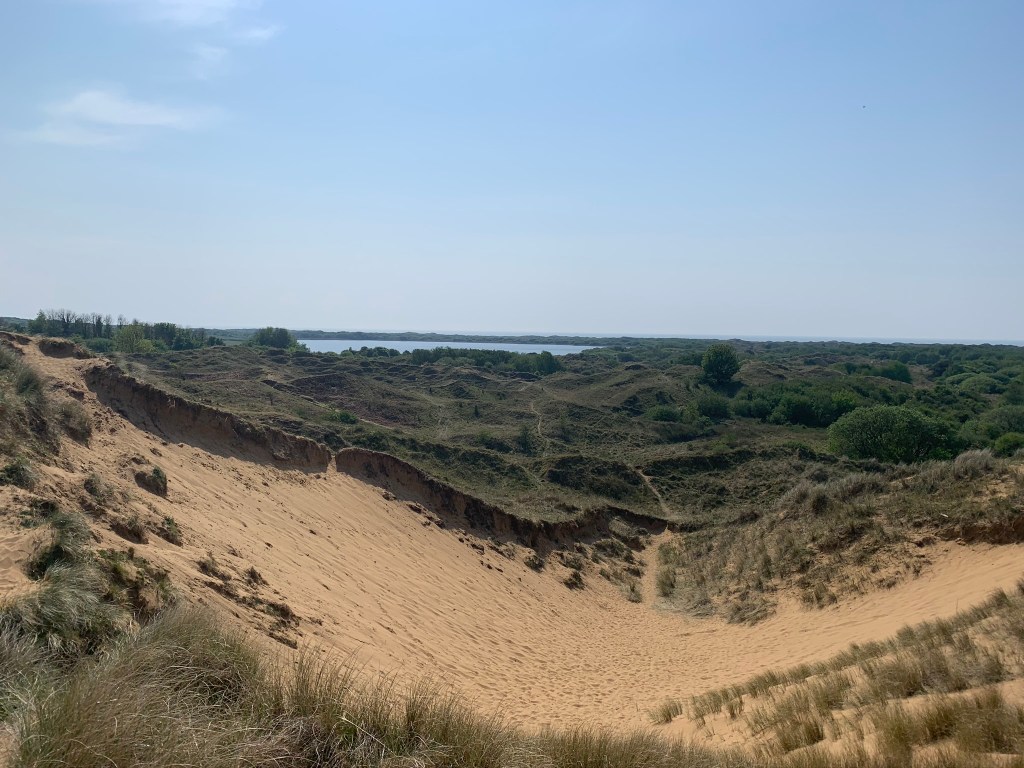
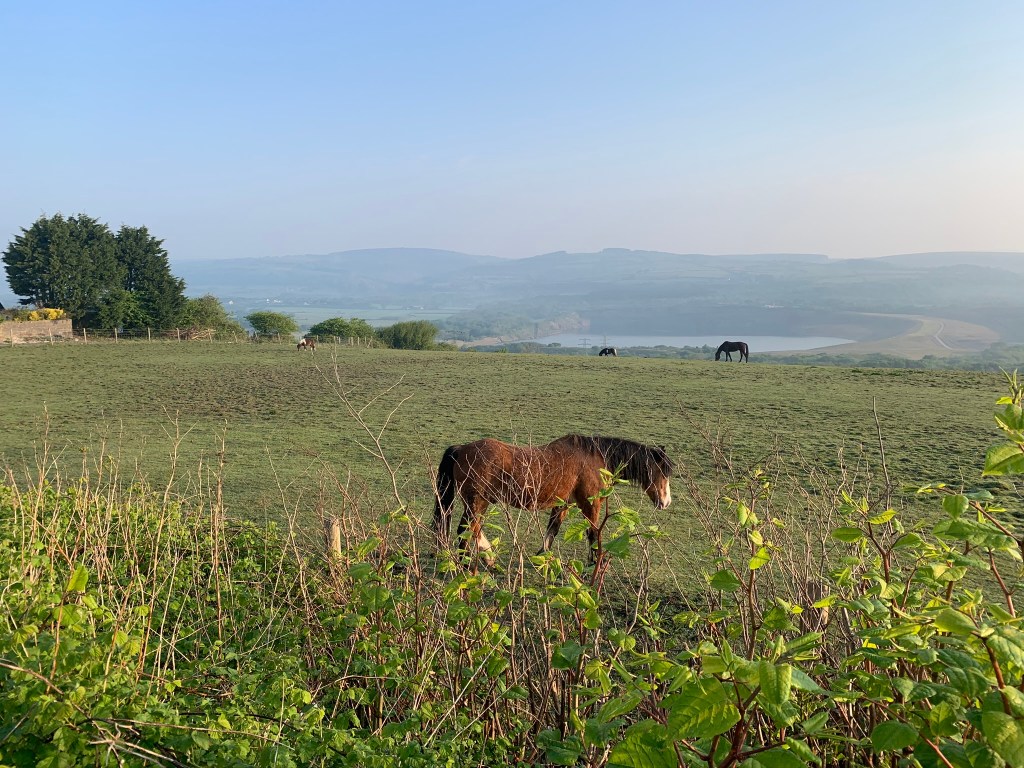
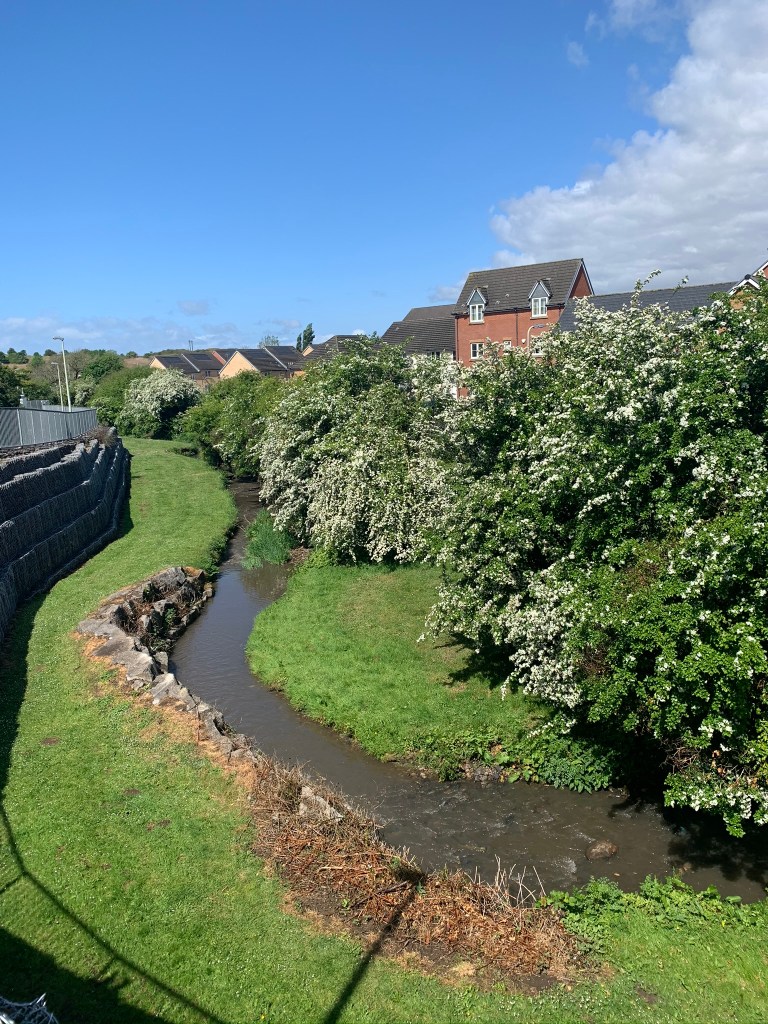
Pictures taken near my home in South Wales this week: Kenfig, Mawdlam, Cefn Cribwr, the Goylake River, Kenfig and Ballas

Women of Courage Heroines of SOE

SOE agent Eileen Mary “Didi” Nearne was born on 15 March 1921 in London to an English father, John, and a Spanish mother, Marie. She was the youngest of four children while her elder sister, Jaqueline, and her brother, Francis, also became SOE agents.

In 1923, the family moved to France where Eileen became fluent in French. After the German invasion in 1940, Eileen and Jacqueline followed the well-worn path to London via Barcelona, Madrid, Lisbon, Gibraltar and Glasgow, while their parents and brothers remained in Grenoble.

Eileen Nearne

In Britain, the SOE soon identified Eileen’s talents. Initially, she worked as a signals operator decoding secret messages, often written in invisible ink, received from agents in the field.

After a period of training, on 2 March 1944, Eileen arrived via Lysander in Les Lagnys, Saint-Valentin. Her mission was to work as a wireless operator for the Wizard network. She also organised sources of finance for the Resistance. Over five months she transmitted 105 messages, each one sent at enormous personal risk.

Coincidentally, Eileen’s organiser, Jean Savy, returned to Britain on 9 April 1944 on the same aircraft as her sister, Jacqueline, who had spent fifteen successful months in the field. Savy arrived in Britain with important information about the Nazi’s V1 rockets.

In July 1944, the Gestapo detected Eileen’s transmitter and arrested her. A period of barbarity followed, which included crude forms of inhuman treatment. Nevertheless, despite the torture, Eileen convinced the Gestapo that a businessman had hired her to send messages and that, at the time, she remained innocent of his British nationality.

In August 1944, the Gestapo sent Eileen to Ravensbrück concentration camp then on to Silesia. At the camps, the guards forced her into slave labour. However, she remained defiant and, despite more torture, refused.

Jacqueline Nearne

On 13 April 1945, Eileen escaped with two French women. Marching to another camp through the snow and dark they hid in a forest then travelled to Markkleeberg where the S.S. arrested them. However, they managed to fool the S.S. (it’s remarkable how many agents managed to do this) and with the aid of a priest they hid in Leipzig until the liberating Americans arrived a few days later.

It’s ironic that Eileen constantly lied to the Gestapo and, for the most part, the believed her. They regarded her as ‘a silly little French girl who was wasting their time.’ However, when she told the Americans the truth they didn’t believe her and it took some time before they handed her over to the British authorities.

After the war, Eileen suffered from what we now recognise as Post Traumatic Stress Disorder. Jacqueline cared for her and in 1997 she felt well enough to appear on a Timewatch television programme where she discussed her wartime experiences.

Eileen died in September 2010 aged eighty-nine.

As ever, thank you for your interest and support.

Hannah xxx

Categories
Dear Reader

Dear Reader #40

Dear Reader,

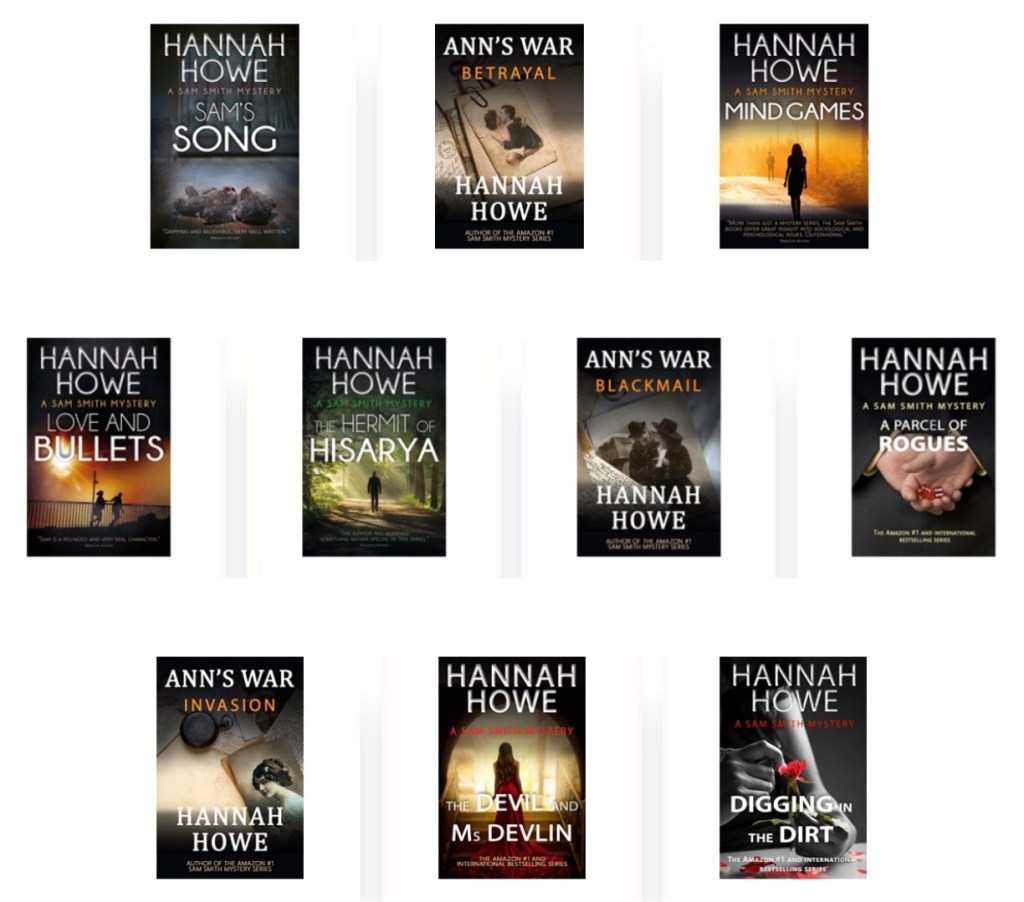
My personal top ten this week with Mind Games making the biggest leap up the charts.

The proof copy of Snow in August, which arrived this week.

Authors take two basic approaches to long-running series. 1. The lead characters remain exactly the same (Columbo is a good example of this). 2. The lead characters develop over time. My Sam Smith Mystery Series slots into the second category.

Looking for Rosanna Mee, book seventeen in the series, will see a development of Faye’s character. Sam will narrate, but Faye will lead the investigation. This will also be an ‘Alan story’ with the psychological aspect well to the fore.

Looking for Rosanna Mee will be available for pre-order shortly and the book will be published later this year.

I’m writing The Olive Tree, A Spanish Civil War Saga. In book one, Roots, Prince Nicolas Esteban invites author Naomi Parker to dinner. What should she wear? She decides on this dress by Madeleine Vionnet.

Recently, I enjoyed Dangerous Crossing, a 1953 film noir mystery, on DVD. Directed by Joseph M. Newman and starring Jeanne Crain and Michael Rennie, the movie was based on the 1943 play Cabin B-13 by John Dickson Carr.

The plot centres on the gaslighting of Jeanne Crain’s character as she embarks upon a honeymoon cruise.

A low-budget movie devoid of special effects, Dangerous Crossing relies on strong characterisation and a genuinely suspenseful plot.

Jeanne Crain is an attractive heroine who features in almost every scene while Michael Rennie lends solid support. To see the best of Jeanne Crain, however, I recommend Leave Her to Heaven where she excels in her trademark ‘girl next door’ role.

Research Makes Writing Easier

In Eve’s War, Guy Samson, my male SOE agent, is loosely based on three people. Guy has a Welsh mother and French father, but these people did not have that background.

While researching the area where my SOE agents will operate, Brittany, I discovered another agent, Andre Hue, who had a Welsh mother and French father. This coincidence completes the circle and makes Guy’s character much stronger. And strong characters make the task of writing so much easier.

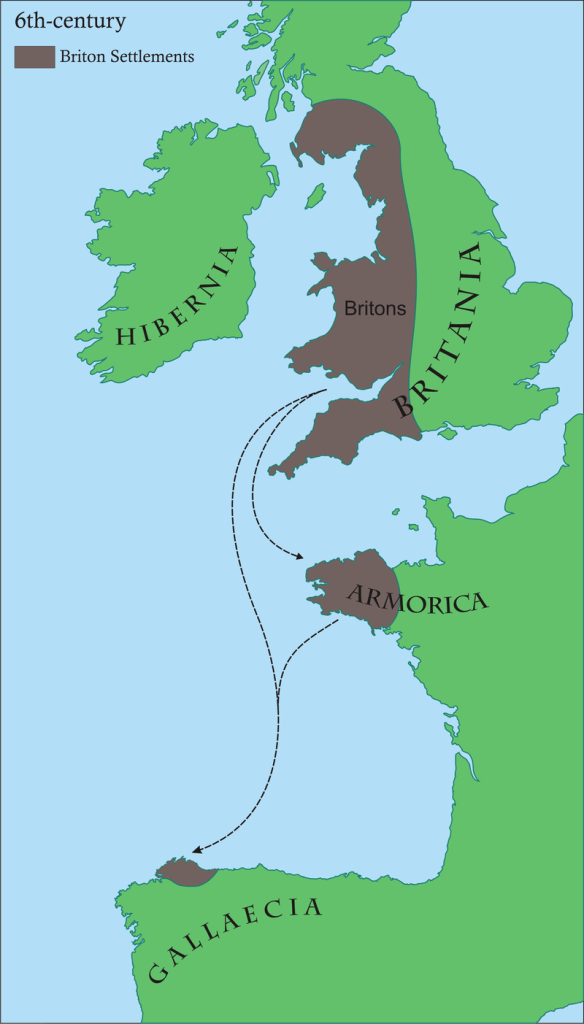
Pictured: the ancient links between Brittany and Wales.

I completed the storyboarding for Operation Locksmith this week, fifteen A3 pages of squiggles. In Operation Locksmith, Eve, Guy and Mimi train to become SOE agents, but is there a traitor in the camp?

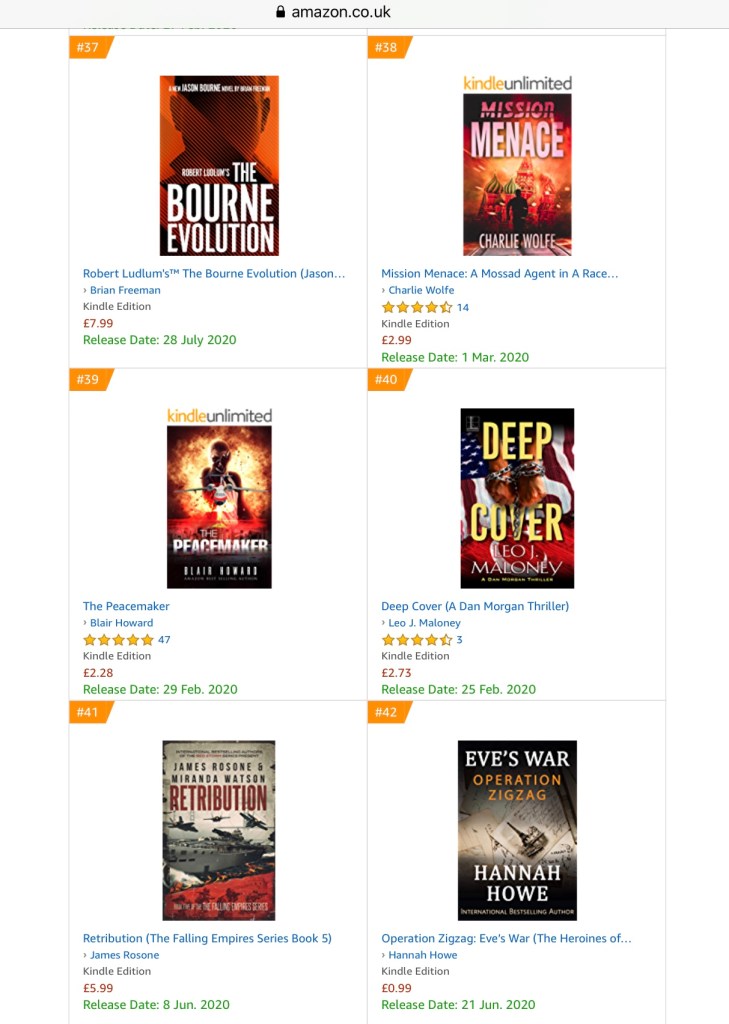
Meanwhile, it’s lovely to see that Operation Zigzag is keeping company with Robert Ludlum’s Bourne series 🙂

https://books2read.com/u/mKDDyv

Women of Courage Heroines of SOE

Maureen Patricia ‘Paddy’ O’Sullivan was born in Dublin on 3 January 1918 the daughter of journalist John Aloysius O’Sullivan (1873–1949) and Johanna Repen (1889–1919), who died when Paddy was only 15 months old.

At the age of seven Paddy was sent to live with an aunt in Belgium where she attended a convent school in Cortrai. At the beginning of the war she worked as a nurse in Highgate Hospital, London. She joined the WAAF on 7 July 1941 as an Aircraft Handler General Duties, and was later promoted to Section Officer. Her SOE report lists that her hobbies included reading, psychology and walking.

Paddy’s trainers had mixed views of her. She could be stubborn and prone to temper. However, others regarded her as kind-hearted and able.

As a member of the SOE, Paddy parachuted into Limoges on 23 March 1944. Falling through the fog, she landed heavily, sustaining a concussion. She awoke to find a cow breathing on her face. Later, she said that the two million francs strapped to her back, money to fund SOE and Resistance activities, saved her life.

As Micheline Marcelle Simonet, Paddy’s cover story revealed that she was a ‘dame de compagnie’ of a doctor in Paris. She was taking  one month’s leave to look for a lost Belgian parent in Creuse. Her documents, including a letter from the doctor, were good. However, the month-long limitation was a strange decision by the SOE because the intention was for Paddy to remain in the area for considerably longer than that. In the event, she changed her cover story and became the friend of a school-teacher’s wife – the school-teacher was a leader of the local Resistance.

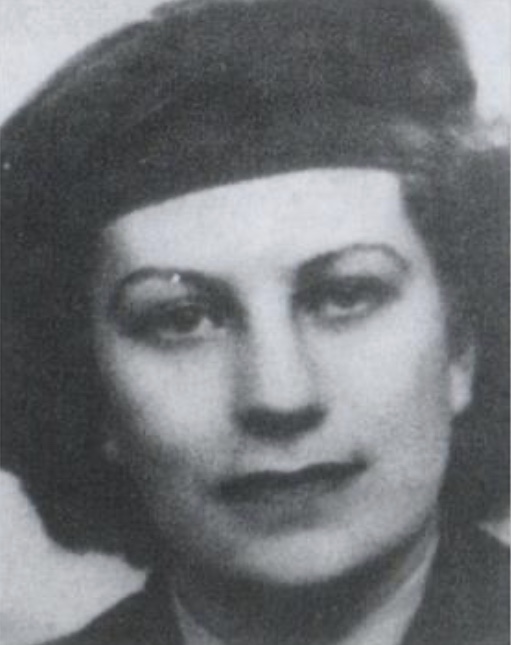
On one occasion, Paddy was stopped by the Gestapo while transporting her wireless, which was hidden in a suitcase. In passable German, she flirted with the officer, made a ‘date’ for the following evening, then escaped, the suitcase forgotten by the lusting officer.

After noble and brave service, Paddy returned to Britain on 5 October 1944. 

As ever, thank you for your interest and support.

Hannah xxx