Categories
Dear Reader

Dear Reader #130

Dear Reader,

My latest translation by Nelmari, the Afrikaans version of Sam’s Song. Available soon 🙂

My latest genealogy article appears on page 48 of the Seaside News.

Another scene familiar to my London ancestors, High Street, Camden Town, c1890.

This week saw the longest game in World Chess Championship history, 136 moves. Eventually, Magnus Carlsen’s rook, knight and two pawns proved too strong for Ian Nepomniachtchi’s queen. Carlsen currently leads the fourteen game series 4 – 3.

Arranging our Christmas decorations with the usual suspects 🌲

I’ve traced the Gadsden branch of my family back to 1086 and the Doomsday Book. At that time the name was recorded as Gatesdene. The family were living in Hertfordshire. Maybe they arrived with William the Conqueror, or shortly after. That said some sources suggest that the name Gadsden has English origins relating to ‘valley’.

A page from the Doomsday Book

The early Gadsdens were well-to-do, landowners who relative to the times enjoyed comfortable lifestyles. For most branches of the family this pattern continued into the nineteenth century.

The Gadsdens mixed with the nobility and moved in royal circles. An example: John of Gadsden was a physician to Edward II and Edward III, the first Englishman to hold that appointment. John wrote a book, Rosa Anglica, the first English textbook on medicine, which compiled the medical knowledge of his age. 

It is believed that John of Gadsden was familiar with the method of distilling fresh water from saltwater. This process, desalination, was thought to be a modern discovery.

Some of John of Gadsden’s contemporaries regarded him as a genius, the ‘brightest man of his age’. He was a philosopher, a philologist, a poet, he was skilled at manual operations and bone-setting, and he was a great oculist. He was skilled at physiognomy and wrote a treatise on chiromancy. A great dealer in ‘secrets’, he also performed ‘miracles’.

John’s greatest skill was in concocting ‘receipts’, potions. However, some people doubted his wisdom and regarded him as a superstitious quack. His doubters accused him of ‘laying baits’ for the delicate, the ladies and the rich. 

When small pox afflicted Edward II’s son, the future Edward III, the king called for John of Gadsden. John’s ‘prescription’ was to dress his patient in scarlet and ensure that everything about the sickbed was made of scarlet. John worked on the ‘sympathetic’ concept, which stated that the colour red cured inflammation. Quackery or not, the king’s son duly recovered ‘without a mark on his face’.

John wrote his book, Rosa Anglica, while resident at Merton College, Oxford. The source of his material stemmed from the Arabians and the moderns ‘who had written in Latin just before him’. His book was an encyclopaedia of all his potions and it offers an insight into the medical practices of the day, as applied to the nobility and common people.
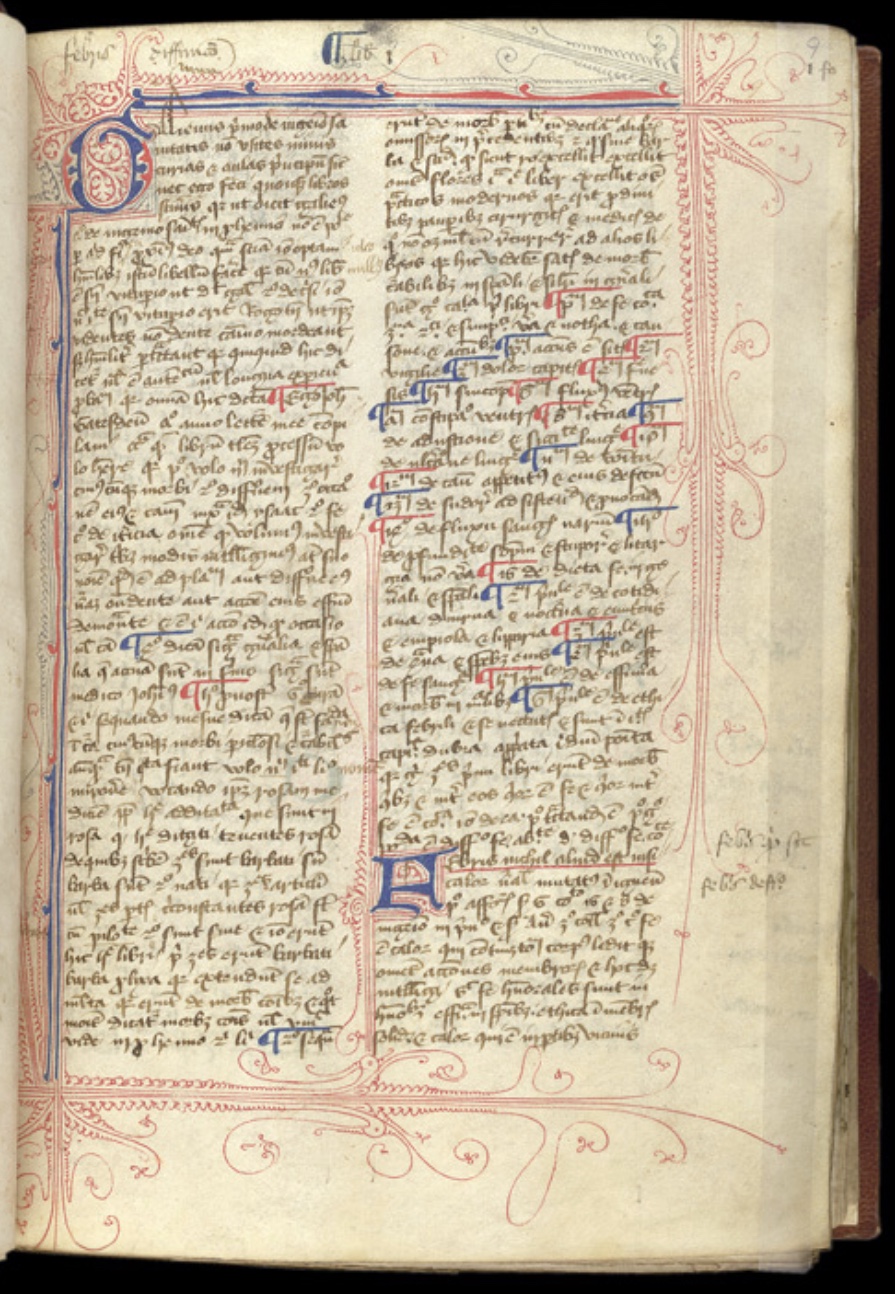
The preface to Rosa Anglica

John wrote ‘Rosa Anglica, or Practical Medicine From Head to Foot’, between 1304 and 1317. His book contained four tracts on urine (a key to medieval medical diagnosis and treatment). The original manuscript was owned by All Souls College, Oxford, a leading centre of medical studies in Europe during the fifteenth century.

In his preface to ‘Rosa Anglica’ John wrote, ‘Just as the rose excels among flowers this book excels among textbooks on practical medicine.’ Clearly, he didn’t suffer from undue modesty.

John found time to be prebendary of St Paul’s. He also held theological posts at Chipping Norton and Chichester. Chaucer knew of him and mentioned him as the ‘Doctor of Physik’.

So, was John of Gadsden a genius or a quack? I suspect that he was a bit of both. Here’s an example of his quackery, a cure for toothache. John recommended that you should extract a tooth by smothering it with the fat from a dead green tree frog, cow dung or partridge brain. For the tooth to grow back, you should apply the brain of a hare to the gums. Clearly, this was nonsense and liable to do more harm than good. Yet, editions of his book were published in 1502 and 1595, and for centuries read throughout Europe.

A dentist with silver forceps and a necklace of large teeth, extracting a tooth c1365.

Many of John’s methods were based on superstition while others were crude. However, whether through luck or good judgment he formed a formidable reputation. 

John was a man of his time. Thankfully, over the centuries we have made advances in medicine. But we should also consider that future generations will look back on us and reckon that some of our methods were based on quackery and that they were crude.

As ever, thank you for your interest and support.

Hannah xxx

For Authors

#1 for value with 565,000 readers, The Fussy Librarian has helped my books to reach #1 on 32 occasions.

A special offer from my publisher and the Fussy Librarian. https://authors.thefussylibrarian.com/?ref=goylake

Don’t forget to use the code goylake20 to claim your discount 🙂

Categories
Dear Reader

Dear Reader #129

Dear Reader,

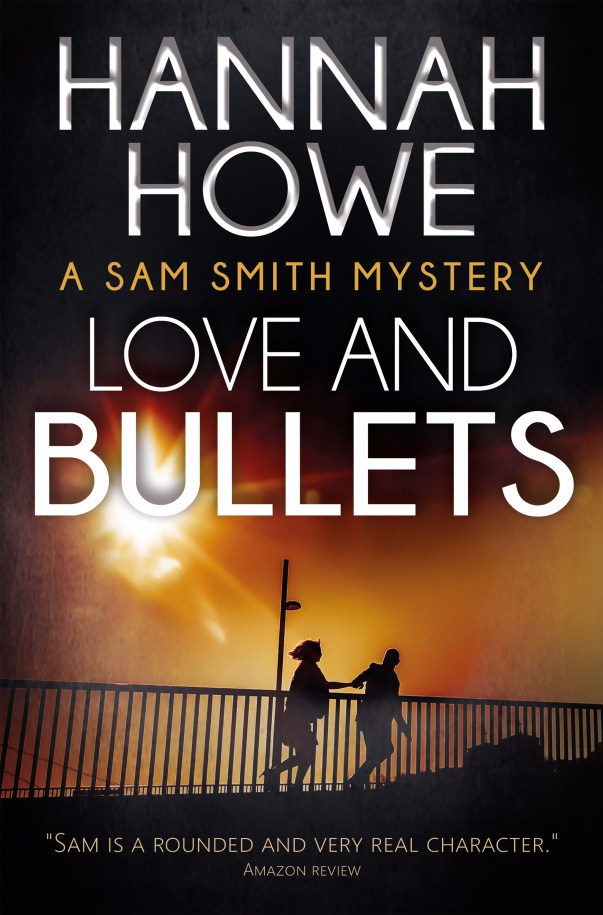
Nelmari has completed the translation of Sam’s Song, book one in my Sam Smith Mystery Series, into Afrikaans and I’m delighted to say that soon she will make a start on Love and Bullets, book two in the series.

After the tragic events of this week.

A scene familiar to my London ancestors, Victoria Station in 1912.

The World Chess Championship between Magnus Carlsen and Ian Nepomniachtchi started this week. I’m a big chess fan so I’m enjoying the coverage on chess.com. Two exciting draws so far. All to play for in the fourteen game series.

https://www.chess.com/news/view/2021-fide-world-chess-championship-game-1-nepomniachtchi-carlsen

The son of Edward Stradling and Joan Beaufort, Sir Henry (Harry) Stradling was born c1412 in St. Donats, Glamorgan. He married Elizabeth Herbert c1440 in St. Athan, Glamorgan, their marriage uniting the powerful Stradling and Herbert families. The marriage produced four children: Thomas, my direct ancestor, Charles, Elizabeth and Jane. 

In 1449, Henry, his wife Elizabeth and their daughter Elizabeth, encountered a Breton pirate, Colyn Dolphyn. A native of Brittany, Colyn Dolphyn was based on Lundy, an island in the Bristol Channel. Five kilometres long and a kilometre wide Lundy was granted by Henry II to the Knights Templars in 1160. Over following centuries privateers took control of the island.

Map of Lundy Island by Henry Mangles Denham (1832)

Because of the dangerous shingle banks and the fast flowing River Severn with its tidal range of 8.2 metres, the second largest in the world, ships were forced to navigate close to Lundy. This meant the island was ideally situated for pirates to prey on merchant ships and their rich cargos.

The chroniclers described Colyn Dolphyn as a tall, athletic, and mighty man, ‘like Saul in Israel’. He ‘towered head and shoulders’ above all men and was regarded as ‘a terror in South Wales’.

In 1449, Henry and his family spent a month visiting their estates in Somerset. Whenever possible, for passengers and trade, ships were the preferred mode of transport because the roads were often nothing more than dirt tracks. Therefore, Henry made the return journey by ship.

Aboard the St Barbe, Henry, his family and crew, set sail from Minehead for the Welsh coast. They encountered Colyn Dolphyn, who transferred them to his barque, the Sea Swallow. Dolphyn demanded a ransom of 1,000 marks for Henry, Elizabeth and daughter Elizabeth’s release. 

The ransom was not forthcoming so over a period of two years the price went up to 2,200 marks. At that point the Stradlings were forced to sell their manors of Bassaleg and Rogerstone in South Wales, two manors in Oxfordshire and the Lordship of Sutton in Monmouthshire. With the ransom paid, Dolphyn released Henry and his family.

Nash Point (Wikipedia)

While the coast of South Wales is beautiful it also contains some treacherous rocks, particularly the rocks off Nash Point, Glamorgan. Several years after kidnapping the Stradlings, Colyn Dolphyn was out pirating when a storm blew up. That storm drove his ship on to Nash Rocks near Colhugh Beach. 

The locals alerted Sir Henry Stradling who raised his men. They captured Colyn Dolphyn and his men, and dispensing swift justice hung them the following day.

In 1837, Taliesin Williams wrote a poem, The Doom of Colyn Dolphyn, which concluded with the following lines:

The beach they trod, destruction there,

Had stamped his footsteps ev’ry where.

Above, below, were strown along,

The fragments of a vessel strong.

Here helm and shatter’d masts were seen,

There lay the hull, the rocks between, 

With upward keel and crag-rent side. 

Thro’ which had pass’d the refluent tide.

And, all around, appear’d in view,

The bodies of a numerous crew. 

Whose course was run, confederates sent,

Well armed on Colyn’s rescue bent. 

But, ere they reach’d the rugged strand,

To ply the dirk, and light the brand. 

Justice ordain’d they should abide,

The tempest’s ordeal, and they died!

The story of the Stradling branch of my family and their encounter with a pirate Colyn Dolphyn as illustrated, animated and told by the children of Wick and Marcross Primary School, South Wales.

Like his father, Edward, Henry Stradling visited Jerusalem, in 1475, where he became a Knight of the Holy Sepulchre. Also like his father, he died on his journey home, at Famagusta, Cyprus, in 1476.

As ever, thank you for your interest and support.

Hannah xxx

For Authors

#1 for value with 565,000 readers, The Fussy Librarian has helped my books to reach #1 on 32 occasions.

A special offer from my publisher and the Fussy Librarian. https://authors.thefussylibrarian.com/?ref=goylake

Don’t forget to use the code goylake20 to claim your discount 🙂
Categories
Dear Reader

Dear Reader #128

Dear Reader,

Some chart news. Operation Cameo, book six in my Eve’s War Heroines of SOE series, is a top twenty hot new release in Britain. We will publish the book in February 2022. Many thanks to all my readers for their support.

This week I parcelled 84 books to send to the Bodleian Library, Oxford; Cambridge University Library; National Library of Scotland; Trinity College Dublin; The British Library and the National Library of Wales. Publishers have been fulfilling this requirement since 1662. A great tradition 🙂

Researching the Gadsden branch of my family I discovered grocers in London and Newport Pagnell. Further research revealed that earlier they had been traders in Liberia, Nevis and South Carolina. 

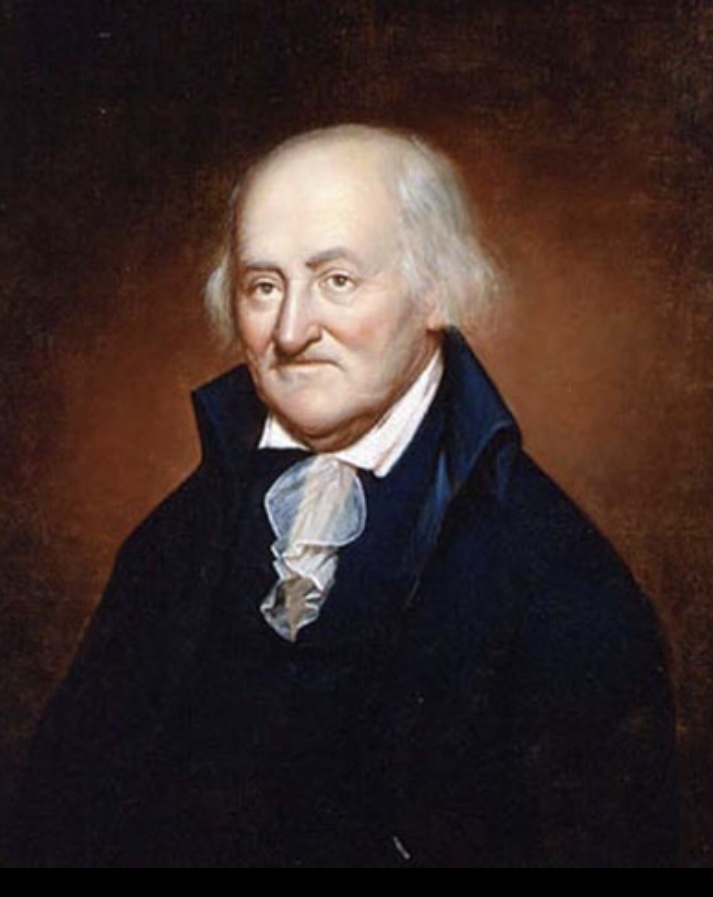
Here’s Christopher Gadsden (16 February 1724 – 28 August 1805) an American politician who was the principal leader of the South Carolina Patriot movement during the American Revolution. He was a delegate to the Continental Congress, a brigadier general, Governor of South Carolina, a merchant and the designer of the Gadsden flag. He was also a signatory to the Continental Association and a Founding Father of the United States. 

More about the Gadsdens in future posts.

I reckon I should award the prize for my most exotically named ancestors to Zephaniah Thorpe and his wife Mary Discipline.

The son of Ralph Thorpe and Mary Wakefield, Zephaniah was baptised on 25 April 1790 in Lakenham, Norfolk. He was named after his grandfather, Zephaniah.

Mary Discipline was born on 25 January 1789 and baptised on 1 February 1789 in Heacham, Norfolk. Her parents were Thomas Discipline and Mary Smith.

Zephaniah Thorpe and Mary Discipline married on 22 August 1813 in St Dunstan, Stepney, which indicates that they had moved from Norfolk to London. However, this was a small step before they embarked on an even greater adventure. Before detailing that adventure it is worth noting that Zephaniah and Mary signed their names on their marriage certificate. For a well-to-do man this was common, but for a woman, even one from the middle classes, it was a rarity. Often, women of the age were not taught how to read or write for fear that it would ‘corrupt’ their minds.

In 1829, Zephaniah and Mary found themselves in New York. You would think that emigration was a ‘young man’s game’, but Zephaniah was 39 and Mary 40 when they embarked on their journey. What compelled them to leave? For settlers in earlier centuries religious persecution offered the main motivation, but in Zephaniah and Mary’s case it would seem that a better quality of life was the main factor.

Zephaniah had a skill – he was a sculptor specialising in marble. In the 1830s New York was a developing city with a need for artisans. Zephaniah and New York were made for each other, so he took the gamble and transferred his family across the Atlantic Ocean.

Using a chisel, sculptors would remove large portions of unwanted stone. During this roughing out phase they would work rhythmically ensuring that the stone was removed quickly and evenly. Some artists would carve directly on to the stone while others used a model formed from wax or clay.

An example of a sculpture created during Zephaniah’s era can be found in Green-Wood Cemetery. There is no evidence that Zephaniah worked on this sculpture, but he definitely saw it and maybe it offered him some inspiration. 

The sculpture is called Charlotte Canda (3 February 1828 – 3 February 1845). It’s a memorial to a young debutant, Charlotte, who died in a horse carriage accident on her way home from her seventeenth birthday party.

Stereoscopic view of Charlotte’s memorial by E & H T Anthony.

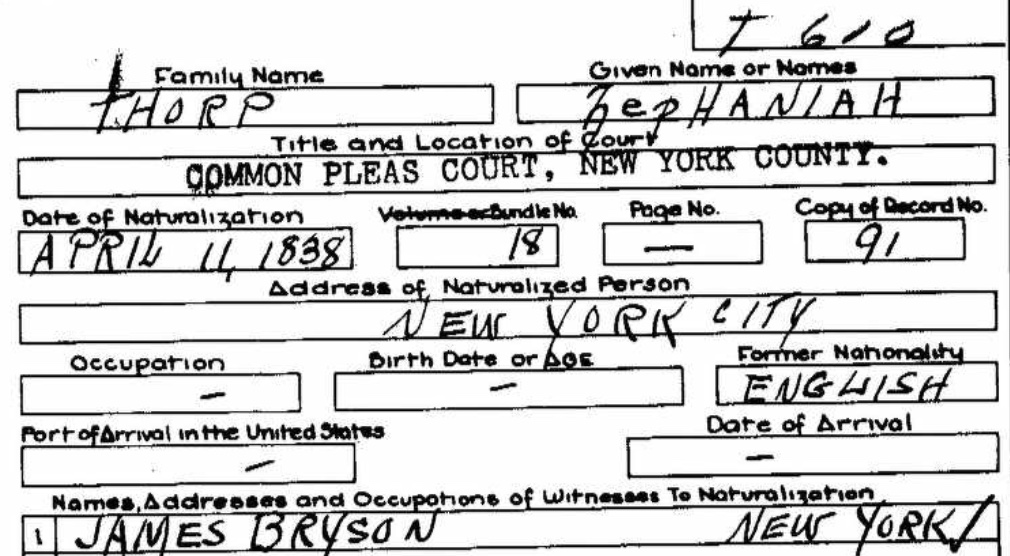
On 11 April 1838 at the Common Pleas Court in New York, Zephaniah and Mary applied for naturalisation. The application, sponsored by James Bryson, was granted and Zephaniah settled his family in Brooklyn.

Application for naturalisation.

In 1855 Zephaniah was living at Number 59 Ward 7, New York with his wife, Mary, their son, Thomas aged 39, a lodger Bartu Durando a jeweller from New Jersey also aged 39, and granddaughter Josephine A Thorp aged 10.

The street contained families from Canada, Germany, Ireland and Prussia plying their trades as bookkeepers, carpenters, clerks and grocers. A cosmopolitan area. Zephaniah’s son Thomas was also a sculptor. What did father and son sculpt? Probably the great marble columns and artefacts in New York’s burgeoning churches and civic buildings. Certainly, there was plenty of work available because by this time they had been plying their trade for 26 years.

Ten years later, Zephaniah, Mary, Thomas and Josephine were living in Brooklyn, in a house valued at $800. In this census Josephine was described as a niece from Alabama. Ten years earlier the census had described her as a grandchild. Official records are not always accurate, sometimes through accident, other times through design – particularly when people wish to hide something. Often, you need to read between the lines. There is no record of Thomas’ wife, so I’m inclined to believe that she died young and that Josephine was Thomas’ daughter. Certainly, she lived with him throughout her childhood.

New York, c1865, a scene familiar to Zephaniah. Maybe he worked on these buildings?

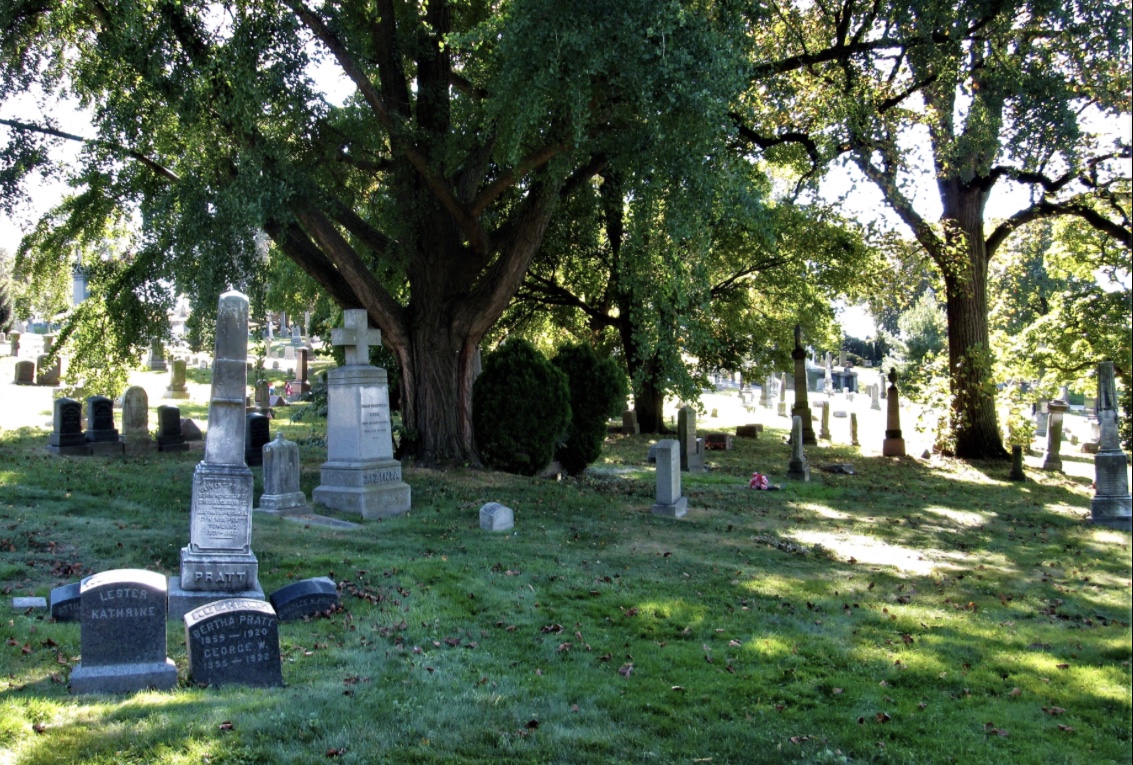
Zephaniah died in Kings, New York on 9 September 1868 aged 80. He was buried in Green-Wood Cemetery, Brooklyn, Kings County, New York.

A Brooklyn directory of 1877 listed Mary as the widow of Zephaniah. It also listed Thomas as a sculptor, living at the same address. Josephine was not listed so it’s fair to assume that she had married and started her own family.

Mary died on 3 September 1876 of pneumonia at 287 Jay Street, Kings, New York. She was buried with Zephaniah in Green-Wood. By this time she had lived amongst the tall buildings of New York for 47 years, a far cry from her birthplace in the flat Norfolk Broads.

Green-Wood Cemetery. Credit: Find a Grave.

As ever, thank you for your interest and support.

Hannah xxx

For Authors

#1 for value with 565,000 readers, The Fussy Librarian has helped my books to reach #1 on 32 occasions.

A special offer from my publisher and the Fussy Librarian. https://authors.thefussylibrarian.com/?ref=goylake

Don’t forget to use the code goylake20 to claim your discount 🙂

Categories
Dear Reader

Dear Reader #127

Dear Reader,

Preparing for 2022. The new year will see the continuation of my Sam Smith and Eve’s War series, the conclusion of my Olive Tree Spanish Civil War Saga, and the start of a new series, Women at War, five novels about ‘ordinary’ women fighting fascism in France, Spain and Bulgaria, 1936 – 1945.

Exciting news. My Sam Smith Mystery Series will be translated into Italian. We will make a start on Sam’s Song this week. As a European, I’m delighted that my books are available in twelve languages.

A rarity in the Victorian era, a husband’s petition for divorce, filed 16 November 1883. The husband stated that on ‘diverse occasions’ his wife committed adultery with ‘sundry persons’. Marriage dissolved. Damages awarded to the husband.

For Armistice Day.

My latest genealogy article for the Seaside News appears on page 36.

My direct ancestor Sir Edward Stradling was born c1295, the second son of Sir Peter de Stratelinges and Joan de Hawey. The exact location of his birthplace is unknown, but likely to be the family estates in Somerset.

When Sir Peter died, Joan married Sir John Penbrigg, who was granted wardship over Sir Peter’s estates and both young sons, Edward and his older brother, John, until they reached their twenty-first birthdays.

As an adult, Edward was Lord of St. Donats in Glamorgan, and Sheriff, Escheator, Justice of the Peace, and Knight of the Shire in Parliament for Somerset and Dorset. He rose to such prominence through his staunch support for Edward III.

St Donats Castle, a print from 1775.

Edward Stradling married Ellen, daughter and heiress of Sir Gilbert Strongbow. They produced the following children:

Edward (my direct ancestor) who married Gwenllian Berkerolles, daughter of Roger Berkerolles of East Orchard, Glamorgan.

John, who married Sarah, another daughter of Roger Berkerolles. Two bothers marrying two sisters.

When John died, c1316, Sir Edward inherited the following lands:

St Donat’s Castle, Glamorgan.

Combe Haweye, Watchet Haweye, Henley Grove by Bruton, Somerset, all of which included three messuages, a mill, five carucates, two virgates of land, thirty-one acres of meadow, and one hundred and forty-one acres of woodland.

Halsway and Coleford in Somerset.

Compton Hawey in Dorset.

Through his wife’s inheritance, he also obtained two manors in Oxfordshire. 

As Lord of St. Donats, Sir Edward rose against the Crown in the Despenser War of 1321–22. The war was a baronial revolt against Edward II led by marcher lords Roger Mortimer and Humphrey de Bohun, fuelled by opposition to Hugh Despenser the Younger, the royal favourite.

15th-century illustration showing Queen Isabella and Roger Mortimer; execution of Hugh Despenser the Younger in the background.

The Crown arrested Sir Edward in January 1322 and seized all his lands in England and Wales. It took two years and a loyalty payment of £200 – £92,000 in today’s money – before his estates were restored.

When Edward II was deposed in 1327, Edward Stradling was knighted by Edward III. Several appointments followed, including Sheriff and Escheator of Somerset and Dorset 1343, MP for Somerset 1343, and Justice of the Peace for Somerset and Dorset 1346–47. On 11 September 1346, Sir Edward was one of three knights of Somerset at Edward III’s Westminster parliament.

Sir Edward was one of the chief patrons of Neath Abbey and on 20 October 1341 he gifted the monastery one acre of land. He died c1363, either in St Donats or Somerset.

The Strandling line continued through the second Sir Edward, born in 1318 in St Donats Castle to Sir William, born in 1365 in St. Donats, to another Sir Edward, born in 1389 in St Donats. This Sir Edward was Chamberlain and Receiver of South Wales, Sheriff of Somerset and Dorset 1424-6, Steward and Receiver of Cantreselly and Penkelly, Keeper of Carmarthenshire and Cardiganshire (appointed 22 August 1439), Constable of Taunton 1434-42, and Knight of the Sepulchre.

Already well established amongst the nobility, the Stradling’s influence increased through the deeds of the third Sir Edward. He married Jane, daughter of Cardinal Beaufort, great uncle of Henry VI. This marriage ensured that he held a powerful position within the royal court. 

Administrative posts in South Wales and money followed. As with modern nobility, medieval nobility was a moneymaking-racket, a mafia, exploiting the poor. Lords and knights gave money to the Church to assuage their sins. Many lords were brutal and ruled through fear. Some, and I hope Edward was amongst them, used their positions of privilege and wealth to better their communities. For Edward these communities included parishes in Glamorgan, Somerset, Dorset and Oxfordshire. Of particular interest to me is the Stradling manor of Merthyr Mawr, a beautiful village, which is on my doorstep.

Sir Edward fought at Agincourt. He was captured by the French, and wool, a staple product of South Wales, was shipped to Brittany to defray his ransom.

In 1411, Sir Edward Stradling went on pilgrimage to Jerusalem. In 1452, aged sixty-three, he went on a second pilgrimage, but did not return. He died on 27 June 1452 in Jerusalem.

View of Jerusalem (Conrad Grünenberg, 1487).

To be a peasant or a noble in medieval times? Although I’m descended from noble houses, my inclination is to side with the peasants. Life is hard for the poor in any age, and it was certainly hard in medieval times. Against that, the nobles had to contend with political intrigues, treachery, wars and pilgrimages, from which many did not return. 

Given a choice, I think I would select a middle course, neither peasant nor noble, but an observer, a chronicler, recording my life and times. After all, through fiction, that’s what I do today.

As ever, thank you for your interest and support.

Hannah xxx

For Authors

#1 for value with 565,000 readers, The Fussy Librarian has helped my books to reach #1 on 32 occasions.

A special offer from my publisher and the Fussy Librarian. https://authors.thefussylibrarian.com/?ref=goylake

Don’t forget to use the code goylake20 to claim your discount 🙂


Categories
Dear Reader

Dear Reader #126

Dear Reader,

Some chart news. Operation Zigzag, book one in my Eve’s War Heroines of SOE series, is #1 on the Amazon charts while Operation Cameo, which I’m currently writing, is a #34 hot new release. Many thanks to all my readers for making this possible.

Through Ellen, born c1320, daughter and heiress of Sir Gilbert Strongbow, I’ve added a Strongbow branch to my family tree. I wonder if this entitles me to free cider 🤔

As mentioned above, Operation Cameo is now available for pre-order. You can find full details here https://www.amazon.com/Operation-Cameo-Eves-Heroines-Book-ebook/dp/B09K82MQNY/

A view familiar to my London ancestors, the Strand looking west towards Trafalgar Square, 1890.

Just asked my youngest son, “What do you want for Christmas?”

“A skeleton.” (He’s thinking of becoming a doctor).

“Where are we going to keep it?”

“The front room.”

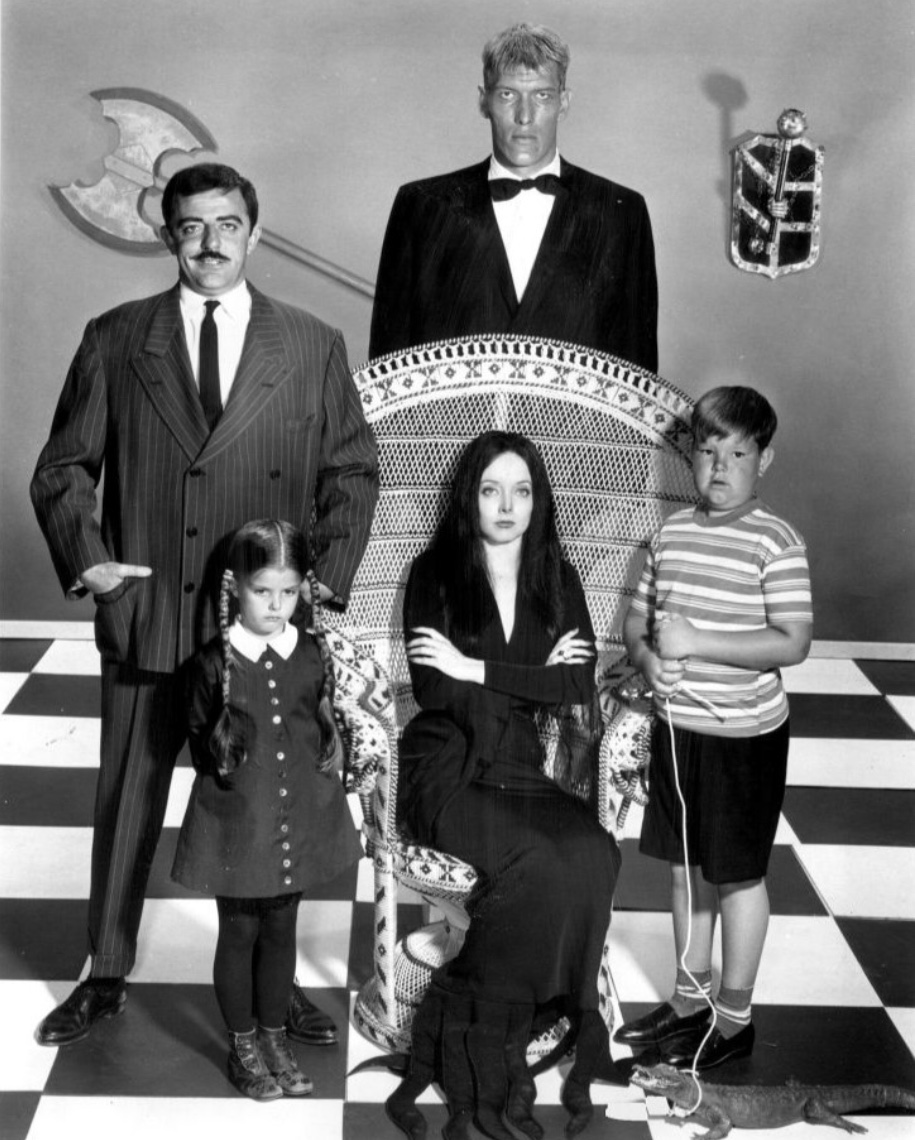
Welcome to the Addams family.

In this month’s issue of Mom’s Favorite Reads…

New York Times and USA Today Bestselling Author Joanna Penn interviewed by Wendy H Jones

Plus…Art, Author Resources, Flash Fiction, New Releases, Photography, Poetry, Puzzles, Recipes, Travel and so much more!

The son of Zephaniah Thorpe and Margaret Entwistle, my direct ancestor Ralph Thorpe was baptised on 14 March 1753 in Bolton-le-Moors, Lancashire.

A warper, a common trade in Lancashire with its proliferation of cotton mills, Ralph moved south in the early 1780s and plied his trade in Essex and Norfolk.

A cotton warper oversaw the industrial process of winding threads from various bobbins on to a warp beam, which had one large bobbin at the back of the loom containing all the warp threads. These threads would gradually unwind during the weaving process, producing the cloth. Warping was the second stage of cotton cloth production, following winding.

A warping machine. Image: Wikipedia.

On 9 December 1783, Ralph married Mary Wakefield in Wanstead, Essex. The couple produced six children including my direct ancestor Thomas Thorpe who, on 9 October 1814, married Mary Ann Freeman and settled in Essex.

Mary Wakefield died on 25 February 1796. A few months later Ralph spent some time in St Thomas’ Hospital, London. That the couple were ill at roughly the same time suggests that they were affected by a transmittable disease. One possibility was smallpox.

Ironically, that same year, 1796, Edward Jenner demonstrated that an infection with the relatively mild cowpox virus conferred immunity against the deadly smallpox virus. His research was crucial in the development of the smallpox vaccine, the first effective vaccine against a contagious disease.

Painting by Ernest Board. Dr Edward Jenner performing his first vaccination on eight year old James Phipps, 14 May 1796.

St Thomas’ Hospital originated as an Augustinian infirmary in the twelfth century and was dissolved in 1540. In 1551 the hospital was refounded by royal charter and functioned as a general hospital for the sick-poor, including sufferers of venereal disease. 

Endowments gave St Thomas’ a degree of financial security. Nevertheless, they still charged patients admission fees, a policy that was condemned by the hospital’s critics for limiting the ability of the very poor to access its services.

A central court of governors governed the hospital and they could number over two hundred. These governors were wealthy individuals who gifted £50 each to the hospital.

Old St Thomas’ Hospital, Southwark, 1739. Image: The Wellcome Library.

The original St Thomas’s Hospital survived the Great Fire of London in 1666. However, upgrades were needed and between 1693 and 1720 more than £37,000 was raised in order to create an elegant classical structure around three spacious courtyards. The rebuilt hospital had nineteen wards, including two foule wards for venereal patients and a cutting ward with room for more than 400 patients. Male and female patients were strictly segregated, as were the venereal patients.

The medical staff included physicians, surgeons and an apothecary, who was not allowed to marry or run a private practice. The nursing staff included a matron, sisters and nurses. The sisters and their nurses lived in the hospital and had to be single or widowed. 

St Thomas’ catered for patients with a wide range of medical and surgical conditions although they did exclude people classed as ‘incurable’ or ‘insane’. Patients were not allowed to stay longer than three months, after which time they were deemed incurable. Ralph left St Thomas’ Hospital on 9 June 1796. Therefore, he must have entered a month or so after Mary died.

St Thomas’ Hospital treated large numbers of patients. In 1800 the total number of inpatients was more than 3,200 with a further 4,700 outpatients. In wartime the patients were often supplemented by large numbers of wounded soldiers and sailors.

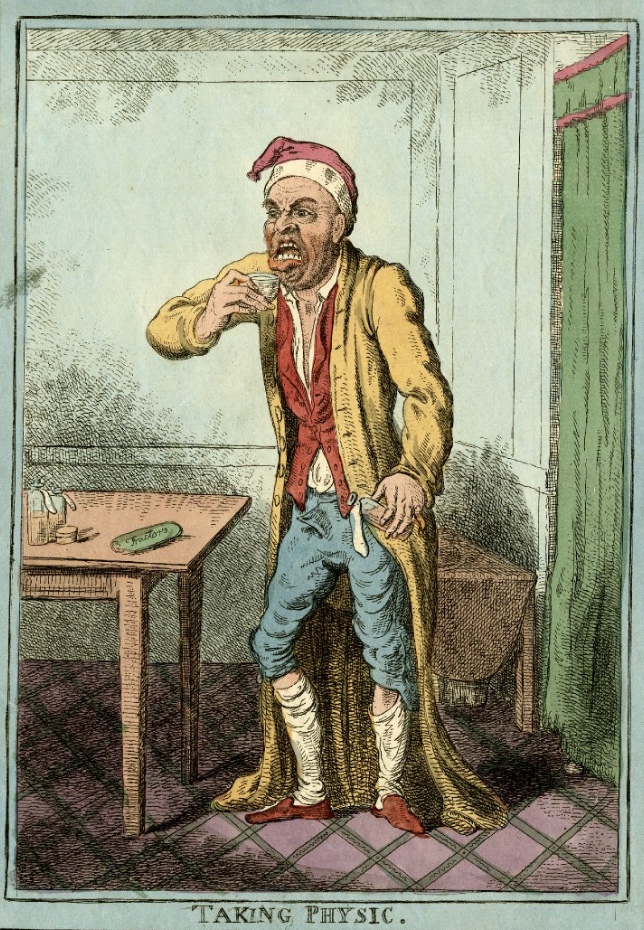
‘Taking Physic’. Image: The Trustees of the British Museum.

The death rates at St Thomas’ were relatively low, although it must be remembered that the hospital did not admit ‘incurable’ patients. In 1726, 4,873 patients were cured while 392 died, a mortality rate of 7.4 percent. In 1735, 4,688 patients were cured while 307 died, a mortality rate of 6.1 per cent. This pattern of mortality rates continued throughout the century.

The patients could be disruptive with harassment, petty theft and ‘ward wandering’ reported. Some patients ran away before the completion of their treatment, especially venereal patients who were subjected to the deeply unpleasant and extremely painful mercury-based ‘salivation’ therapies.

Having recovered, but without his wife, Ralph returned to Bolton-le-Moors where, on 23 January 1803, he married Mary Holden. Ralph died on 28 August 1826 in Bolton-le-Moors.

As ever, thank you for your interest and support.

Hannah xxx

For Authors

#1 for value with 565,000 readers, The Fussy Librarian has helped my books to reach #1 on 32 occasions.

A special offer from my publisher and the Fussy Librarian. https://authors.thefussylibrarian.com/?ref=goylake

Don’t forget to use the code goylake20 to claim your discount 🙂