Categories
Dear Reader

Dear Reader #121

Dear Reader,

I’ve received messages asking me when Operation Cameo, book six in my Eve’s War Heroines of SOE series, will be available. I’m pleased to say that the book will be listed on all major platforms as a pre-order later this month.

The earliest photograph to feature people. The Boulevard du Temple 1838 by Louis Daguerre. Because the exposure lasted for several minutes the moving traffic in the busy street left no trace. Only a shoe polisher and his client remained in place long enough to appear on the printed image. Sam mentions this in my latest Sam Smith mystery, Damaged.

Summer 1915, C Company, The Queen’s Royal West Surrey Regiment, Number Nine Platoon. This picture includes my 2 x great grandfather Albert Charles Bick. 

On 25 September 1915 the Royal West Surrey Regiment engaged in the Battle of Loos, which resulted in 80% British casualties, including Albert, when the generals gassed their own men.

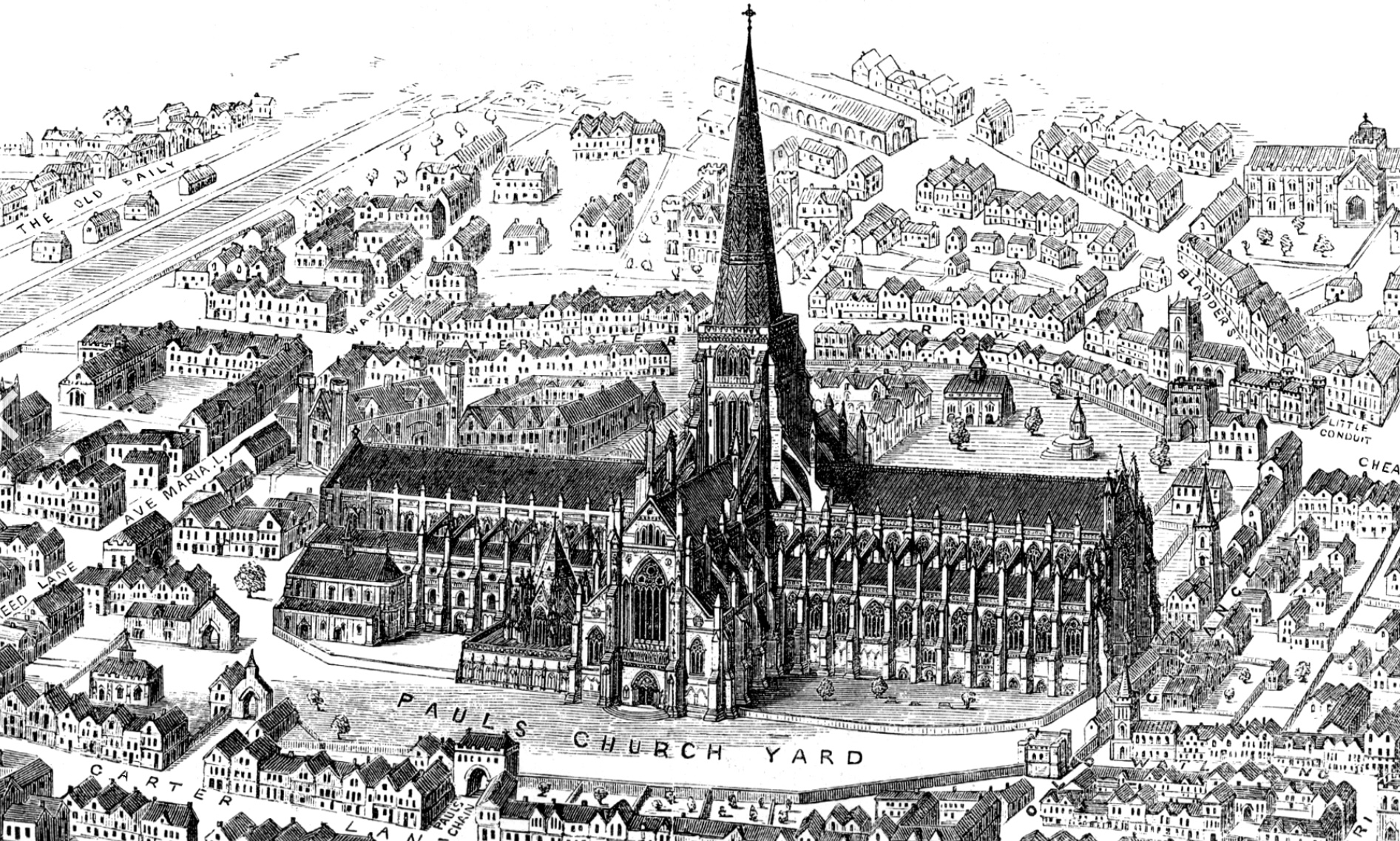
A State Lottery was recorded in 1569. The tickets were sold at St. Paul’s Cathedral in London, pictured c1560.
A poem written in Welsh c1920 about my 2 x great grandfather William Howe. Lines include: ‘He deserves all the praise he receives’. ‘A Christian in his warm home’. ‘William Howe is a godly saint for getting us all to pray again in the chapel with the children’. ‘We will enjoy a big feast at the Sunday School’. ‘We will sing his praises when we meet in heaven’.

My latest article for the Seaside News appears on page 36 of this month’s magazine.

I’ve traced the Bick branch of my family back to the fifteenth century. They settled in Badgeworth, Gloucestershire and lived there for hundreds of years. My branch of the family moved to London in the Victorian era, but you can still find Bicks in numerous numbers in Gloucestershire.

Unfortunately, the records for the Bicks of Badgeworth are not extensive, but I have uncovered a few nuggets of information that add details to my ancestors’ lives.

The surname Bick is of Dutch and German origin. It derives from the Middle Dutch and Middle High German word bicke meaning pickaxe or chisel. The name was associated with stonemasons and people who worked with pickaxes and chisels.

It’s likely that the Bicks arrived in Gloucestershire from the Netherlands or Germany in the early Middle Ages. My branch of the family feature in many land deeds during the sixteenth and seventeenth centuries. These deeds indicate that they farmed land as yeomen. However, they were never described as ‘gentlemen’, which suggests that there was no link with the gentry.

Bick sons married the daughters of the following families: Meek, Fawkes, Spring, Blush, Izod and Netherton. Evocative names. These families were also of the yeomen class. The name Fawkes suggests a link to the infamous Guy Fawkes. However, Guy was from York and it is unlikely that my ancestor, Jane Fawkes, was closely related to him.

From the land, my Bick ancestors became innkeepers, running coaching inns. George was a popular name over four successive generations. George ‘the second’ – 22 October 1668 to 3 June 1738 – was an innkeeper in Badgeworth. Some of the Bicks left wills, but they are difficult to read and those that are legible contain only basic details of modest inheritances for sons and daughters.

The Bick ancestor who captured my attention was Thomas Bick, born 1575 in Badgeworth. He died in 1623 of the ‘pest’, also known as the pestilence or plague. The plague is an infectious disease caused by the bacteria Yersinia pestis, which mainly infects rats and other rodents who become the prime reservoir for the bacteria.

Seventeenth century plague doctor with protective mask and clothing.

The Pestilence was a bubonic plague pandemic that occurred in Afro-Eurasia from 1346 to 1353. The plague created religious, social and economic upheavals with profound effects for the inhabitants of the time. It also drastically altered the course of European history.

Further waves of the plague swept over Europe throughout the fourteenth to seventeenth centuries. Certain years were more blighted than others, including 1623 the year that Thomas died. That bout of the pestilence lasted until 1640. It reoccurred again in 1644–54 and 1664–67. 

The 1664 to 1667 episode was the last major epidemic of the bubonic plague to occur in England. In 1665-66 it swept through London producing the ‘Great Plague of London’. Then, in September 1666, the ‘Great Fire of London’ destroyed the city. Some people speculated that the fire killed the pestilence, although records suggest that the disease was already on the wane. My London ancestors were caught up in the ‘Great Fire of London’, but more about them in future posts.

London 1665.

As we know to our cost, when we abuse nature and animals we create pandemics. Our ancestors did not have the scientific knowledge to appreciate this, but we do; there is no excuse.

Along with the pestilence, our ancestors died from a range of diseases and illnesses. Here is an example from 1632 with a few definitions.

Cut of the Stone – The surgical removal of a bladder stone

French Pox – Syphilis

Jawfaln – Locked jaw

Impostume – An abscess

King’s Evil – A tuberculous swelling of the lymph glands

Livergrown – Liver disease, possibly caused by alcoholism 

Murthered – Murdered

Planet – To be stricken with terror or affected adversely by the supposed influence of a planet

Purples – Purple blotches on the skin caused by broken blood vessels, indicative of an underlying illness, such as scurvy

Rising of the Lights – A condition of the larynx, trachea or lungs

Tissick – A cough

Tympany – Bloating

The saddest entry on this list, and the largest in number, is chrisomes and infants. Chrisomes refers to a baby less than a month old, which indicates that the start could often be the most dangerous period of a person’s life.

Stay safe. Wishing you well.

As ever, thank you for your interest and support.

Hannah xxx

For Authors

#1 for value with 565,000 readers, The Fussy Librarian has helped my books to reach #1 on 31 occasions.

A special offer from my publisher and the Fussy Librarian. https://authors.thefussylibrarian.com/?ref=goylake

Don’t forget to use the code goylake20 to claim your discount 🙂

Categories
Dear Reader

Dear Reader #120

Dear Reader,

My latest translation, Eve’s War: Operation Sherlock, in Spanish.

Through my gateway ancestor Barbara Aubrey (1637 – 1711) I am directly related to the Welsh nobility including The Lord Rhys, Yr Arglwydd Rhys, Prince of Wales. A ‘bit of a lad’ The Lord Rhys married twice, had eleven mistresses and fathered at least twenty-four children. A successful leader for over fifty years he was “a man of excellent wit and quick in repartee.”

My ancestor Rev William Aubrey (1573 – 1646) was the rector of Pendoylon parish church. William married Jane Mathews (1580 – 1650), whose line takes my ancestry back to Robert de Vere, the Third Earl of Oxford. Robert was a Surety Baron who witnessed the signing of Magna Carta.

Pedigree chart: Jeremy Crick.

My ancestor Humphrey Mathew (1567 – 1651) owned Castell-y-Mynach a late medieval mansion remodelled in the early seventeenth century and largely refenestrated in the late eighteenth-early nineteenth century. Humphrey married Mary Lewis.

This branch of my family leads to seven Magna Carta Surety Barons: Hugh le Bigod, Roger Bigod, Gilbert de Clare, Richard de Clare, John de Lacy, William de Mowbray and Saher de Quincy.

Looks like Magna Carta was our family gathering 🙂

Image: CBHC

The Iveson/Iverson branch of my family arrived in Britain with William the Conqueror in 1066 – the surname Iveson derives from Ives or Yves the French for yew or bow. Initially, they settled in the north of England, and Scotland. In Scotland they formed the Clan MacIver.

Born in 1586 in Edinburgh my ancestor Abraham Iveson migrated to Gloucester County, Virginia in 1636. He accompanied nineteen other settlers. 

On 17 October 1636 Abraham was listed as a headright for James Vanerit who had acquired 1,000 acres of land in Elizabeth City County, Virginia from a Mr Stafferton. Stafferton was owed the land for providing the transportation of the twenty colonists, including Abraham.

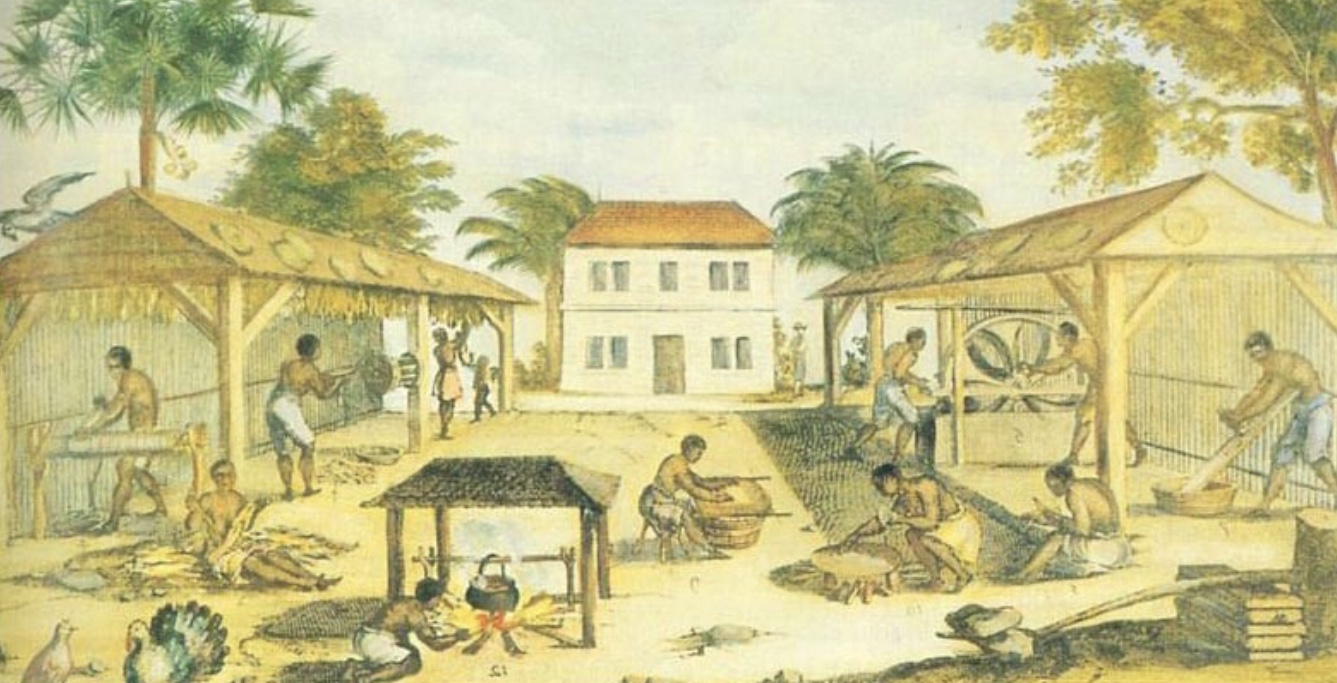
Dated 26 April 1637, a bill of landing listing Joseph Clifton, a London merchant, showed goods conveyed on the Tristan and Jane of London to ‘Abraham Iveson, planter’, and several others. The settlers were in need of home comforts and supplies, which arrived on the trade ships from Britain. In return, those ships carried the planters crops, including tobacco.

Tobacco advertisement, 18th century.

The planers in Virginia were cultivating hay, cotton, wheat, peanuts, barely, but mainly tobacco. Captain Francis Willis owned 3,000 acres of land, four others including Abraham owned 1,000 acres, and fifty-five others owned smaller parcels. 

A patent dated 10 June 1651 stated that Mr Abraham Iveson acquired 655 acres of land on the southwest side of the North River in Mobjack Bay, Gloucester County. As well as a landowner and planter Abraham was a member of the Virginia House of Burgesses, the elected lower house of the colonial Virginia General Assembly.

Abraham married twice, in Scotland Rebecca Gifford and later in Virginia (after Rebecca’s death), Joan Towson. He had six children: Hugh, Sarah, Richard, Lucy, Elizabeth and Abraham. He died in Virginia, in 1655.

After Abraham’s death, on 9 October 1677, his second wife Joan made a gift of an African slave girl to her grandson William, son of James Kay. William was to receive the slave girl when he came of age, and the children of this slave were to be bequeathed to James’ other children. Witnesses to this transaction were William Kay and Abraham’s son, also Abraham.

The slave trade triangle. Image: Wikipedia.

What to make of Abraham and his family?

At the beginning in the seventeenth century, many Scottish people emigrated to America, Australia, Canada, India, New Zealand and South Africa. These emigrants included freemen who left Scotland to promote trade or to set up military outposts and way stations for merchant ships. They also included people fleeing poverty and religious groups fleeing oppression. Abraham’s status in Virginia suggests that he was in the freeman category.

No surviving documents link Abraham to the tobacco trade, but given the size of his landholding and the fact that tobacco was the main crop cultivated in Virginia it seems fair to assume that he was involved in the tobacco trade. To make money from such a harmful drug is morally dubious, but maybe we can forgive Abraham in this instance because he was ‘of his time’.

Virginia tobacco slaves, 17th century.

You could also argue that his slave ownership was ‘of its time’, but I find that a flimsy argument. By ‘owning’ people and restricting their freedom he knew what he was doing. Maybe he was kind to his slaves – I hope so – nevertheless, he did own them. 

Of my ancestors, Abraham is not alone in owning slaves in America and the West Indies. I will write about these ancestors in due course. Most of the ancestors I write about fill me with pride and I would love to have met them. Even though I’m not sure that I would have liked Abraham, I would have enjoyed talking with him too, if only to hear the moral defence of his position.

As ever, thank you for your interest and support.

Hannah xxx

For Authors

#1 for value with 565,000 readers, The Fussy Librarian has helped my books to reach #1 on 31 occasions.

A special offer from my publisher and the Fussy Librarian. https://authors.thefussylibrarian.com/?ref=goylake

Don’t forget to use the code goylake20 to claim your discount 🙂

Categories
Dear Reader

Dear Reader #119

Dear Reader,

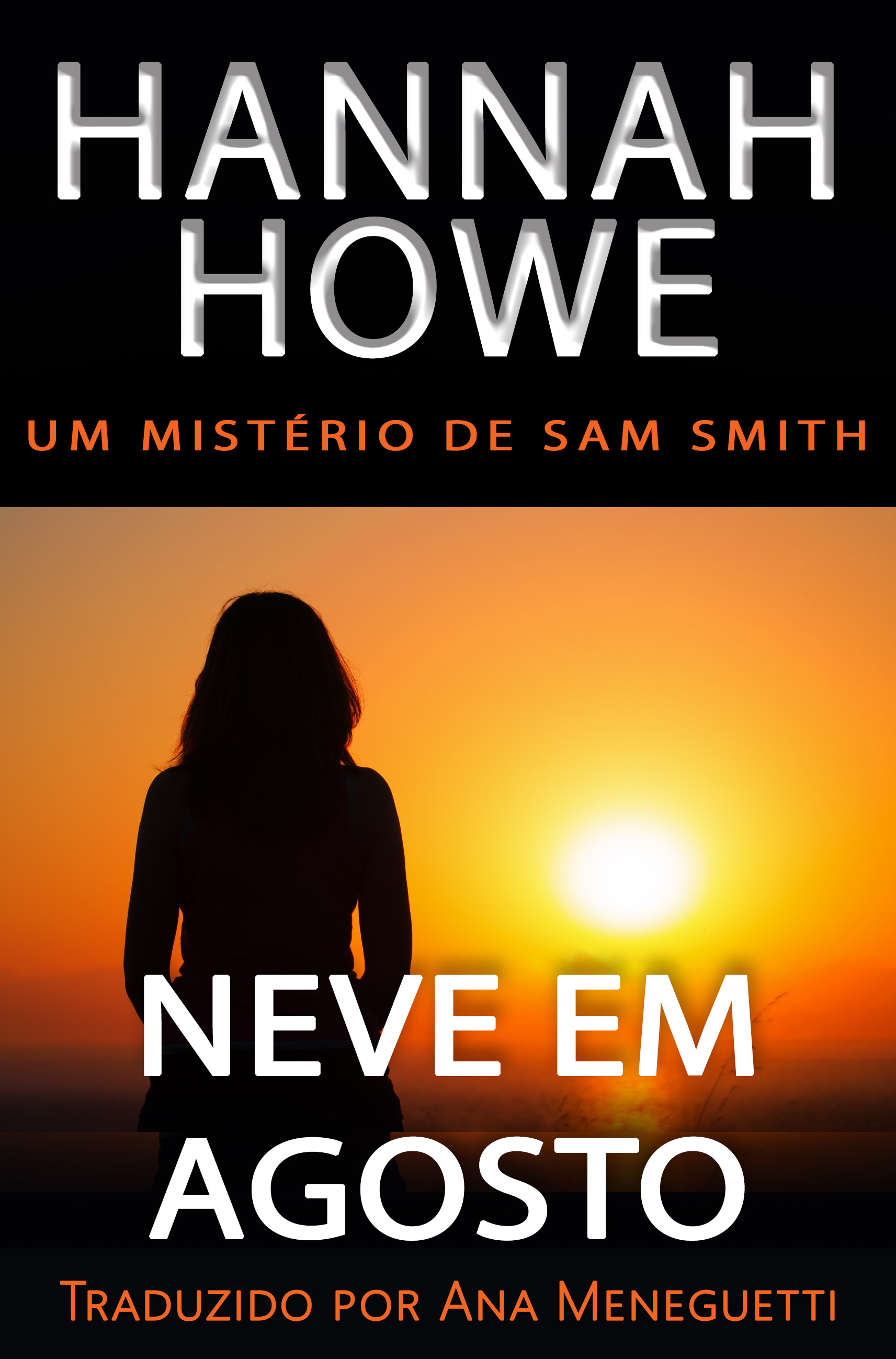
My latest translation, the Portuguese version of Snow in August, Sam Smith Mystery Series book sixteen.

Recently, I had the pleasure of interviewing author, playwright and journalist Tim Walker for Mom’s Favorite Reads. Meanwhile, Tim’s just published a new book, his thoughts on meeting stars of stage and screen. You can learn more about Tim’s book here https://www.amazon.co.uk/Star-Turns-Secrets-Screen-Legends/dp/1914489004/

Ancestry have updated my DNA result. I’m 65% Welsh. The other 35% is shared between Belgium, the Channel Islands, England, the Netherlands, Luxembourg, France, Switzerland, Germany, Ireland, Scotland, Faroe Islands, Iceland and Norway.

My main genetic communities are Wales, Pennsylvania, Eastern Ohio, Northern West Virginia and Maryland.

I have cousins in Australia, New Zealand, California, Oklahoma, Kansas, Texas, Wisconsin, Illinois, Michigan, New York, Ohio, Ontario, Toronto, Pennsylvania, West Virginia, New Jersey and North Carolina.

I’m sure I have relatives in other countries and territories that this DNA test doesn’t cover, but it’s fascinating to see where my ancestors came from and where they settled as emigrants.

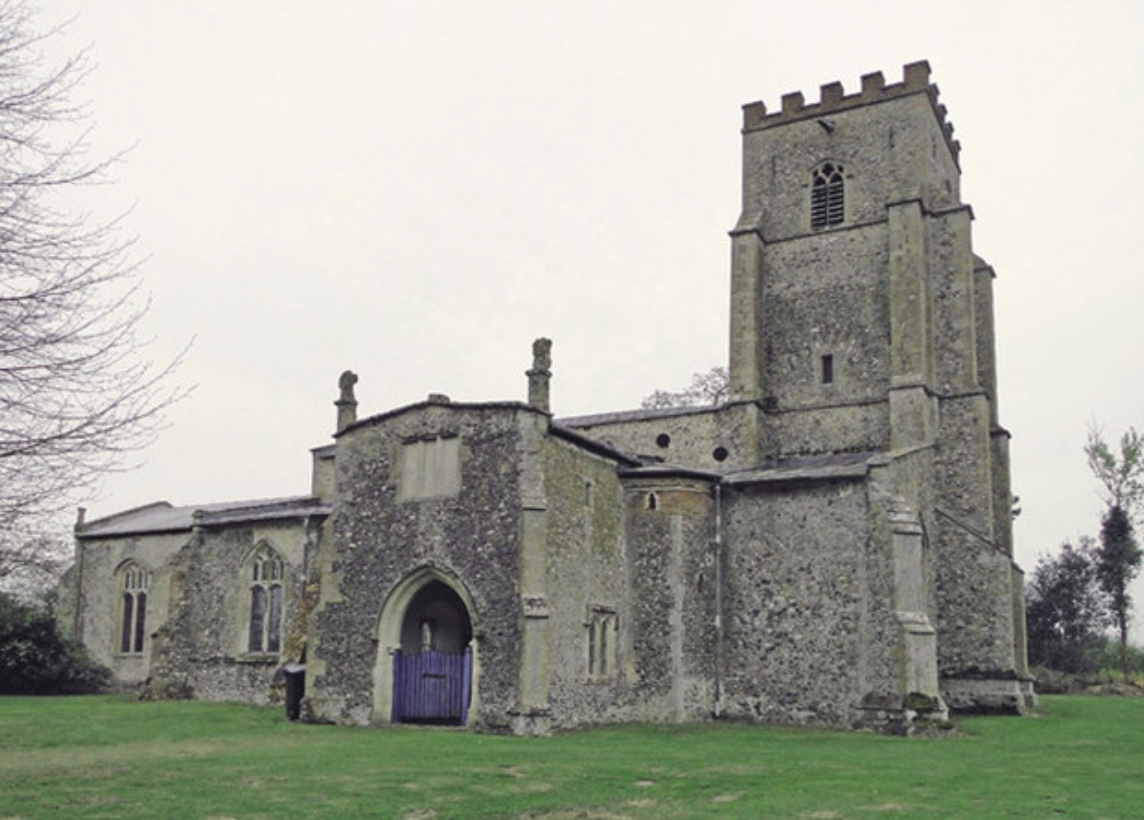
My ancestor Arthur Iveson was born on 16 June 1772 in Hawes, Yorkshire to Thomas Iveson and Margaret Taylor. Maybe due to complications from the birth Margaret died in October 1772 while Thomas died in 1788. As the youngest child, Arthur followed a tradition common amongst well-to-do families – he entered the Church.

St Margaret’s Church, Hawes. Credit: Wikipedia.

In 1793 the Bishop of Carlisle ordained Arthur as a deacon and a year later he became a priest in York. From York the Church sent Arthur to Nottinghamshire then to Norfolk where he established himself as Rector of East Bradenham.

In Norfolk, on 6 March 1797, Arthur married Martha English. Of course, as a rector Arthur could read and write, and he signed his name. Martha also signed her name, something not many women of the time could do, even women born into wealthy families.

Between 1798 and 1806 the couple produced six children: Ann, Thomas, born 18 March 1799, Arthur, Martha, Martha and Arthur. Martha #1 and Arthur #1 died in infancy.

Apart from the tragic infant deaths, everything was going well for Arthur. Between 1802 and 1817 he appeared on the Electoral Roll in Norfolk, which placed him in a privileged position, one of the elite in the country who could vote. In 1816 his son Thomas became a clerk to William James Murray in Kings Lynn and shortly after that he followed his father into the Church, becoming a vicar.

St Mary’s Church, East Bradenham. Credit: Wikipedia.

Arthur’s wife, Martha, died in 1828, and from that point events took a sinister turn.

At ten o’clock on the evening of 28 May 1832 Thomas entered Arthur’s rooms to talk with his father. The talk developed into an argument and Thomas produced a gun. He fired one shot, which entered Arthur’s heart.

With his father dying, Thomas ran next door to summon Captain Lake. He informed the captain of the shooting and Lake hastened to Arthur’s aid. The captain summoned two medical men, Mr Murlin, a surgeon, and Dr Tweedale, and they tended to Arthur, alas in vain, for he died within twenty minutes of the shooting.

The moment Arthur died, Thomas entered the kitchen and took a considerable amount of laudanum, which Mr Murlin promptly forced from his body. The Officers of Justice arrived and Thomas surrendered to them.

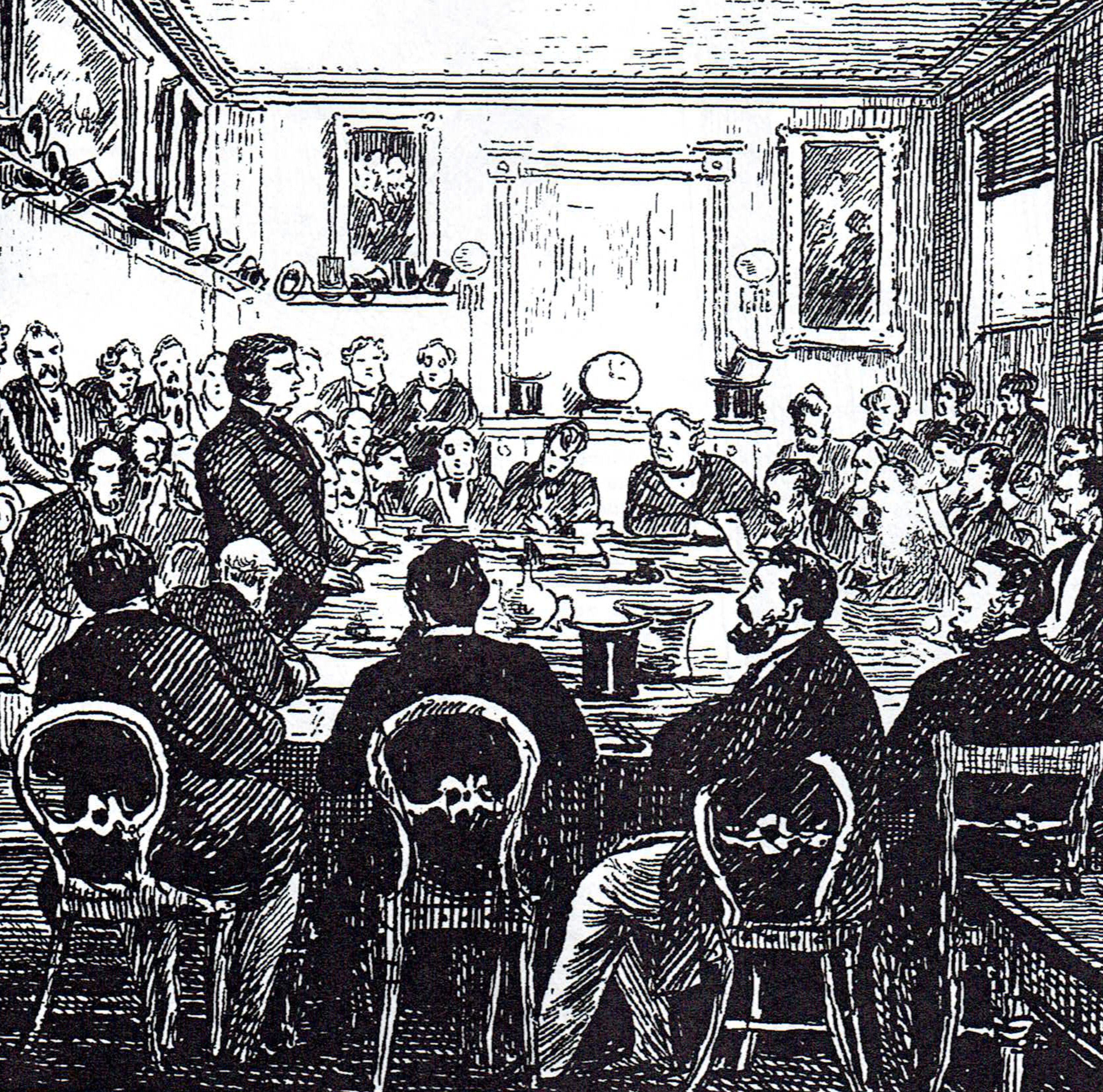
In July 1832 an inquest into the death of Arthur Iveson was held in a local public house, followed by a trial at the Quarter Sessions. During the inquest and trial it emerged that Thomas was ‘intelligent’ and a ‘gentleman’, although his behaviour of late had been eccentric.

The trial established that Thomas entered Arthur’s rooms with intent to shoot his father and that the bullet fired from his gun killed him. However, the jury acquitted Thomas on the grounds of insanity.

After the trial, Thomas entered a local infirmary and died there on 15 February 1836.

A Victorian Inquest

There is a postscript to this remarkable story. On 4 January 1848 in Hawes, Yorkshire, two cousins, John and Arthur Iveson, cousins of Arthur of Norfolk’s offspring, went drinking in a local pub, The Fountain Inn. They got drunk, argued, and engaged in a brawl. The brawl resulted in the death of Arthur Iveson.

The trail that followed delivered a verdict of manslaughter and John was sentenced to two months hard labour. After his prison sentence John resumed his role of local butcher. Twenty-two at the time of the manslaughter, he later married, raised a family and enjoyed a long life.

What to make of the Ivesons? Are they a violent branch of my family? I’m in touch with four first cousins, Iverson sisters, and no one would regard them as violent. Indeed, the opposite is true. It would appear that Thomas killed Arthur when in a troubled state of mind while John killed his cousin Arthur due to excessive alcohol consumption. 

History repeats, so they say, but when it comes to family members killing each other maybe it’s better if it doesn’t. 

To all current and future Ivesons, pax vobiscum – peace be with you.

As ever, thank you for your interest and support.

Hannah xxx

For Authors

#1 for value with 565,000 readers, The Fussy Librarian has helped my books to reach #1 on 31 occasions.

A special offer from my publisher and the Fussy Librarian. https://authors.thefussylibrarian.com/?ref=goylake

Don’t forget to use the code goylake20 to claim your discount 🙂

Categories
Dear Reader

Dear Reader #118

Dear Reader,

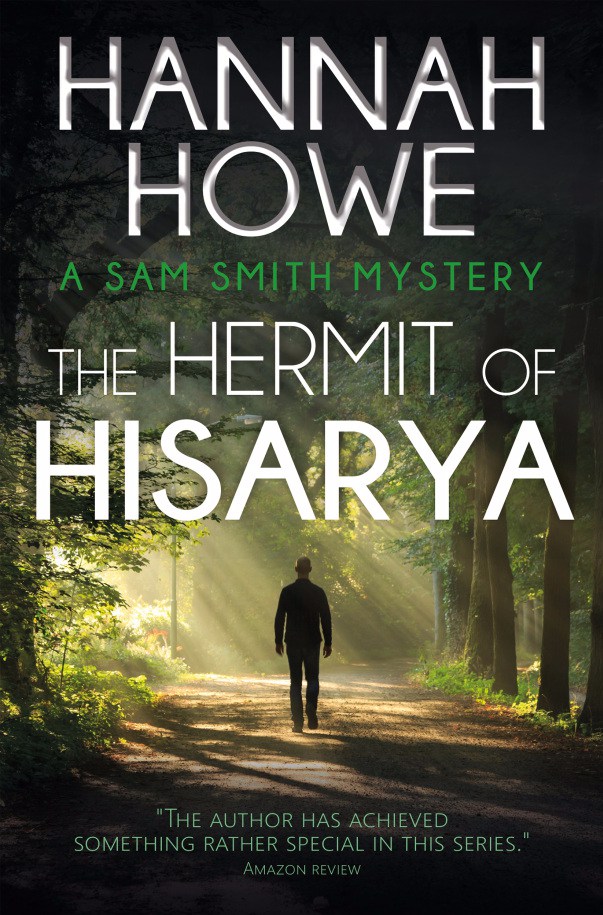
My Sam Smith mystery The Hermit of Hisarya has been included in academic lectures this week in Bulgaria, discussing cultural studies and world literature, and the interrelation between cultural identity and the imagination. What an honour, I’m blown away 😱

https://academia.edu/51152850/

My latest translation, The Hermit of Hisarya in Portuguese.

My article about my ancestor John Howe features in this month’s Seaside News.

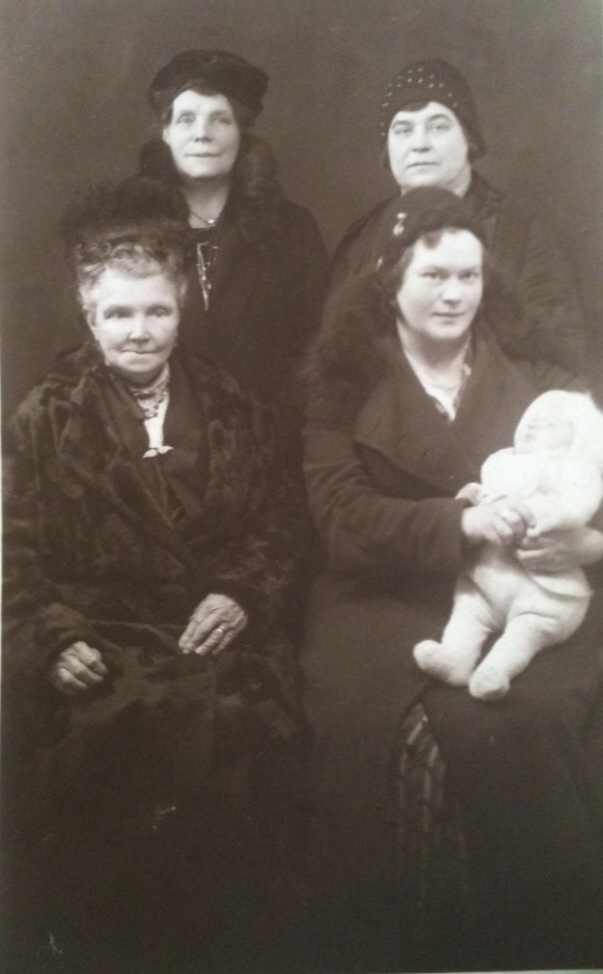
c1926, five generations from the Iveson branch of my family. More about the Ivesons next week.

My 5 x great grandmother Jennet, aka Jane, Williams was born to David Williams and Mary Jones in 1787 in Newton-Nottage, Wales. In the eighteenth century Newton-Nottage was a rural community and the majority of its inhabitants earned a living from the land.

Nottage, 19th century tithe map. Source: The National Library of Wales.

Jennet married Thomas Morgan in nearby Laleston on 10 October 1815. The couple produced five children: William, Richard, Mary, Sarah and a second child called Richard. Sadly, infant mortality was common in the nineteenth century and parents often reused a favourite name.

Jennet and Thomas’ eldest son, William, was born in 1812, three years before their marriage. Their first Richard was baptised on 21 January 1816, which indicates that Jennet was six months pregnant with her second child at the time of her marriage.

The accepted wisdom is that bastard children and their mothers were cast out by Victorian society. For the middle and upper classes this might well have been true. However, for the lower classes and those living in rural communities the locals took a more pragmatic view. Producing babies, in and out of wedlock, was literally a fact of life. An example from my family tree: my 3 x great grandparents William Bick and Fanny Brereton had six children before their marriage on 13 December 1868 (they had five more children after their marriage). Obviously, they did not feel pressurised into marriage and were not ostracised by their community. Marriages were expensive and many people needed the money for food and shelter. That said, some women were embarrassed about admitting to an illegitimate child as we shall see shortly.

Jennet’s husband, Thomas Morgan, was a shoemaker while his father, Richard, was a victualer in Laleston. When Thomas Morgan was born in 1784 only seven children were baptised in Laleston (population 2011, 12,586), which indicates that it was a small community, and that a birth, marriage or death was a major event.

Laleston baptisms, 1784.

Thomas Morgan died on 28 December 1827. A widow, Jennet supported herself and her family by working as a stone cutter at the local limestone quarries. Women who worked with stone, iron or coal usually wore shorter dresses compared to the Victorian norm because of the danger of those dresses catching fire. ‘Shorter’ in this instance means just a few inches above the ankle, so they were hardly a huge advertisement for health and safety.

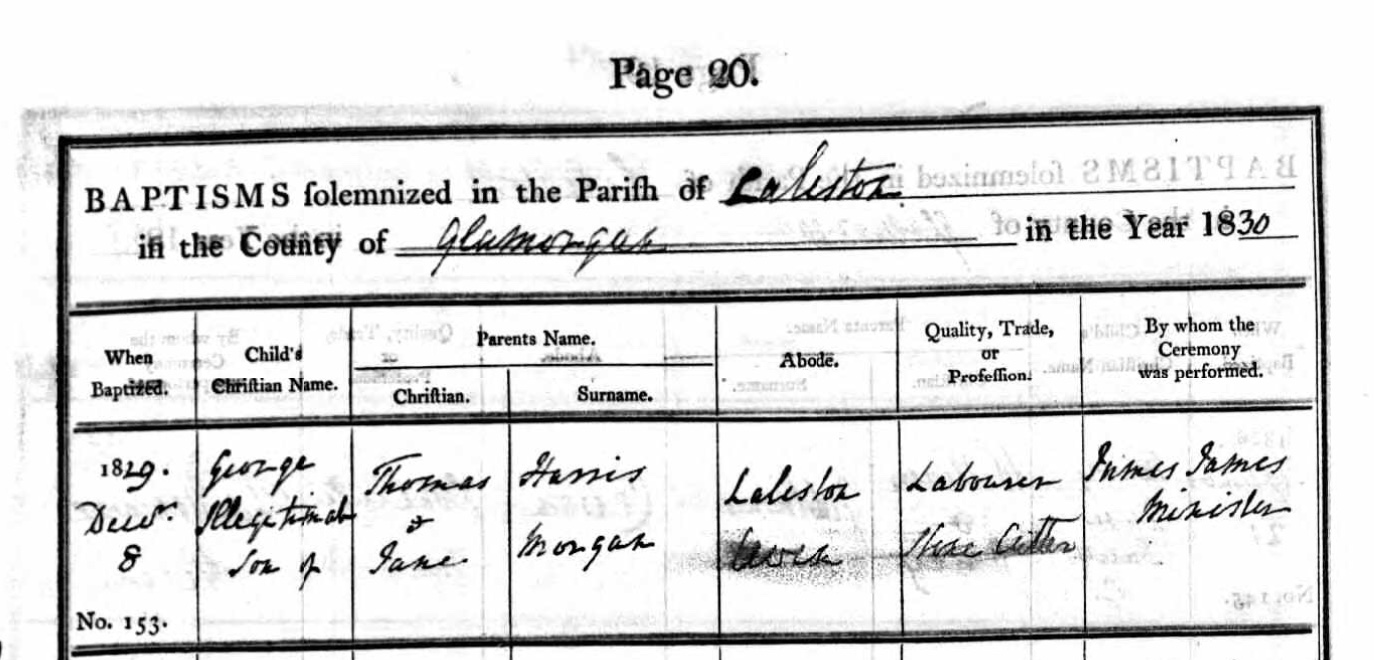
In 1829 Jennet met Thomas Harris and the couple produced a son, George, baptised on 8 December 1829. In the ten years before 1829 and the ten years after there was no one called Harris living in Laleston or surrounding villages. A family called Harris arrived in the 1840s, but they were not related to Thomas or George.

George’s baptismal record.

So, what of the mysterious Thomas Harris? It would appear that he drifted into Laleston looking for work, took advantage of Jennet, a lonely widow, then drifted out again. There is nothing to suggest that he acknowledged George as his son or supported him during his childhood.

Between 1829 and 1851 George was know as George Morgan and George Harris. In 1841 Jennet told the census enumerator that George’s surname was Morgan, even though her husband had died two years previously. Clearly, with this untruth she was trying to save face.

On 24 December 1853 George, now a blacksmith, married Lydia Williams and the couple took the surname Morgan. Indeed, George acknowledged Thomas Morgan as his father. Did he know the truth? Probably, because at various times before his marriage he did call himself Harris. Thomas Harris played no part in George’s life, so George decided to adopt his mother’s married name.

Lydia was a ‘minor’ at the time of her marriage to George and the couple were living at the same address. A ‘minor’ in this context means someone under the age of twenty-one; Lydia was twenty. During her marriage to George she gave birth to ten children.

On 9 April 1873 at the age of 86 Jennet died in Laleston. In her later years she lived with her daughter, and my direct ancestor, Mary, along with Mary’s husband and children. All of my Welsh ancestors during the Victorian era were tight-knit and supported each other. To date, I have not discovered any of them in the workhouse.

As ever, thank you for your interest and support.

Hannah xxx

For Authors

#1 for value with 565,000 readers, The Fussy Librarian has helped my books to reach #1 on 31 occasions.

A special offer from my publisher and the Fussy Librarian. https://authors.thefussylibrarian.com/?ref=goylake

Don’t forget to use the code goylake20 to claim your discount 🙂

Categories
Dear Reader

Dear Reader #117

Dear Reader,

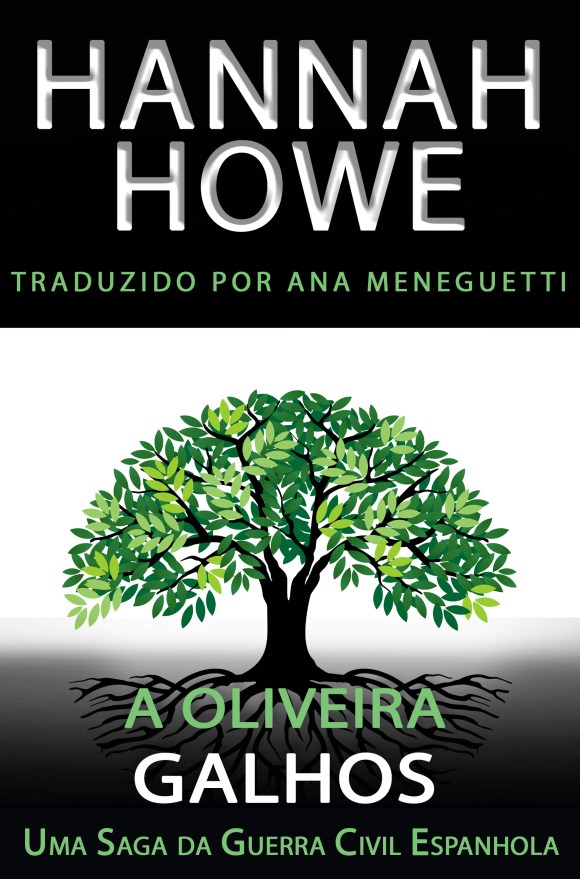
My latest translations, The Olive Tree: Leaves, Sins of the Father, Smoke and Mirrors, and Mind Games, all in Portuguese.

Just discovered that my 7 x great grandfather Thomas Hopkin lived to be 96 (1730 – 1826). He lived in Hutchens Point, Nottage, Glamorgan. On 29 May 1762 he married Catherine Rees from St Athan.

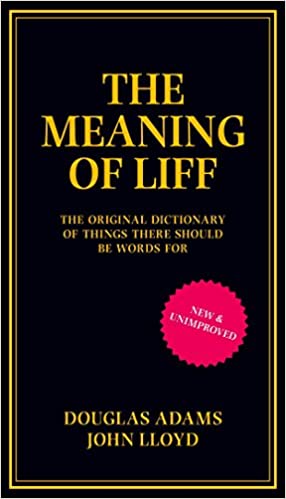
In the 1980s, Douglas Adams wrote a book, The Meaning of Liff, in which he applied humorous definitions to place names. He included Nottage: items you store in your shed for years, decide to throw out, only to realise that you need them a week later.

From 1918, ’Marriage Advice to Young Ladies’ from a ‘Suffragette Wife’.

Original pamphlet: Pontypridd Museum, Wales.

In this month’s issue of Mom’s Favorite Reads…

An exclusive interview with author, playwright and journalist Tim Walker featuring his meetings with a range of movie stars

Short Stories

Poetry

New Releases 

Travel

Activities 

Author Resources 

And so much more!

Around twelve years ago this was the first branch of my family tree that I explored in detail.

My 3 x great grandfather Thomas Jones was born to Thomas Jones, a coal miner, and Mary Morgan on 16 July 1843 in Laleston, Glamorgan. Thomas and Mary were not married at the time. This is a common discovery I have made for many of my Victorian ancestors and I will elaborate further in a future post.

Thomas’ wife and my 3 x great grandmother Hannah Morgan (the names Hannah, Morgan and Jones reoccur a lot in my family; indeed, four of the first sixteen branches start with a Jones) was born on 30 July 1848 to Richard Morgan, an ostler, and Margaret Jones in Tythegston, a small village near Laleston. You can read Richard and Margaret’s story here https://hannah-howe.com/ancestry/ancestry-13/

In 1851 Thomas was living with his parents in Laleston along with his three year old sister Ann and his grandmother, Jennet Morgan. Jennet was a widow at this time. Meanwhile, Hannah was living in Tythegston with her patents, four siblings, three lodgers and her grandmother, Mary.

Bridgend, 18 June 1850, a picture commemorating the opening of the railway station.

Ten years later Thomas was employed as a servant at Broadland House, Laleston. The owner of Broadland House, at the time, was Charles Drummond, a Londoner, an ‘esquire’, who later moved to Somerset. Drummond died in Somerset in 1888 leaving £2,500 11 shillings in his will.

Broadland House was set in 70 acres of land and the farm employed five servants, including Thomas, who worked as a ‘cow boy’. Mention of cow boys conjures up images of the Wild West. However, Thomas’ work was more prosaic, milking and feeding the animals. Twelve years old, Hannah was still at school and it’s likely that the couple had yet to meet.

That changed a few years later and on 22 February 1868 Thomas and Hannah found themselves walking down the aisle in Ruhama Baptist Chapel, Bridgend. There is a large church in Laleston so presumably Hannah chose the venue.

A child soon followed, my direct ancestor, Thomas. At the time of Thomas’ birth the landscape around Laleston was changing dramatically with the arrival of the railways and the development of coal mines. Thomas left the land to work in a coal mine and this ushered in a period of transience for the family as they moved from village to village seeking employment.

In 1881 the family found themselves in Llandyfodwg near Bridgend. Now with five children, Thomas and Hannah lived in Cardigan Terrace. The street name is revealing and indicates that it was established when a number of families settled in Llandyfodwg to work on the land and in the local coal mines. These families originated from west Wales. They were joined by families from the West Country of England. 

The west Walians and the locals spoke Welsh while the people from the West Country spoke English. Over time, a period of twenty years, many Welsh speakers became bilingual. However, few of the English people learned Welsh.

No pictures of Thomas Jones or Hannah Morgan exist, but this is their son, Richard Morgan Jones.

Each change of address for Thomas and Hannah represented a move of only a few miles. The baptismal records of their children allow us to chart their movements: Laleston, Newcastle, Llangeinor and Llandyfodwg, all within a five mile radius of Bridgend. 

Within this transience records were lost and Hannah disappeared from history. A death record dated 1881 pointed to Hannah. However, when examined in detail it revealed a different Hannah Jones (her married name, of course). My Hannah’s death was not recorded, or more likely it was lost.

Hannah definitely died before 1891 because at that time Thomas was a widow. He’d moved to Llantrisant, the home town of Hannah’s grandparents. Maybe he moved there to be closer to his extended family.

In 1891 Thomas was still working in the coal mines. His working life  represented stark contrasts: the early years spent in the open air, the latter years spent working in the dark. Both occupations offer a certain romanticism: the pastoral beauty of the countryside, the camaraderie of men working in life-threatening conditions, their existence reliant upon each other.

In 1891 Thomas and his three children, Thomas, Richard and Margaret, lived in Dinas, Llantrisant. Like their father, Thomas Jr and Richard were coal miners while fifteen year old Margaret was their housekeeper. Margaret’s childhood effectively came to an end when her mother died as she assumed the role of ‘woman of the house.’

Thomas’ street contained thirty people. All the men were coal miners. Twenty-three of those people spoke Welsh, six spoke English and only one was bilingual. 

After 1891, like Hannah, Thomas disappeared from the historical record. It’s probable that he died in May 1898.

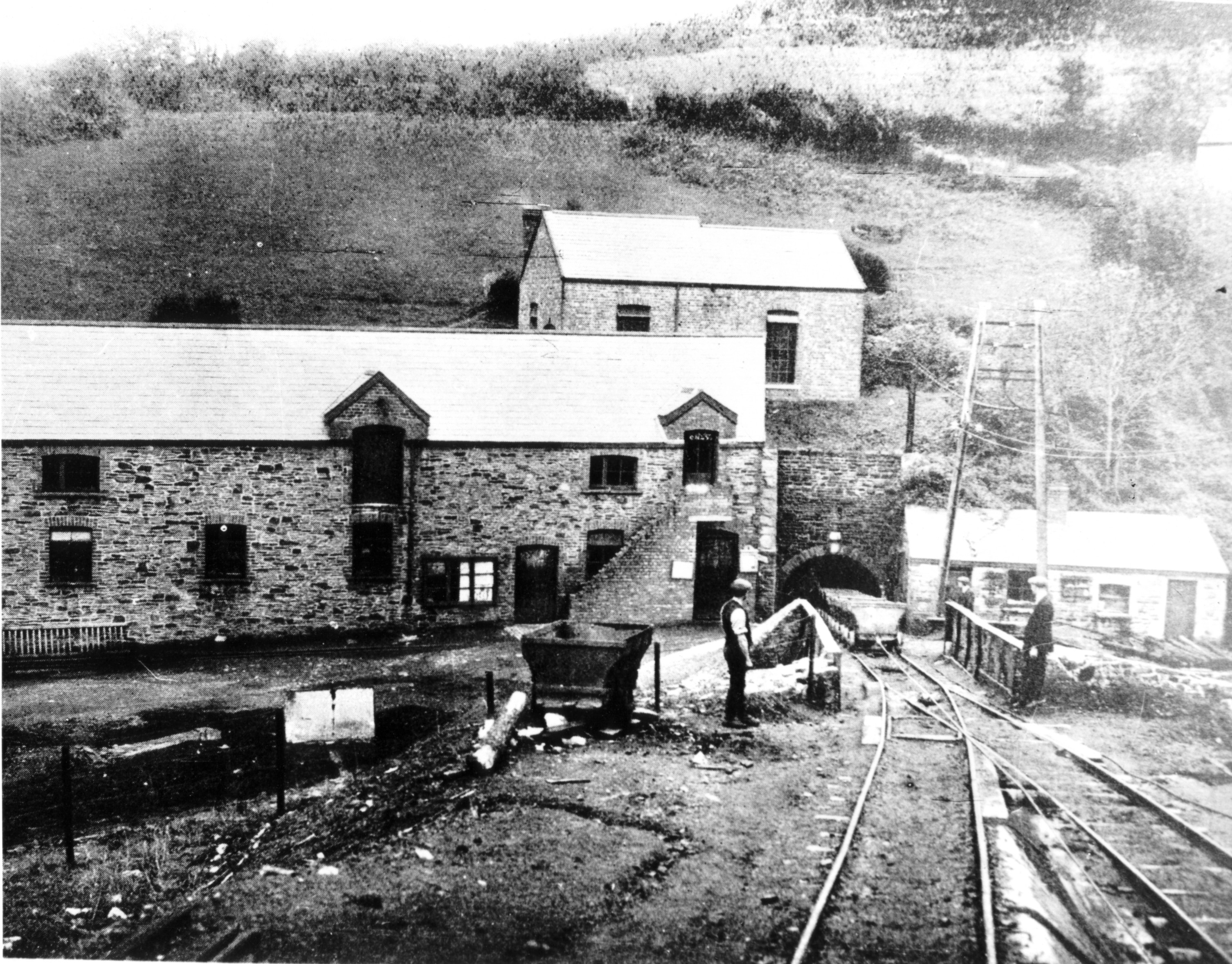
Bridgend coalfield: Bryndu Colliery.

While at work Thomas diced with death, every day. At random I have selected ten Joneses who worked alongside Thomas in the local coal mines. The brief notes that follow record their fate.

Thomas Jones, aged 22: killed by falling from a byat while moving a stage in the shaft.

Evan Jones, aged 14: killed by a full train passing over him.

William Jones, aged 38: killed when the mineshaft roof fell.

William Jones, aged 37: killed by a fall of coal.

William Jones, aged 16: killed by a fall of coal.

Richard Jones, aged 34: killed when the side of the pit gave way.

David Jones, aged 45: killed when the mine roof collapsed.

Thomas Jones, aged 48: killed by an explosion of firedamp, one of two people killed.

David Jones, aged 26: killed by a gas explosion, one of eleven people killed.

Lewis Jones, aged 12: run over by trams through breakage of coupling chains.

Bridgend coalfield: Aberbaiden Colliery showing the entrance to the slip.

Did my Thomas die in a mining accident? It’s possible, but there is no record. More likely he died from the illnesses associated with working in the coal mines, particularly ‘the dust’, aka emphysema, a cruel illness that smoothers the sufferer. 

Ancestors like my 3 x great grandfather Thomas worked and died so that Victorian society could prosper and a few select men could become obscenely rich. It’s a lesson from history we have yet to learn. Today, rich men pollute the planet and massage their egos by jetting into space. Meanwhile, many of their workers live and die in poverty. We must hope for a wiser generation, our children’s generation, that will look into the past, learn the lessons, and create a better future for us all.

As ever, thank you for your interest and support.

Hannah xxx

For Authors

#1 for value with 565,000 readers, The Fussy Librarian has helped my books to reach #1 on 31 occasions.

A special offer from my publisher and the Fussy Librarian. https://authors.thefussylibrarian.com/?ref=goylake

Don’t forget to use the code goylake20 to claim your discount 🙂