Categories
Dear Reader

Dear Reader #136

Dear Reader,

Preparing a new series, Women at War, three novels set in France in 1944. Research ongoing, writing will start later this year.
My direct ancestors Robert Gadsden and William Gadsden were grocers.

Robert was born on 30 November 1714 in Hanslope, Buckinghamshire. On 18 October 1743 he married Elizabeth Richardson in Newport Pagnell, Buckinghamshire, but the marriage did not produce any children. Elizabeth died young and, on 18 July 1755 in Newport Pagnell, Robert married for a second time. His new bride was another Elizabeth, Elizabeth Crips, a widow. This marriage produced seven children, including their first born, my direct ancestor William.

Grocery stores in the 1700s sold a wide variety of items including sugar, tobacco, spices, coffee, tea, rice, chocolate and dried fruit. They featured local produce and items like those listed above from abroad. Earlier and later generations of Gadsdens were traders who travelled far and wide, to America and Africa, for example. Its tempting to think that Robert and William developed their stores from these overseas connections. However, instead of travelling they focused on selling their goods from their local stores.

Robert died on 21 July 1768 in Newport Pagnell. William was only twelve and so too young to take over the family business. Instead, he had to learn the trade as an apprentice. He commenced his apprenticeship on 13 March 1772 in Newport Pagnell.
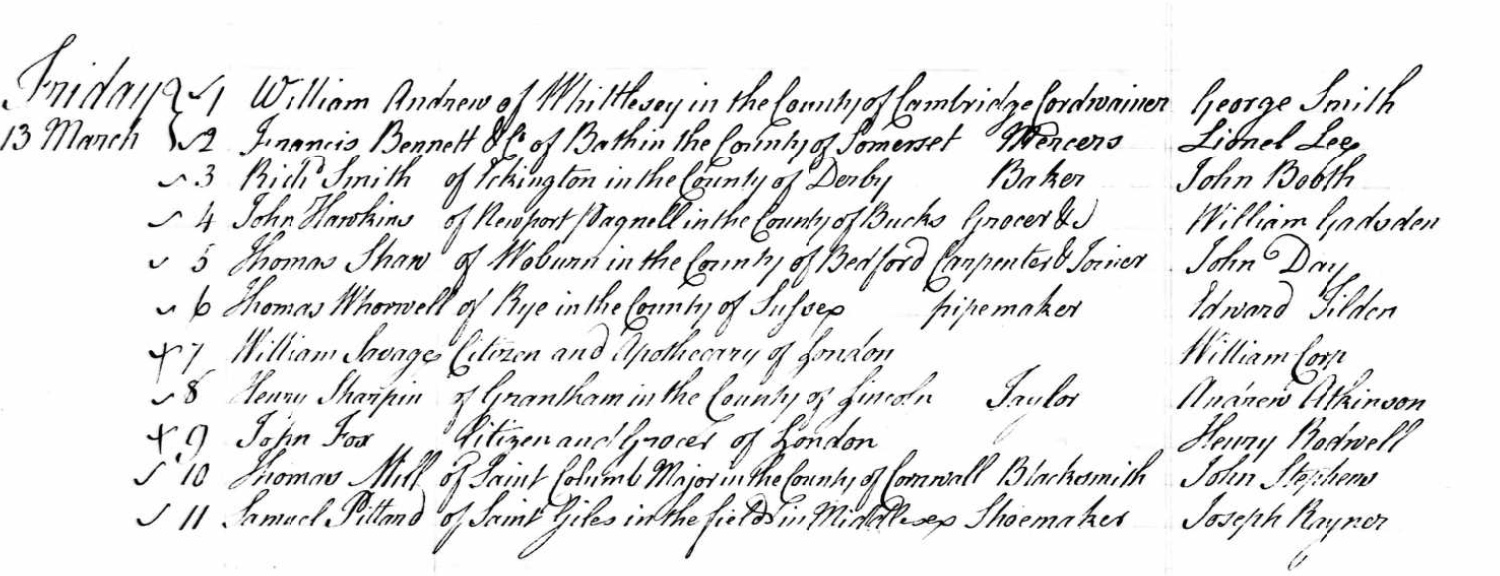
William’s apprenticeship

William was born on 3 August 1756 in Newport Pagnell and baptised five days later. After his apprenticeship he married twenty-year-old Elizabeth Chibnall, also in Newport Pagnell. The couple produced nine children, including my direct ancestor William and the baby of the family, Robert. Both were to feature in trials at the Old Bailey.

It would appear that William, born 1756, ran a steady business as a grocer. Maybe on account of the land tax introduced in 1798 he moved his family and business to London. He settled in Shoreditch and died there on 14 July 1819, a death that triggered a tragic chain of events.

On 17 February 1820 twenty-two-year-old Robert Gadsden was indicted for feloniously breaking and entering the dwelling-house of John West, Esq. This incident occurred at one o’clock in the afternoon, on 29 January 1820 at St. Marylebone. John West’s wife, Harriet, was present when Robert allegedly stole a shawl, value twenty shillings, the goods of Sarah Griffiths.

Sarah Griffiths gave evidence: “I am servant to Mr. John West who lives in Baker Street, Portman Square, St. Marylebone. On the 29th of January, about one o’clock, I was in the house; Mrs. West, and five of the servants were at home. My shawl laid on a table in the housekeeper’s room, opposite the window which looks into the area – it was about a quarter of a yard from the window – the sash was down; nobody was in the room. I was upstairs, heard an alarm, came down, missed it, and found the prisoner in custody.”

William Ledger gave evidence: “I am servant to Mr. West. I had been out to fetch some water, and as I returned I saw the prisoner down the area – he was a stranger. I watched him, saw him lay a bundle of wood on the ledge of the window, lift up the sash, and with a stick that had a hook to it, he drew out the shawl off the table, put it under his jacket, and walked on into the passage of the house. I ran downstairs, secured him in the passage, and saw him throw the shawl down.”

Finally, Richard Coates gave evidence: “I am a constable. I was sent for, and took the prisoner at Mr. West’s, with the shawl.”

The shawl was produced in court and sworn to. Then Robert spoke in his defence: “I went to see if they wanted any wood; the shawl laid on the window-ledge, and I carried it into the passage. He took me, and it fell from my hand.”

Verdict: Guilty.

Sentence: Death.

The shock deeply upset Robert’s mother, Elizabeth, and she died less than a week later, on 23 February 1820.
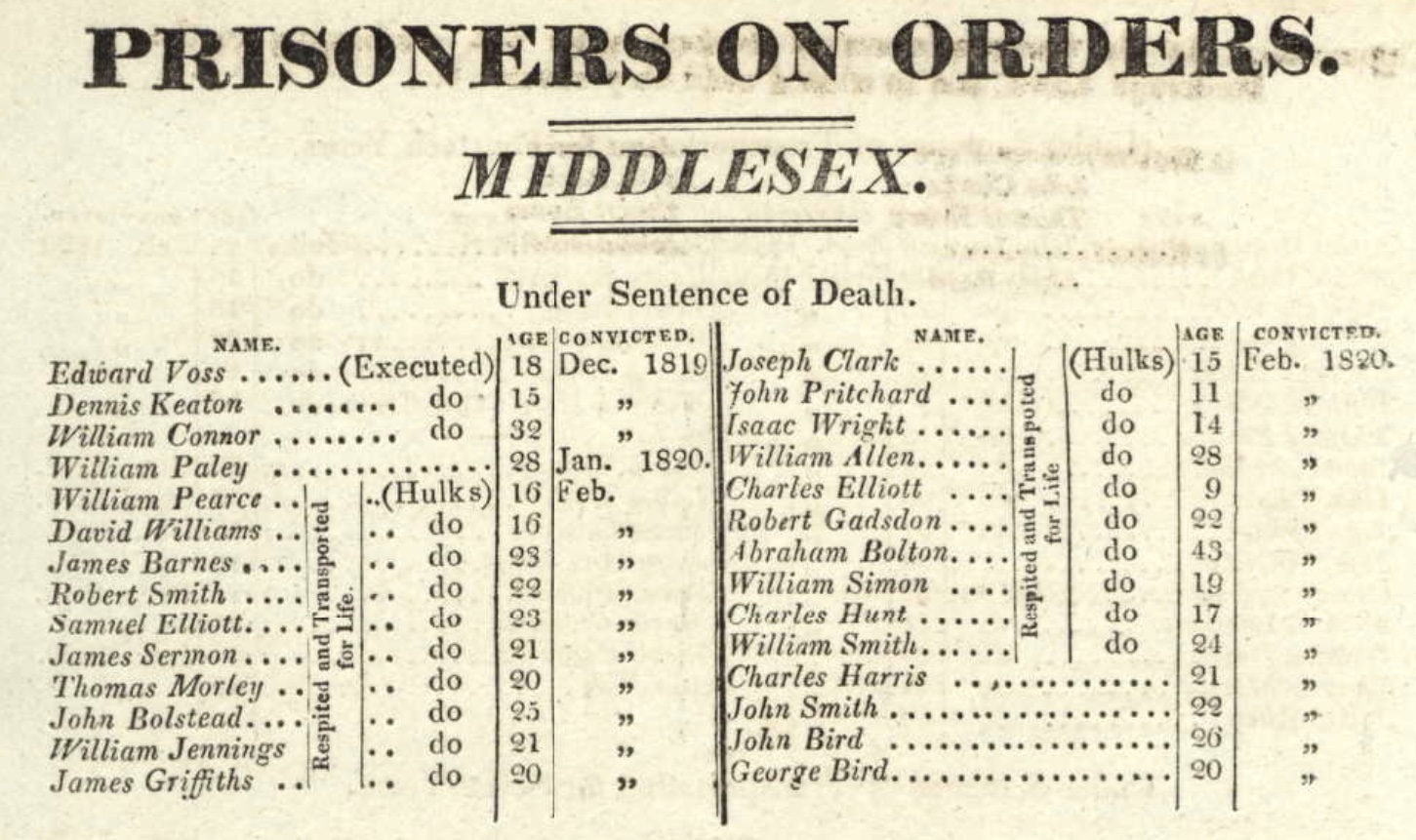
Robert condemned. Look at the ages of those sentenced to hang for petty crimes.

Sentenced to hang, Robert appealed. On 11 April 1820 he found himself on the prison hulk Bellerophon moored at Woolwich. With his appeal successful, he was transferred to the Caledonia, which set sail in July 1820 for Hobart Town, Van Diemen’s Land.

Initially transported for life, Robert gained a full pardon on 13 July 1840. However, before that the authorities granted him parole. On 1 April 1829 in Hobart, Robert married Elizabeth Lewis. A daughter, Elizabeth, arrived a year later. Sadly, she died before her fourth birthday.

Van Diemen’s Land 1828

After his pardon, Robert remained in Hobart. He died there in 1870. While he was in Australia, maybe Robert corresponded with his brother, William. If he did, maybe William reflected on his appearance at the Old Bailey. However, before exploring that case, some details about William.

William Gadsden was born on 10 December 1790. On 14 May 1810 he married Maria Beadle at Saint Matthew, Bethnal Green, London. The couple produced five children including my direct ancestor Sarah.

William broke the link with the grocery trade and made a living as a willow cutter, a silk weaver and latterly as a stone mason. His appearance at the Old Bailey occurred on 15 January 1817 as a witness.

The trial featured James Taylor, 17, and John Blake, 18. They were accused of stealing one pair of boots, value one shilling.

John Burton, owner of the boots, stated: “I live at Hackney. On the 17th of December, between two and four o’clock in the afternoon, I lost the boots from my tool-house, adjoining my dwelling-house; my yard door was on the latch, and so was the tool-house door; I missed the boots after four o’clock. I went next day to inquire if any jack-ass boys had been seen about, and found that the prisoners had been our way, selling catsup. I went to town, and found the two prisoners at the Bull’s Head, Kingsland’s Road; they were taken into custody.”
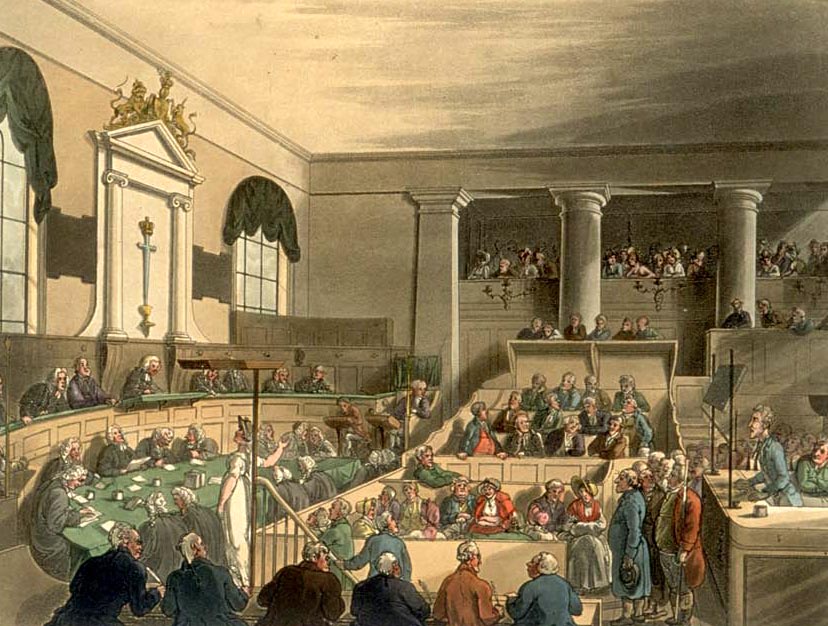
The Old Bailey, early nineteenth century

James Ingram gave evidence: “I am a smith; I was at the Bull’s Head, in Kingsland Road; about half-past five o’clock in the afternoon, the prisoner, Taylor, came into the house with a pair of boots, he asked me if I knew anybody that would buy them; I told him I would go and see; I took them out of his hand, and went to Saunders’ Gardens, which is close to the house, and offered them to Gadsden for twelve shillings. He offered me ten shillings for them; I went to Taylor, and he said I might let him have them – I did, and gave the money to Taylor, and he gave me a shilling for my trouble; he told me if Blake should come in, and ask what I sold them for, to say six shillings. In about a quarter of an hour Blake came in, and said, if he had been there at the time they should not have been sold for that money. I was quartered at the Bull’s Head.”

William Gadsden said: “I gave ten shillings for the boots. I gave them up to Armstrong.”

John Armstrong: “On the 17th of December, Mr. Burton applied to me. I and my son, accompanied him to the Bull’s Head, in Kingsland Road, and found Ingram and Blake sitting there together, we took them. I left Ingram in Burton’s care, and took Taylor, who was there. I took Ingram to Gadsden’s house, and he gave me the boots; we took the three to the office, and I heard both Taylor and Blake say, it was the first thing they had ever done, and that it was through distress.”

Joshua Armstrong: “I was with my father, and took the prisoners; they said it was the first robbery they had ever committed.”

Verdict: both Blake and Taylor guilty.

Sentence: Transportation for seven years.

I wonder if William and Robert ever reflected on their experiences at the Old Bailey and the fateful day in January 1820 when Robert stole a shawl and set in motion a chain of events which meant that they would never see each other again.

As ever, thank you for your interest and support.

Hannah xxx

For Authors

#1 for value with 565,000 readers, The Fussy Librarian has helped my books to reach #1 on 32 occasions.

A special offer from my publisher and the Fussy Librarian. https://authors.thefussylibrarian.com/?ref=goylake

Don’t forget to use the code goylake20 to claim your discount 🙂

Categories
Dear Reader

Dear Reader #132

Dear Reader,

This week, Sam’s Song received its 800th review. I can still recall my sense of wonder at reading the first review. Someone actually liked the book and gave it five stars 😱 Sam’s Song was supposed to be a one-off. Nineteen books later…

My direct ancestor, Philippa of Hainault 24 June 1310 – 15 August 1369, Queen of England, wife and political advisor of Edward III. More importantly she was popular because of her compassion. This is an ancestor I can definitely relate to.

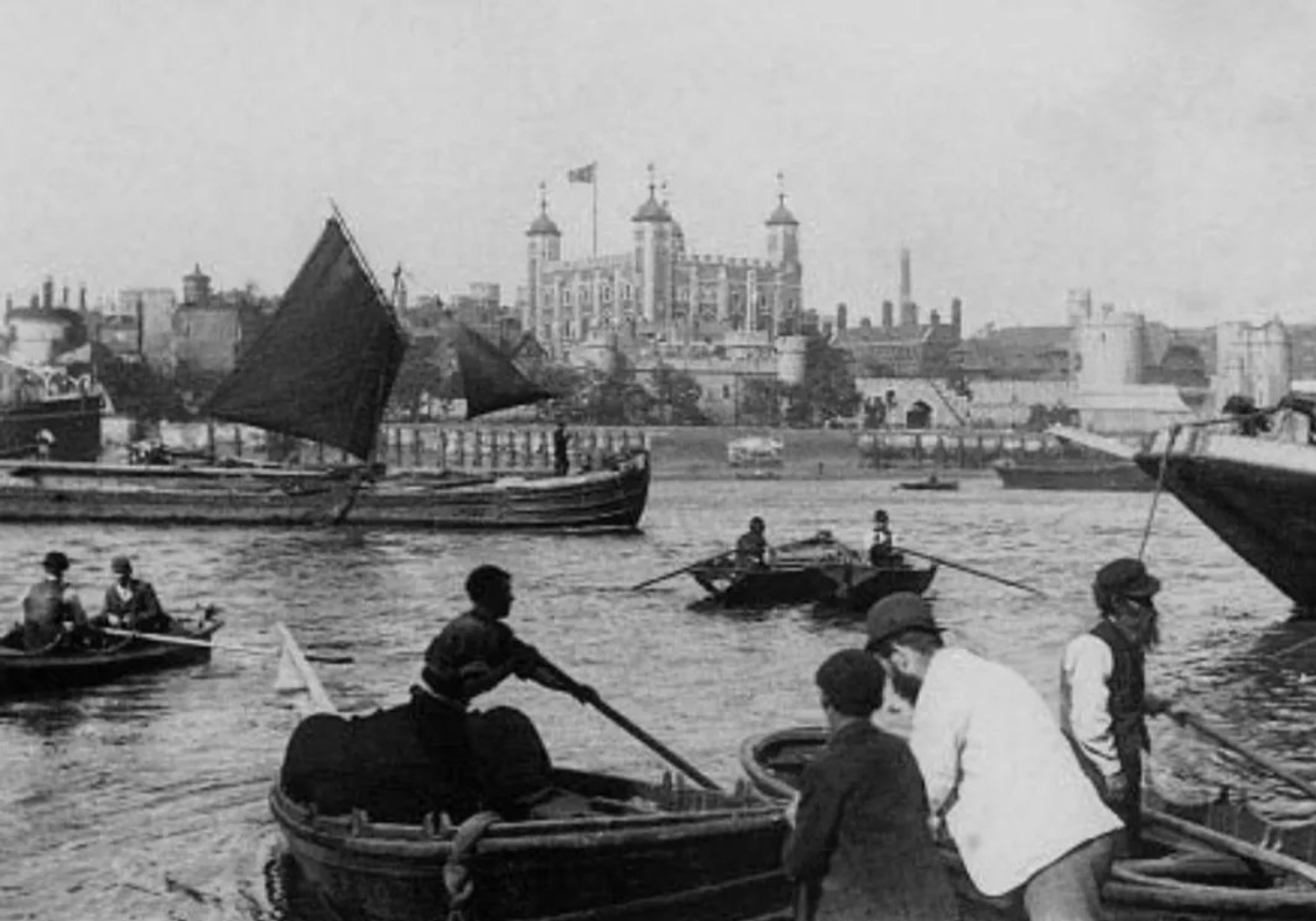
Many of my London ancestors worked on the River Thames. Here’s a scene from 1895.

My direct ancestor, Isabelle Capet born 1292 in Paris, died 22 August 1358 in Hertford Castle. Isabelle was noted for her diplomatic skills, intelligence and beauty. She also overthrew her husband, Edward II, and embarked upon an affair with Roger Mortimer. A feisty woman.


The Gadsden branch of my family were millers, travellers, traders and latterly grocers. And in John Gadsden they were involved in ‘Popish plots’.

In 1650 a report stated that John Gadsden, a miller, possessed ‘a very ill character and is a very dangerous person and was very busy in a Popish Plot.’ He left his home ‘for fear of being taken up upon some matters against the government.’ However, he was easily found, betrayed by neighbours, and the deputy took him into custody. John’s fate was not recorded, but his death on 18 August 1666 in Newport Pagnell suggests that he survived that immediate crisis.

John’s son, Richard, my direct ancestor, was born on 6 July 1613 in Stoke Goldington, Buckinghamshire. In Newport Pagnell on 28 October 1633 Richard married Catherine Wright. The couple produced six children.

Around this time various members of the Gadsden family were travelling and trading in America and the West Indies. Some sources suggest that Richard died in St Kitts and Nevis, c1690.

French map of Nevis, 1764.

In 1690, a massive earthquake and tsunami destroyed the city of Jamestown, the capital of Nevis. The damage was so extensive that the survivors abandoned the city. It’s reputed that the whole city sank into the sea. To date, I have not been able to establish whether Richard witnessed this earthquake or was a victim. It’s possible that this might be a family legend with no basis in truth. Before stating the story as true I would like to discover more evidence. Colonial and shipping records show that the Gadsdens were definitely in the region during this period, but more research is required.

Richard and Catherine’s son, William, my direct ancestor, was born on 30 July 1642 in Newport Pagnell, Buckinghamshire. William married Mary Nicholl on 6 January 1668 in Stoke Goldington, Buckinghamshire. The couple produced eight children.

Again there is a suggestion that William died abroad, in 1691 in West Nimba, Liberia. What was he doing in Liberia? To answer that question, we need to look at Liberia’s history.

Map of Liberia, c1830.

Portuguese explorers established contacts with people living in what later became known as Liberia in 1462. They named the area Costa da Pimenta, the Pepper or Grain Coast, because of the abundance of melegueta pepper, a highly desired spice in European cooking.

In 1602 the Dutch established a trading post at Grand Cape Mount, but this was destroyed a year later. In 1663, the English established new trading posts on the Pepper Coast and it would appear that William was involved in them. Again, before confirming this as fact more research is required, but the patterns of the Gadsden’s lives and their interest in trade suggests the tale might contain a grain of truth.

The above generations of the Gadsdens illustrate the fascination and frustration of genealogy. The fascination is there on a personal level because these people are my ancestors and also as a storyteller I’m entranced by their stories. However, sometimes there are gaps in the historical records, which makes definitive proof impossible to find. Sometimes it’s tempting to follow this quote from The Man Who Shot Liberty Valance, ‘When the legend becomes fact, print the legend.’ As a storyteller, this appeals to me. However, as a social historian I like to base my family stories on fact.

After John, Richard and William Gadsden, we move on to firmer historical ground with Christopher, Robert and William. Their stories also involved travel, to America and Australia, and they featured in dramatic trials at the Old Bailey. More about them in future posts.

*****

My next blog post will appear after Christmas Day, so I would like to take this opportunity to wish you a healthy and happy Christmas with this Christmas card from 1876.

As ever, thank you for your interest and support.

Hannah xxx

For Authors

#1 for value with 565,000 readers, The Fussy Librarian has helped my books to reach #1 on 32 occasions.

A special offer from my publisher and the Fussy Librarian. https://authors.thefussylibrarian.com/?ref=goylake

Don’t forget to use the code goylake20 to claim your discount 🙂

Categories
Dear Reader

Dear Reader #129

Dear Reader,

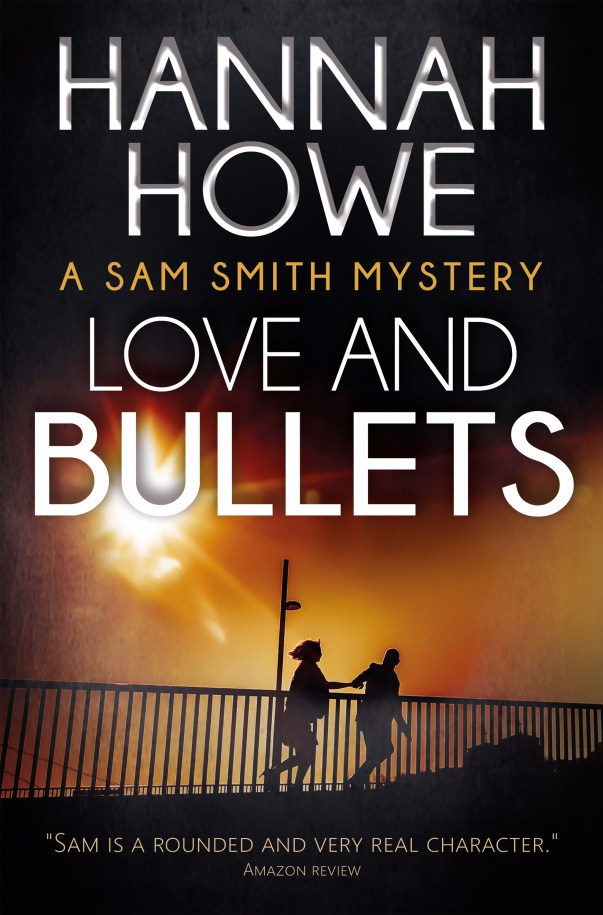
Nelmari has completed the translation of Sam’s Song, book one in my Sam Smith Mystery Series, into Afrikaans and I’m delighted to say that soon she will make a start on Love and Bullets, book two in the series.

After the tragic events of this week.

A scene familiar to my London ancestors, Victoria Station in 1912.

The World Chess Championship between Magnus Carlsen and Ian Nepomniachtchi started this week. I’m a big chess fan so I’m enjoying the coverage on chess.com. Two exciting draws so far. All to play for in the fourteen game series.

https://www.chess.com/news/view/2021-fide-world-chess-championship-game-1-nepomniachtchi-carlsen

The son of Edward Stradling and Joan Beaufort, Sir Henry (Harry) Stradling was born c1412 in St. Donats, Glamorgan. He married Elizabeth Herbert c1440 in St. Athan, Glamorgan, their marriage uniting the powerful Stradling and Herbert families. The marriage produced four children: Thomas, my direct ancestor, Charles, Elizabeth and Jane. 

In 1449, Henry, his wife Elizabeth and their daughter Elizabeth, encountered a Breton pirate, Colyn Dolphyn. A native of Brittany, Colyn Dolphyn was based on Lundy, an island in the Bristol Channel. Five kilometres long and a kilometre wide Lundy was granted by Henry II to the Knights Templars in 1160. Over following centuries privateers took control of the island.

Map of Lundy Island by Henry Mangles Denham (1832)

Because of the dangerous shingle banks and the fast flowing River Severn with its tidal range of 8.2 metres, the second largest in the world, ships were forced to navigate close to Lundy. This meant the island was ideally situated for pirates to prey on merchant ships and their rich cargos.

The chroniclers described Colyn Dolphyn as a tall, athletic, and mighty man, ‘like Saul in Israel’. He ‘towered head and shoulders’ above all men and was regarded as ‘a terror in South Wales’.

In 1449, Henry and his family spent a month visiting their estates in Somerset. Whenever possible, for passengers and trade, ships were the preferred mode of transport because the roads were often nothing more than dirt tracks. Therefore, Henry made the return journey by ship.

Aboard the St Barbe, Henry, his family and crew, set sail from Minehead for the Welsh coast. They encountered Colyn Dolphyn, who transferred them to his barque, the Sea Swallow. Dolphyn demanded a ransom of 1,000 marks for Henry, Elizabeth and daughter Elizabeth’s release. 

The ransom was not forthcoming so over a period of two years the price went up to 2,200 marks. At that point the Stradlings were forced to sell their manors of Bassaleg and Rogerstone in South Wales, two manors in Oxfordshire and the Lordship of Sutton in Monmouthshire. With the ransom paid, Dolphyn released Henry and his family.

Nash Point (Wikipedia)

While the coast of South Wales is beautiful it also contains some treacherous rocks, particularly the rocks off Nash Point, Glamorgan. Several years after kidnapping the Stradlings, Colyn Dolphyn was out pirating when a storm blew up. That storm drove his ship on to Nash Rocks near Colhugh Beach. 

The locals alerted Sir Henry Stradling who raised his men. They captured Colyn Dolphyn and his men, and dispensing swift justice hung them the following day.

In 1837, Taliesin Williams wrote a poem, The Doom of Colyn Dolphyn, which concluded with the following lines:

The beach they trod, destruction there,

Had stamped his footsteps ev’ry where.

Above, below, were strown along,

The fragments of a vessel strong.

Here helm and shatter’d masts were seen,

There lay the hull, the rocks between, 

With upward keel and crag-rent side. 

Thro’ which had pass’d the refluent tide.

And, all around, appear’d in view,

The bodies of a numerous crew. 

Whose course was run, confederates sent,

Well armed on Colyn’s rescue bent. 

But, ere they reach’d the rugged strand,

To ply the dirk, and light the brand. 

Justice ordain’d they should abide,

The tempest’s ordeal, and they died!

The story of the Stradling branch of my family and their encounter with a pirate Colyn Dolphyn as illustrated, animated and told by the children of Wick and Marcross Primary School, South Wales.

Like his father, Edward, Henry Stradling visited Jerusalem, in 1475, where he became a Knight of the Holy Sepulchre. Also like his father, he died on his journey home, at Famagusta, Cyprus, in 1476.

As ever, thank you for your interest and support.

Hannah xxx

For Authors

#1 for value with 565,000 readers, The Fussy Librarian has helped my books to reach #1 on 32 occasions.

A special offer from my publisher and the Fussy Librarian. https://authors.thefussylibrarian.com/?ref=goylake

Don’t forget to use the code goylake20 to claim your discount 🙂

Categories
Dear Reader

Dear Reader #121

Dear Reader,

I’ve received messages asking me when Operation Cameo, book six in my Eve’s War Heroines of SOE series, will be available. I’m pleased to say that the book will be listed on all major platforms as a pre-order later this month.

The earliest photograph to feature people. The Boulevard du Temple 1838 by Louis Daguerre. Because the exposure lasted for several minutes the moving traffic in the busy street left no trace. Only a shoe polisher and his client remained in place long enough to appear on the printed image. Sam mentions this in my latest Sam Smith mystery, Damaged.

Summer 1915, C Company, The Queen’s Royal West Surrey Regiment, Number Nine Platoon. This picture includes my 2 x great grandfather Albert Charles Bick. 

On 25 September 1915 the Royal West Surrey Regiment engaged in the Battle of Loos, which resulted in 80% British casualties, including Albert, when the generals gassed their own men.

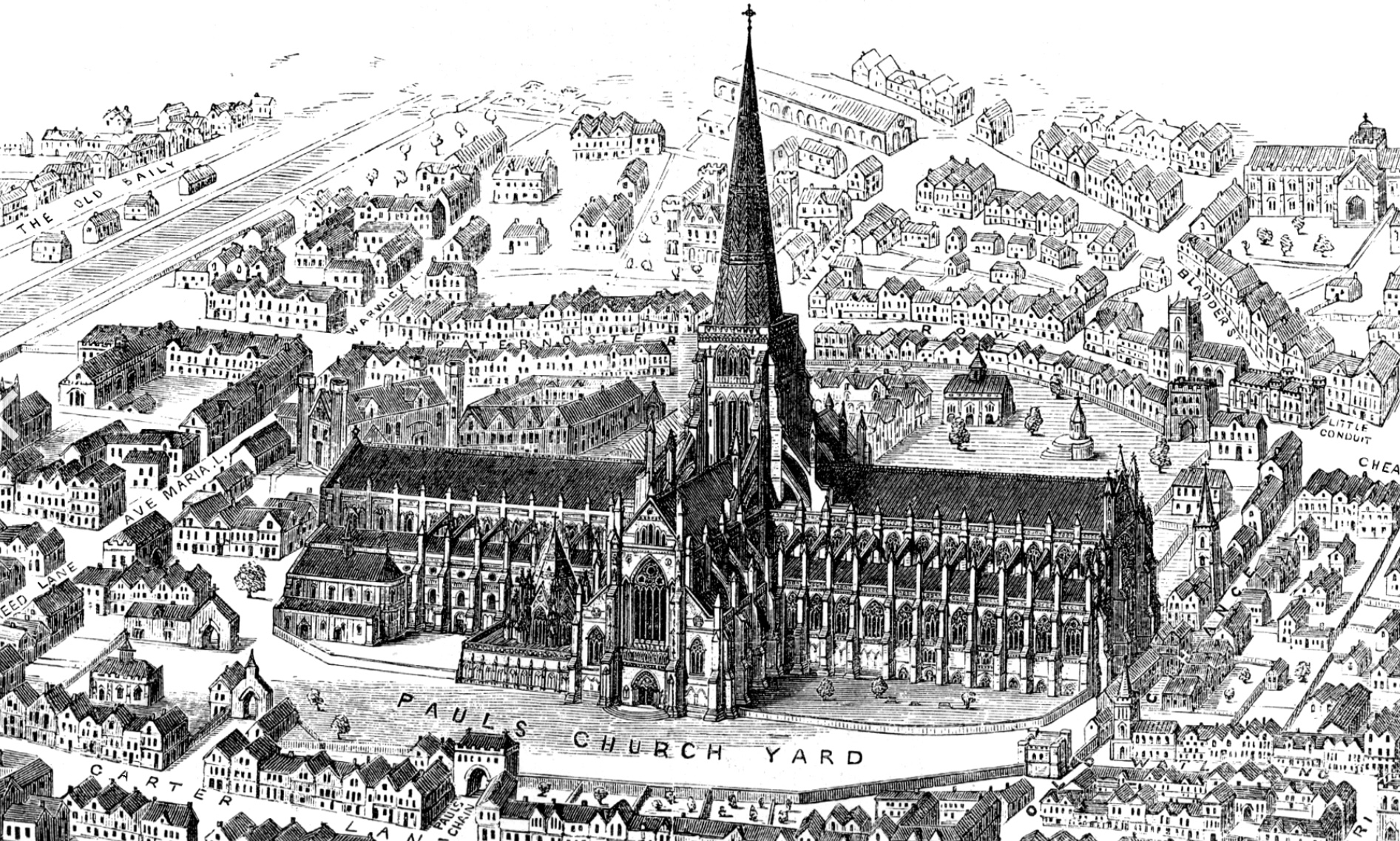
A State Lottery was recorded in 1569. The tickets were sold at St. Paul’s Cathedral in London, pictured c1560.

A poem written in Welsh c1920 about my 2 x great grandfather William Howe. Lines include: ‘He deserves all the praise he receives’. ‘A Christian in his warm home’. ‘William Howe is a godly saint for getting us all to pray again in the chapel with the children’. ‘We will enjoy a big feast at the Sunday School’. ‘We will sing his praises when we meet in heaven’.

My latest article for the Seaside News appears on page 36 of this month’s magazine.

I’ve traced the Bick branch of my family back to the fifteenth century. They settled in Badgeworth, Gloucestershire and lived there for hundreds of years. My branch of the family moved to London in the Victorian era, but you can still find Bicks in numerous numbers in Gloucestershire.

Unfortunately, the records for the Bicks of Badgeworth are not extensive, but I have uncovered a few nuggets of information that add details to my ancestors’ lives.

The surname Bick is of Dutch and German origin. It derives from the Middle Dutch and Middle High German word bicke meaning pickaxe or chisel. The name was associated with stonemasons and people who worked with pickaxes and chisels.

It’s likely that the Bicks arrived in Gloucestershire from the Netherlands or Germany in the early Middle Ages. My branch of the family feature in many land deeds during the sixteenth and seventeenth centuries. These deeds indicate that they farmed land as yeomen. However, they were never described as ‘gentlemen’, which suggests that there was no link with the gentry.

Bick sons married the daughters of the following families: Meek, Fawkes, Spring, Blush, Izod and Netherton. Evocative names. These families were also of the yeomen class. The name Fawkes suggests a link to the infamous Guy Fawkes. However, Guy was from York and it is unlikely that my ancestor, Jane Fawkes, was closely related to him.

From the land, my Bick ancestors became innkeepers, running coaching inns. George was a popular name over four successive generations. George ‘the second’ – 22 October 1668 to 3 June 1738 – was an innkeeper in Badgeworth. Some of the Bicks left wills, but they are difficult to read and those that are legible contain only basic details of modest inheritances for sons and daughters.

The Bick ancestor who captured my attention was Thomas Bick, born 1575 in Badgeworth. He died in 1623 of the ‘pest’, also known as the pestilence or plague. The plague is an infectious disease caused by the bacteria Yersinia pestis, which mainly infects rats and other rodents who become the prime reservoir for the bacteria.

Seventeenth century plague doctor with protective mask and clothing.

The Pestilence was a bubonic plague pandemic that occurred in Afro-Eurasia from 1346 to 1353. The plague created religious, social and economic upheavals with profound effects for the inhabitants of the time. It also drastically altered the course of European history.

Further waves of the plague swept over Europe throughout the fourteenth to seventeenth centuries. Certain years were more blighted than others, including 1623 the year that Thomas died. That bout of the pestilence lasted until 1640. It reoccurred again in 1644–54 and 1664–67. 

The 1664 to 1667 episode was the last major epidemic of the bubonic plague to occur in England. In 1665-66 it swept through London producing the ‘Great Plague of London’. Then, in September 1666, the ‘Great Fire of London’ destroyed the city. Some people speculated that the fire killed the pestilence, although records suggest that the disease was already on the wane. My London ancestors were caught up in the ‘Great Fire of London’, but more about them in future posts.

London 1665.

As we know to our cost, when we abuse nature and animals we create pandemics. Our ancestors did not have the scientific knowledge to appreciate this, but we do; there is no excuse.

Along with the pestilence, our ancestors died from a range of diseases and illnesses. Here is an example from 1632 with a few definitions.

Cut of the Stone – The surgical removal of a bladder stone

French Pox – Syphilis

Jawfaln – Locked jaw

Impostume – An abscess

King’s Evil – A tuberculous swelling of the lymph glands

Livergrown – Liver disease, possibly caused by alcoholism 

Murthered – Murdered

Planet – To be stricken with terror or affected adversely by the supposed influence of a planet

Purples – Purple blotches on the skin caused by broken blood vessels, indicative of an underlying illness, such as scurvy

Rising of the Lights – A condition of the larynx, trachea or lungs

Tissick – A cough

Tympany – Bloating

The saddest entry on this list, and the largest in number, is chrisomes and infants. Chrisomes refers to a baby less than a month old, which indicates that the start could often be the most dangerous period of a person’s life.

Stay safe. Wishing you well.

As ever, thank you for your interest and support.

Hannah xxx

For Authors

#1 for value with 565,000 readers, The Fussy Librarian has helped my books to reach #1 on 31 occasions.

A special offer from my publisher and the Fussy Librarian. https://authors.thefussylibrarian.com/?ref=goylake

Don’t forget to use the code goylake20 to claim your discount 🙂
Categories
Dear Reader

Dear Reader #119

Dear Reader,

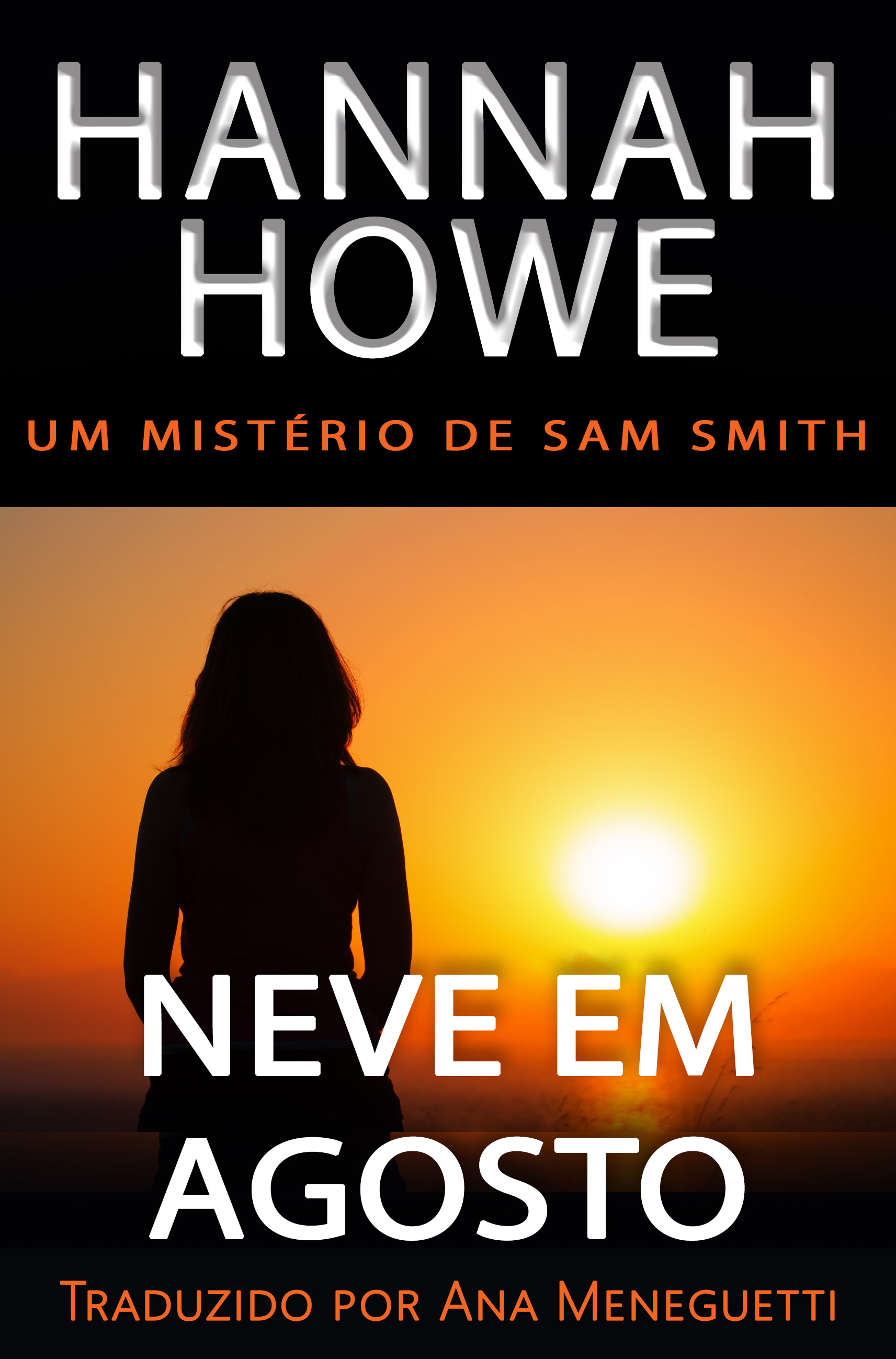
My latest translation, the Portuguese version of Snow in August, Sam Smith Mystery Series book sixteen.

Recently, I had the pleasure of interviewing author, playwright and journalist Tim Walker for Mom’s Favorite Reads. Meanwhile, Tim’s just published a new book, his thoughts on meeting stars of stage and screen. You can learn more about Tim’s book here https://www.amazon.co.uk/Star-Turns-Secrets-Screen-Legends/dp/1914489004/

Ancestry have updated my DNA result. I’m 65% Welsh. The other 35% is shared between Belgium, the Channel Islands, England, the Netherlands, Luxembourg, France, Switzerland, Germany, Ireland, Scotland, Faroe Islands, Iceland and Norway.

My main genetic communities are Wales, Pennsylvania, Eastern Ohio, Northern West Virginia and Maryland.

I have cousins in Australia, New Zealand, California, Oklahoma, Kansas, Texas, Wisconsin, Illinois, Michigan, New York, Ohio, Ontario, Toronto, Pennsylvania, West Virginia, New Jersey and North Carolina.

I’m sure I have relatives in other countries and territories that this DNA test doesn’t cover, but it’s fascinating to see where my ancestors came from and where they settled as emigrants.

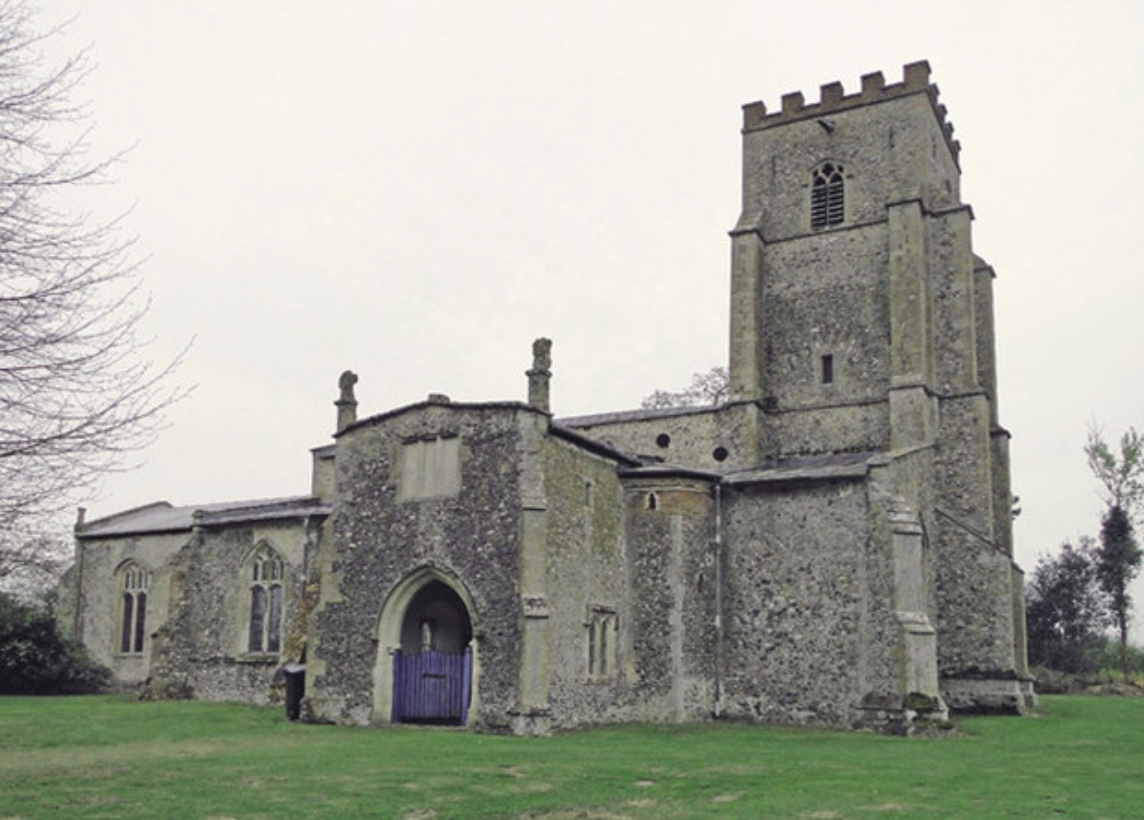
My ancestor Arthur Iveson was born on 16 June 1772 in Hawes, Yorkshire to Thomas Iveson and Margaret Taylor. Maybe due to complications from the birth Margaret died in October 1772 while Thomas died in 1788. As the youngest child, Arthur followed a tradition common amongst well-to-do families – he entered the Church.

St Margaret’s Church, Hawes. Credit: Wikipedia.

In 1793 the Bishop of Carlisle ordained Arthur as a deacon and a year later he became a priest in York. From York the Church sent Arthur to Nottinghamshire then to Norfolk where he established himself as Rector of East Bradenham.

In Norfolk, on 6 March 1797, Arthur married Martha English. Of course, as a rector Arthur could read and write, and he signed his name. Martha also signed her name, something not many women of the time could do, even women born into wealthy families.

Between 1798 and 1806 the couple produced six children: Ann, Thomas, born 18 March 1799, Arthur, Martha, Martha and Arthur. Martha #1 and Arthur #1 died in infancy.

Apart from the tragic infant deaths, everything was going well for Arthur. Between 1802 and 1817 he appeared on the Electoral Roll in Norfolk, which placed him in a privileged position, one of the elite in the country who could vote. In 1816 his son Thomas became a clerk to William James Murray in Kings Lynn and shortly after that he followed his father into the Church, becoming a vicar.

St Mary’s Church, East Bradenham. Credit: Wikipedia.

Arthur’s wife, Martha, died in 1828, and from that point events took a sinister turn.

At ten o’clock on the evening of 28 May 1832 Thomas entered Arthur’s rooms to talk with his father. The talk developed into an argument and Thomas produced a gun. He fired one shot, which entered Arthur’s heart.

With his father dying, Thomas ran next door to summon Captain Lake. He informed the captain of the shooting and Lake hastened to Arthur’s aid. The captain summoned two medical men, Mr Murlin, a surgeon, and Dr Tweedale, and they tended to Arthur, alas in vain, for he died within twenty minutes of the shooting.

The moment Arthur died, Thomas entered the kitchen and took a considerable amount of laudanum, which Mr Murlin promptly forced from his body. The Officers of Justice arrived and Thomas surrendered to them.

In July 1832 an inquest into the death of Arthur Iveson was held in a local public house, followed by a trial at the Quarter Sessions. During the inquest and trial it emerged that Thomas was ‘intelligent’ and a ‘gentleman’, although his behaviour of late had been eccentric.

The trial established that Thomas entered Arthur’s rooms with intent to shoot his father and that the bullet fired from his gun killed him. However, the jury acquitted Thomas on the grounds of insanity.

After the trial, Thomas entered a local infirmary and died there on 15 February 1836.

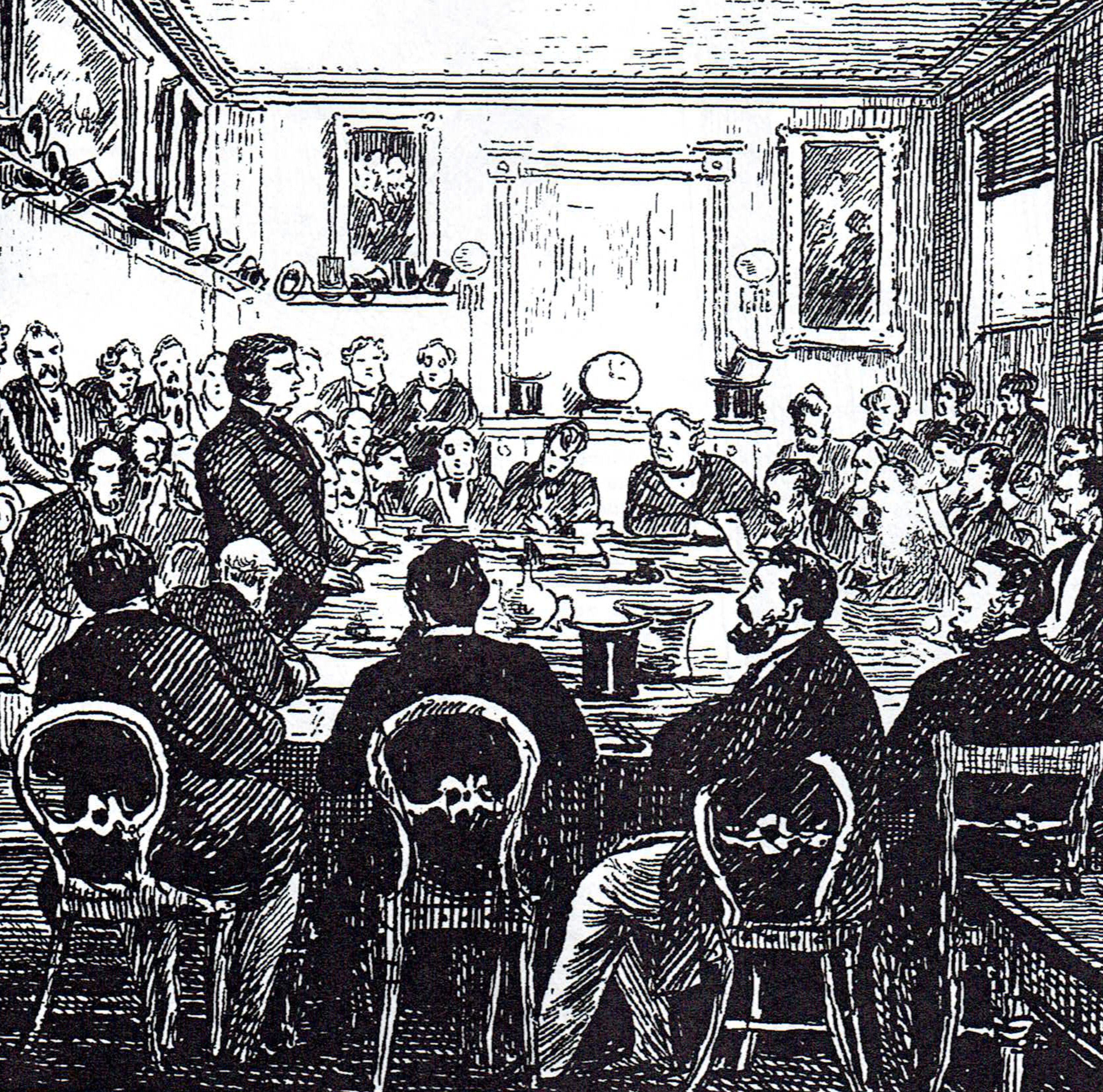
A Victorian Inquest

There is a postscript to this remarkable story. On 4 January 1848 in Hawes, Yorkshire, two cousins, John and Arthur Iveson, cousins of Arthur of Norfolk’s offspring, went drinking in a local pub, The Fountain Inn. They got drunk, argued, and engaged in a brawl. The brawl resulted in the death of Arthur Iveson.

The trail that followed delivered a verdict of manslaughter and John was sentenced to two months hard labour. After his prison sentence John resumed his role of local butcher. Twenty-two at the time of the manslaughter, he later married, raised a family and enjoyed a long life.

What to make of the Ivesons? Are they a violent branch of my family? I’m in touch with four first cousins, Iverson sisters, and no one would regard them as violent. Indeed, the opposite is true. It would appear that Thomas killed Arthur when in a troubled state of mind while John killed his cousin Arthur due to excessive alcohol consumption. 

History repeats, so they say, but when it comes to family members killing each other maybe it’s better if it doesn’t. 

To all current and future Ivesons, pax vobiscum – peace be with you.

As ever, thank you for your interest and support.

Hannah xxx

For Authors

#1 for value with 565,000 readers, The Fussy Librarian has helped my books to reach #1 on 31 occasions.

A special offer from my publisher and the Fussy Librarian. https://authors.thefussylibrarian.com/?ref=goylake

Don’t forget to use the code goylake20 to claim your discount 🙂