Categories
Dear Reader

Dear Reader #137

Dear Reader,

After a break since Christmas 2021, my blog is back. A week before Christmas, I became ill with Covid. That illness continued well into January. Since then, I have been catching up with my writing schedule, hence the break. 

I hope you will enjoy this blog post and future content.

My latest translations, the Italian version of Operation Locksmith and the Portuguese version of Damaged: Sam Smith Mystery Series book nineteen.

In this month’s issue of Mom’s Favorite Reads…

An exclusive interview with Jennifer Shahade two-time USA Women’s Chess Champion, poker champion, author and podcaster. Plus, Author Features, Nature, Photography, Poetry, Recipes, Short Stories, Jazz Appreciation Month, and so much more!

My Recent Genealogical Research

My 3 x great grandmother Sarah Ann Cottrell was born on 24 June 1848 in St Leonard’s, Shoreditch. Aged twelve she worked as a matchbox maker, on piece rates. Sarah Ann’s father, Mathew, was a fishmonger, a decent trade, so her matchboxes brought in bonus pennies to support her mother and five siblings.
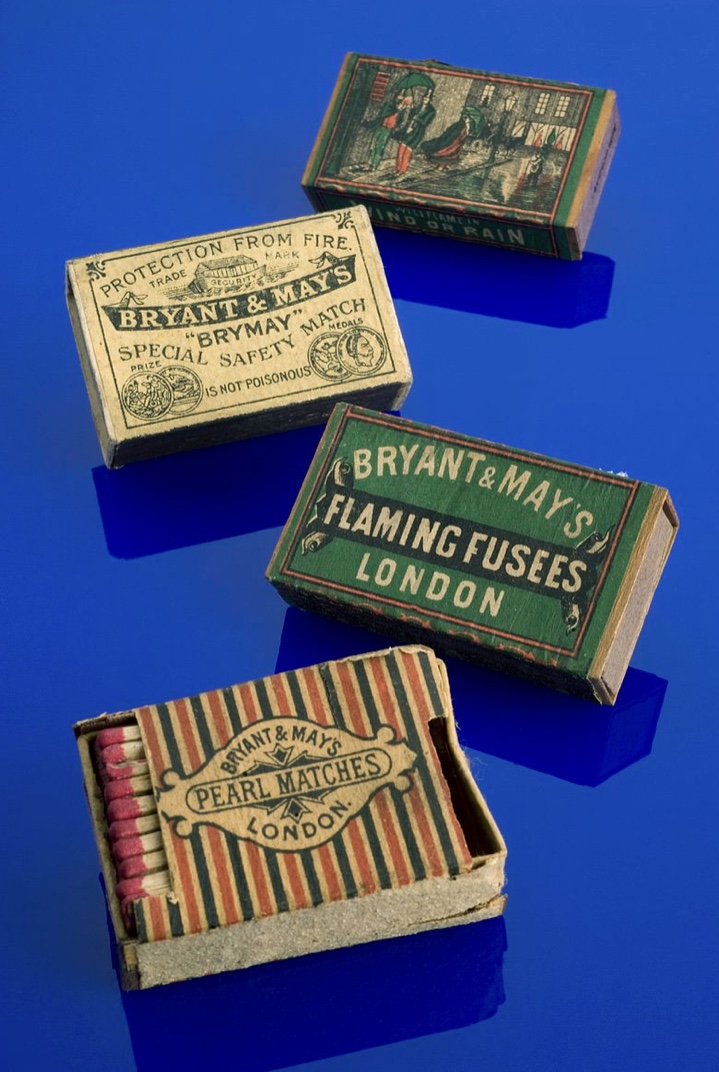
Picture: Wellcome Trust

My 4 x great grandfather Mathew Cottrell was a fishmonger at Billingsgate Market. Here’s the market as Mathew would have seen it plus a description, both from the Illustrated London News, 7 August 1852.

In 1852, my 4 x great grandfather Mathew Cottrell was a fishmonger at Billingsgate Market so it seems fair to assume that his wife, Sarah, was adept at preparing fish dishes. Here’s some advice from A Mother’s Handbook, published the same year.

“Fish should be garnished with horseradish, or hard boiled eggs, cut in rings, and laid around the dish, or pastry, and served with no other vegetable but potatoes. This, or soup, is generally eaten at the commencement of a dinner.”

My 5 x great grandfather Samuel Cottrell was born on 11 July 1796 in Finsbury. After his marriage to Ann Baker he moved to Billingsgate where he worked as a fishmonger. Samuel and Ann were nonconformists, protestant dissenters. He lived in Dunnings Alley, a hotbed of dissent.

Somehow, Samuel and Ann avoided every census in the 1800s. However, the nonconformists kept detailed records, including details of Samuel’s family. These records confirm that a midwife was in attendance for all of Ann’s births along with, on occasion, a surgeon.
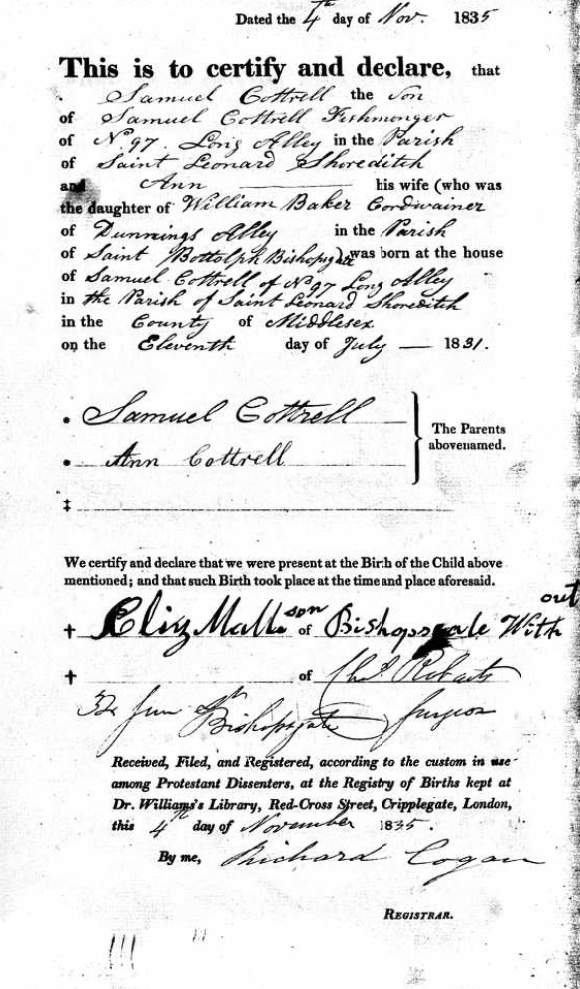
My 5 x great grandfather Samuel Cottrell lived a long life, 84 years. However, he struggled during his final two years. Unable to move freely, in 1878 he spent a month in Homerton Workhouse Infirmary. He signed himself out.

Two years later, Samuel spent two years in Bow Road Infirmary, pictured. Shortly after he left, a ‘Mad Russian’ murdered one of the inmates, slicing him with a knife. Within ten days Samuel was back in Homerton. He spent a further six months there, dying on 1 September 1880.

They kept stealing his shoes. My 6 x great grandfather John Cottrell was a boot maker. The Old Bailey website lists three occasions 1830 – 1832 when boys aged ten, twelve and seventeen stole his shoes. The court offered mercy to the ten year old, but the other two were transported for seven years.

St Mary Woolnoth, London. My 7 x great grandfather John Cottrell was born there on 6 Nov 1747 and baptised there on 29 Nov 1747. He ran a business as a chandler. He served on several coroner’s inquest juries and, like my Howe ancestors, was an Overseer of the Poor.

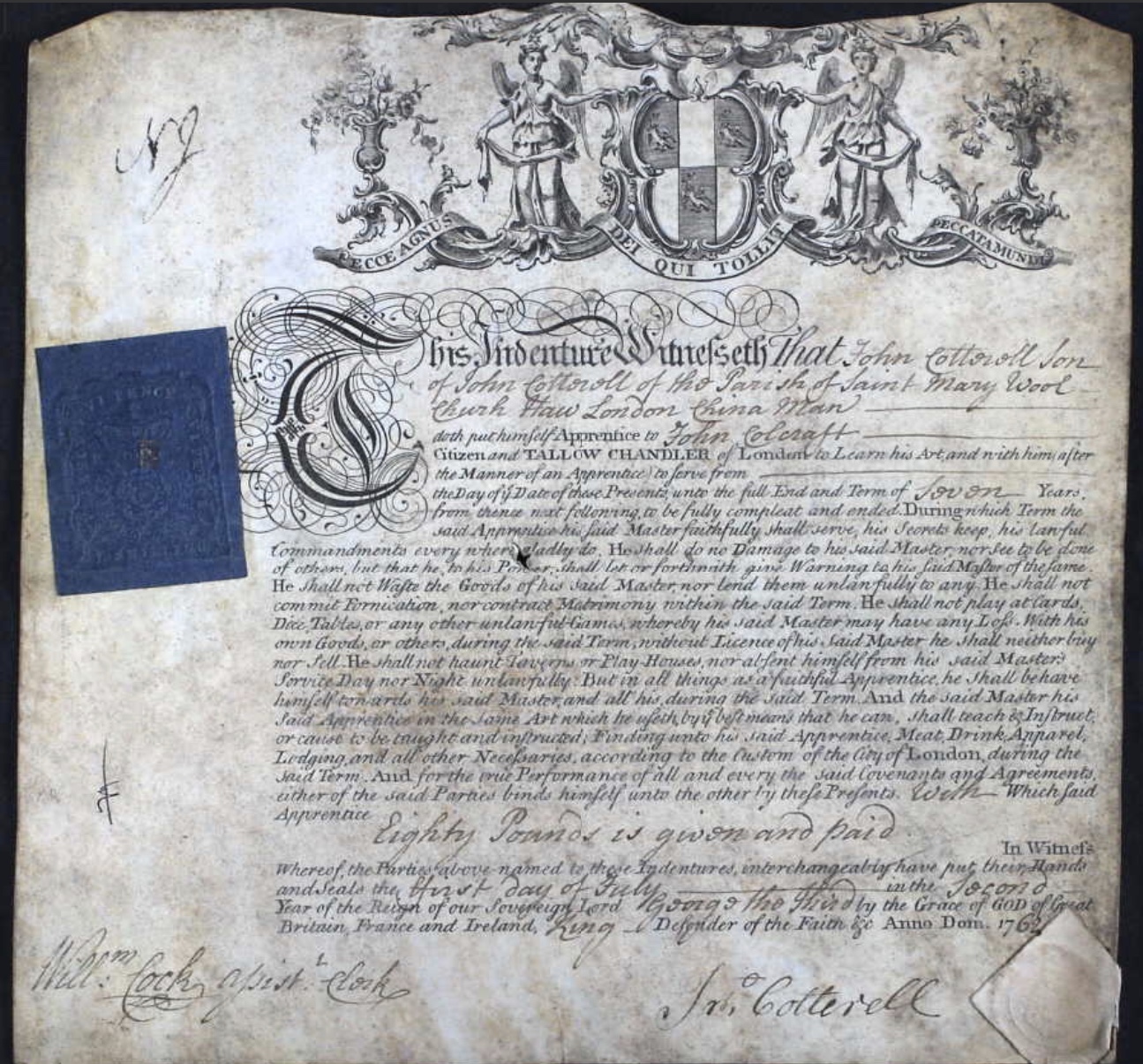
1 July 1762. An indenture belonging to my 7 x great grandfather John Cotterell. His father, also John, paid John Coleratt £80 (£8,200 today) so that he could learn the trade of tallow chandler. These indentures were standard in the 18th and 19th centuries with the names and trades added as applicable.

Apprentices were forbidden from playing cards, dice, entering taverns or playhouses, fornicating or marrying. Usually, these indentures covered a period of seven years. Little wonder that some apprentices broke the agreement and absconded.

John served his apprenticeship and in 1775 established a business on 55 Fore Street, Moorfield, selling food and household items.
As a ‘respectable member of the community’ my 7 x great grandfather John Cotterell served on five Coroner’s juries, in 1776,  1779, 1781, 1783 and 1785, each time investigating suspicious deaths in the community. 

In 1785 on ‘Friday this 20th. Day of May by Seven of the Clock in the After noon twenty-four able and sufficient Men of said Liberty’ gathered at John’s house to investigate the death of Robert Jurquet. The jury concluded that being of unsound mind, with a razor, Robert Jurquet took his own life.

My 7 x great grandfather John Cotterell’s elder brother, William, was sword bearer of the City of London. The office was created in the 14th century when it was recorded that the Lord Mayor should have, at his own expense, someone to bear his sword before him: 

‘a man well-bred’, one ‘who knows how in all places, in that which unto such service pertains, to support the honour of his Lord and of the City.’

Picture: George III receiving the Civic (Pearl) Sword from the Lord Mayor of London on his way to St Paul’s Cathedral, an event William probably attended.

As ever, thank you for your interest and support.

Hannah

For Authors

#1 for value with 565,000 readers, The Fussy Librarian has helped my books to reach #1 on 32 occasions.

A special offer from my publisher and the Fussy Librarian. https://authors.thefussylibrarian.com/?ref=goylake

Don’t forget to use the code goylake20 to claim your discount 🙂

Categories
Dear Reader

Dear Reader #136

Dear Reader,

Preparing a new series, Women at War, three novels set in France in 1944. Research ongoing, writing will start later this year.

My direct ancestors Robert Gadsden and William Gadsden were grocers.

Robert was born on 30 November 1714 in Hanslope, Buckinghamshire. On 18 October 1743 he married Elizabeth Richardson in Newport Pagnell, Buckinghamshire, but the marriage did not produce any children. Elizabeth died young and, on 18 July 1755 in Newport Pagnell, Robert married for a second time. His new bride was another Elizabeth, Elizabeth Crips, a widow. This marriage produced seven children, including their first born, my direct ancestor William.

Grocery stores in the 1700s sold a wide variety of items including sugar, tobacco, spices, coffee, tea, rice, chocolate and dried fruit. They featured local produce and items like those listed above from abroad. Earlier and later generations of Gadsdens were traders who travelled far and wide, to America and Africa, for example. Its tempting to think that Robert and William developed their stores from these overseas connections. However, instead of travelling they focused on selling their goods from their local stores.

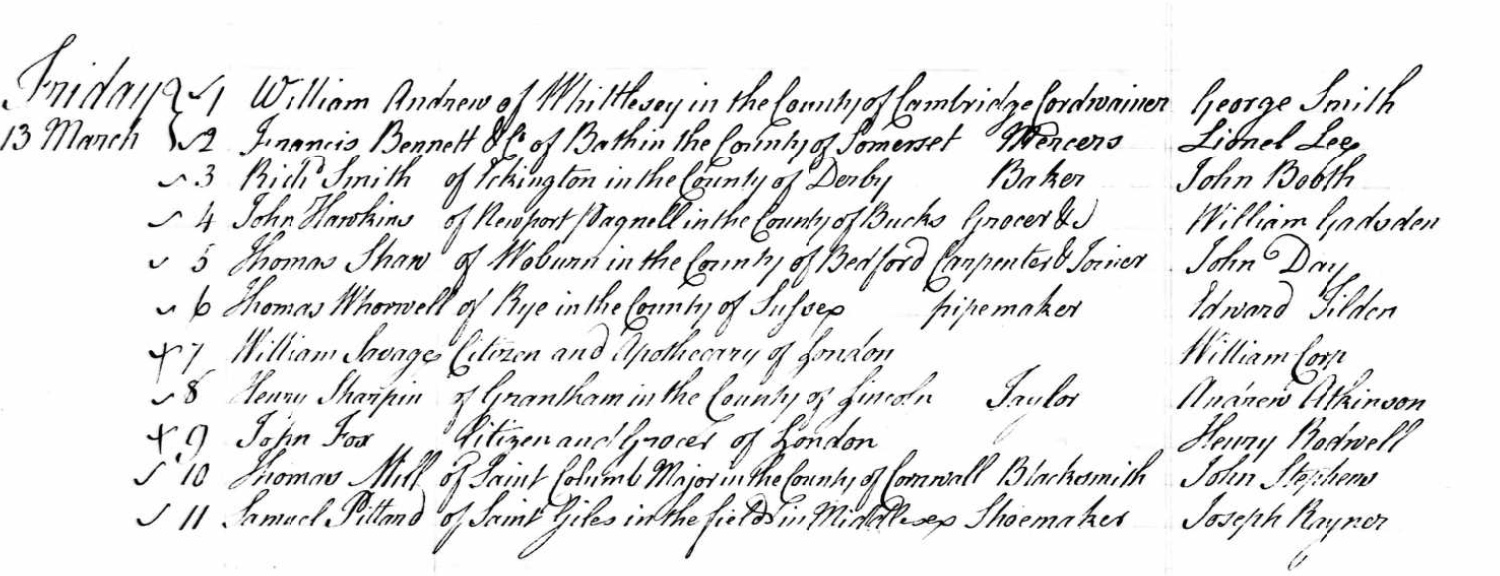
Robert died on 21 July 1768 in Newport Pagnell. William was only twelve and so too young to take over the family business. Instead, he had to learn the trade as an apprentice. He commenced his apprenticeship on 13 March 1772 in Newport Pagnell.

William’s apprenticeship

William was born on 3 August 1756 in Newport Pagnell and baptised five days later. After his apprenticeship he married twenty-year-old Elizabeth Chibnall, also in Newport Pagnell. The couple produced nine children, including my direct ancestor William and the baby of the family, Robert. Both were to feature in trials at the Old Bailey.

It would appear that William, born 1756, ran a steady business as a grocer. Maybe on account of the land tax introduced in 1798 he moved his family and business to London. He settled in Shoreditch and died there on 14 July 1819, a death that triggered a tragic chain of events.

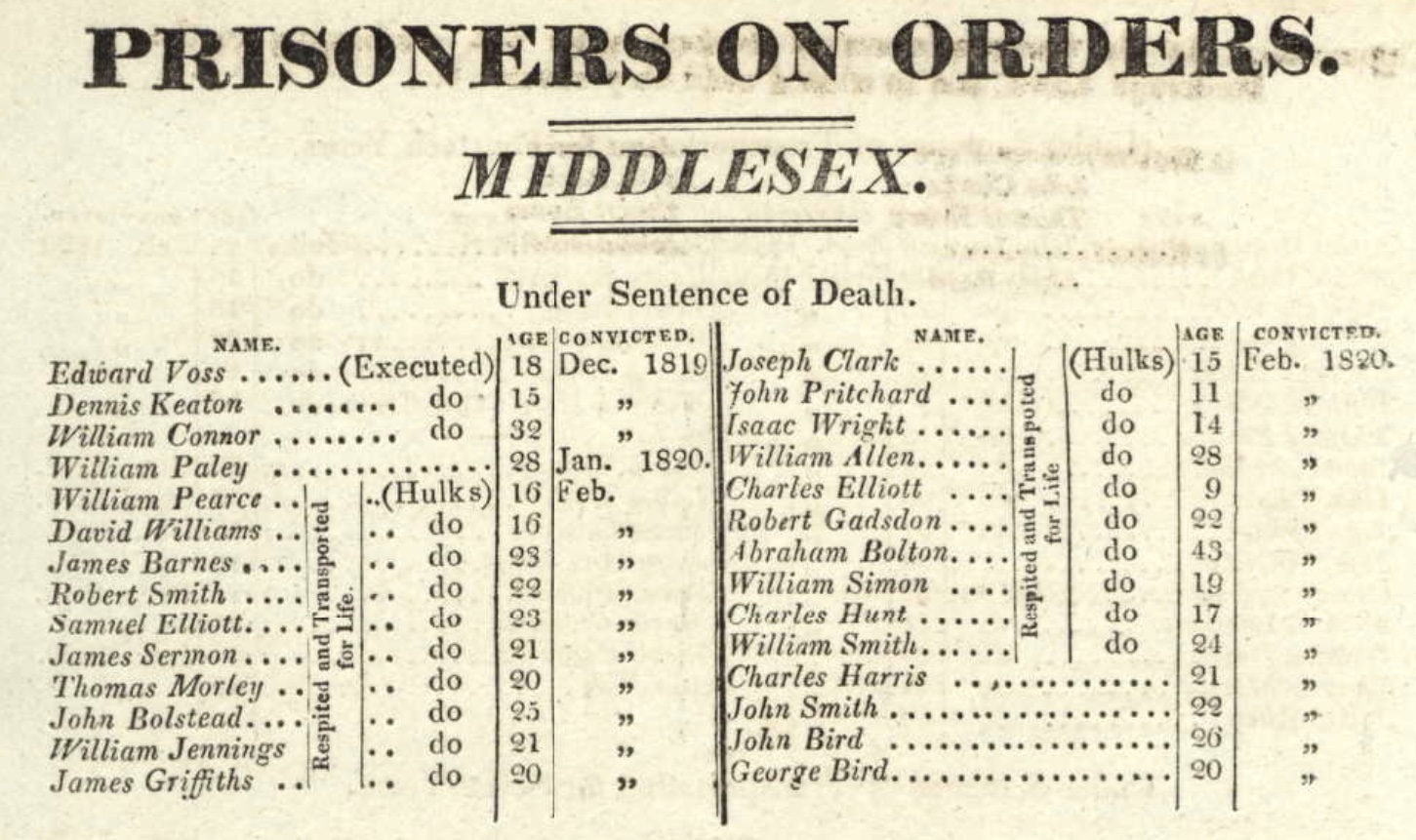
On 17 February 1820 twenty-two-year-old Robert Gadsden was indicted for feloniously breaking and entering the dwelling-house of John West, Esq. This incident occurred at one o’clock in the afternoon, on 29 January 1820 at St. Marylebone. John West’s wife, Harriet, was present when Robert allegedly stole a shawl, value twenty shillings, the goods of Sarah Griffiths.

Sarah Griffiths gave evidence: “I am servant to Mr. John West who lives in Baker Street, Portman Square, St. Marylebone. On the 29th of January, about one o’clock, I was in the house; Mrs. West, and five of the servants were at home. My shawl laid on a table in the housekeeper’s room, opposite the window which looks into the area – it was about a quarter of a yard from the window – the sash was down; nobody was in the room. I was upstairs, heard an alarm, came down, missed it, and found the prisoner in custody.”

William Ledger gave evidence: “I am servant to Mr. West. I had been out to fetch some water, and as I returned I saw the prisoner down the area – he was a stranger. I watched him, saw him lay a bundle of wood on the ledge of the window, lift up the sash, and with a stick that had a hook to it, he drew out the shawl off the table, put it under his jacket, and walked on into the passage of the house. I ran downstairs, secured him in the passage, and saw him throw the shawl down.”

Finally, Richard Coates gave evidence: “I am a constable. I was sent for, and took the prisoner at Mr. West’s, with the shawl.”

The shawl was produced in court and sworn to. Then Robert spoke in his defence: “I went to see if they wanted any wood; the shawl laid on the window-ledge, and I carried it into the passage. He took me, and it fell from my hand.”

Verdict: Guilty.

Sentence: Death.

The shock deeply upset Robert’s mother, Elizabeth, and she died less than a week later, on 23 February 1820.

Robert condemned. Look at the ages of those sentenced to hang for petty crimes.

Sentenced to hang, Robert appealed. On 11 April 1820 he found himself on the prison hulk Bellerophon moored at Woolwich. With his appeal successful, he was transferred to the Caledonia, which set sail in July 1820 for Hobart Town, Van Diemen’s Land.

Initially transported for life, Robert gained a full pardon on 13 July 1840. However, before that the authorities granted him parole. On 1 April 1829 in Hobart, Robert married Elizabeth Lewis. A daughter, Elizabeth, arrived a year later. Sadly, she died before her fourth birthday.

Van Diemen’s Land 1828

After his pardon, Robert remained in Hobart. He died there in 1870. While he was in Australia, maybe Robert corresponded with his brother, William. If he did, maybe William reflected on his appearance at the Old Bailey. However, before exploring that case, some details about William.

William Gadsden was born on 10 December 1790. On 14 May 1810 he married Maria Beadle at Saint Matthew, Bethnal Green, London. The couple produced five children including my direct ancestor Sarah.

William broke the link with the grocery trade and made a living as a willow cutter, a silk weaver and latterly as a stone mason. His appearance at the Old Bailey occurred on 15 January 1817 as a witness.

The trial featured James Taylor, 17, and John Blake, 18. They were accused of stealing one pair of boots, value one shilling.

John Burton, owner of the boots, stated: “I live at Hackney. On the 17th of December, between two and four o’clock in the afternoon, I lost the boots from my tool-house, adjoining my dwelling-house; my yard door was on the latch, and so was the tool-house door; I missed the boots after four o’clock. I went next day to inquire if any jack-ass boys had been seen about, and found that the prisoners had been our way, selling catsup. I went to town, and found the two prisoners at the Bull’s Head, Kingsland’s Road; they were taken into custody.”

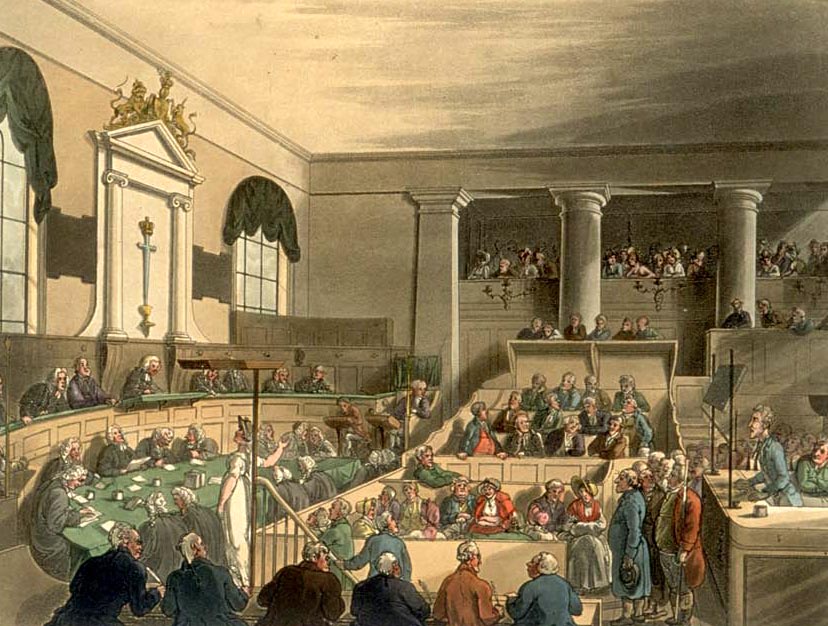
The Old Bailey, early nineteenth century

James Ingram gave evidence: “I am a smith; I was at the Bull’s Head, in Kingsland Road; about half-past five o’clock in the afternoon, the prisoner, Taylor, came into the house with a pair of boots, he asked me if I knew anybody that would buy them; I told him I would go and see; I took them out of his hand, and went to Saunders’ Gardens, which is close to the house, and offered them to Gadsden for twelve shillings. He offered me ten shillings for them; I went to Taylor, and he said I might let him have them – I did, and gave the money to Taylor, and he gave me a shilling for my trouble; he told me if Blake should come in, and ask what I sold them for, to say six shillings. In about a quarter of an hour Blake came in, and said, if he had been there at the time they should not have been sold for that money. I was quartered at the Bull’s Head.”

William Gadsden said: “I gave ten shillings for the boots. I gave them up to Armstrong.”

John Armstrong: “On the 17th of December, Mr. Burton applied to me. I and my son, accompanied him to the Bull’s Head, in Kingsland Road, and found Ingram and Blake sitting there together, we took them. I left Ingram in Burton’s care, and took Taylor, who was there. I took Ingram to Gadsden’s house, and he gave me the boots; we took the three to the office, and I heard both Taylor and Blake say, it was the first thing they had ever done, and that it was through distress.”

Joshua Armstrong: “I was with my father, and took the prisoners; they said it was the first robbery they had ever committed.”

Verdict: both Blake and Taylor guilty.

Sentence: Transportation for seven years.

I wonder if William and Robert ever reflected on their experiences at the Old Bailey and the fateful day in January 1820 when Robert stole a shawl and set in motion a chain of events which meant that they would never see each other again.

As ever, thank you for your interest and support.

Hannah xxx

For Authors

#1 for value with 565,000 readers, The Fussy Librarian has helped my books to reach #1 on 32 occasions.

A special offer from my publisher and the Fussy Librarian. https://authors.thefussylibrarian.com/?ref=goylake

Don’t forget to use the code goylake20 to claim your discount 🙂

Categories
Dear Reader

Dear Reader #135

Dear Reader,

Cover reveal for Sugar Daddy, Sam Smith Mystery Series book twenty, due for publication later this year. This story is about an unscrupulous businessman who lures a student into prostitution and the brink of suicide. Sam isn’t impressed and sets out to nail the bastard.

My latest genealogy article for the Seaside News appears on page 48 of the magazine 🙂

My latest translation, the Italian version of Sam’s Song, available soon. And the good news is Stefania has agreed to translate more books in my Sam Smith mystery series 🙂

On 18 April 1887 my grand aunt Elizabeth Middleton was accused of ‘receiving’. It’s likely that she came into contact with stolen goods at a London market. This was common at the time. Also common for the time, the case was dismissed.

I’ve researched the Aubrey branch of my family tree back to Saunder de Sancto Alberico, aka Aubrey, of Normandy. He arrived with William the Conquerer in 1066. Earlier, he produced a son, Sir Reginald Aubrey, born c1060, who married Isabel de Clare. The de Clare family produced William the Conqueror so it’s clear that all these noble families were close.

Sir Reginald was a member of an army commanded by Bernard Newmarche. This army fought the Welsh c1093 in the Brycheiniog (Brecknock) region of Wales. After numerous battles, Newmarche granted Sir Reginald the manors of Abercynrig and Slwch. Unrest continued, so Newmarche’s forces stayed at his castle in present day Brecon until the early 1100s. By that time, through their land-grab, the Aubreys had established themselves in the Brecon Beacons.

The line continued through another Reginald to William. Marriages to other noble families, such as the Gunters, ensured that the Aubreys consolidated their position in society then prospered. William produced a son, William, who produced a son, Thomas, born c1190 in Abercynrig. A hundred years after their arrival in Brecon, the Aubreys were now one of the leading noble families.

The Aubrey Manor House

Five Thomases take us to Richard Aubrey, born c1350 in Abercynrig. Abercynrig Manor in the parish of Llanfrynach is located just over a mile north of Llanfrynach village and just over two miles southeast of Brecon. Aubrey ownership of the manor house is listed as follows:

Reginald Aubrey, born c1095

William, born c1125

William, born c1160

Thomas, born c1190

Thomas, born c1220

Thomas, born c1255

Thomas, born c1285

Thomas, born c1315

Richard, born c1350

Walter, born c1380

Morgan, born c1410

Jenkin, born c1435

Hopkin, born c1465

William, born c1480

Richard, born c1510

Dr William Aubrey, born 1529

Sir Edward Aubrey, born c1550

Sir William Aubrey, born 1583

The succession of father to son was broken in the 1550s when Richard Aubrey sold Abercynrig to his cousin Dr William Aubrey, an anti-Puritan lawyer and judge.

William Aubrey, born c1480, disinherited his sons Morgan and John, my direct ancestor Richard therefore inheriting. Morgan went to London where he established a trade in salt and silk. This made him a wealthy man. Later, he moved to Herefordshire, took over the estate of Clehonger, and established a cadet branch of the family.

Dr William Aubrey was born in 1529 at Cantref, Brecknockshire, the second son of Thomas Aubrey MD and Agnes Vaughan. He was educated at Christ’s College, Brecon, then Oxford. He entered  Oxford c1543 and obtained a degree in 1547. Two years later he was made a Bachelor of Civil Law and five years after that a Doctor of Civil Law.

Dr William Aubrey

After a distinguished career at Oxford, Dr William Aubrey became a prominent member of the group of Welsh civil lawyers who played a notable role in ecclesiastical, judicial and diplomatic affairs during Elizabeth I’s reign. 

John Aubrey, the seventeenth-century antiquary, left an account of his great-grandfather, William, praising his ‘rare skill and science in the law’, and ‘sound judgment and good experience therein.’

John described William as of ‘medium build and somewhat inclining to fatness of visage, with a grave countenance and a delicate, quick, lively and piercing black eye.’

Although he lived most of his life in London or Kent, William considered himself a Welshman. He bought land off family members and became one of the largest landowners in Brecon. Indeed, he was able to ride ‘nine miles together in his own land.’

Through his Welsh and English lands, William acquired an income of £2,500 a year, approximately £350,000 a year in today’s money. He wrote, ‘God of his goodness hath very plentifully bestowed upon me.’

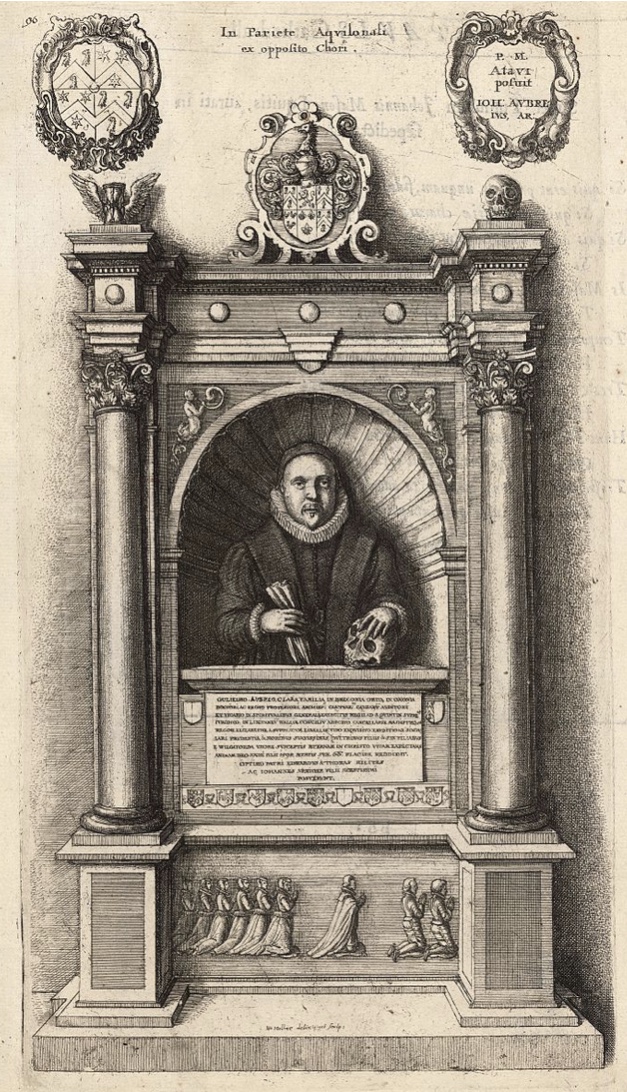
An engraving of Dr William Aubrey’s monument by Wenceslaus Hollar. William’s six daughters and wife are depicted on the bottom, along with two of his sons. It is not known why his third son was not depicted.

William married Wilgiford and the couple produced three sons and six daughters. He died on 25 June 1595 and was buried at Old St Paul’s on 24 July. It’s suggested that his chief clerk, his ‘loving and trusty servant’ Hugh Georges, proved the will on 29 July, then ran away to Ireland with the money. Antiquary and great-grandson John Aubrey stated somewhat tersely, “Georges cosened (deceived) all the legatees.”

As ever, thank you for your interest and support.

Hannah xxx

For Authors

#1 for value with 565,000 readers, The Fussy Librarian has helped my books to reach #1 on 32 occasions.

A special offer from my publisher and the Fussy Librarian. https://authors.thefussylibrarian.com/?ref=goylake

Don’t forget to use the code goylake20 to claim your discount 🙂
Categories
Dear Reader

Dear Reader #134

Dear Reader,

A lovely start to the year. Damaged, my latest Sam Smith mystery, published 15 January 2022, is a #60 hot new release 🙂

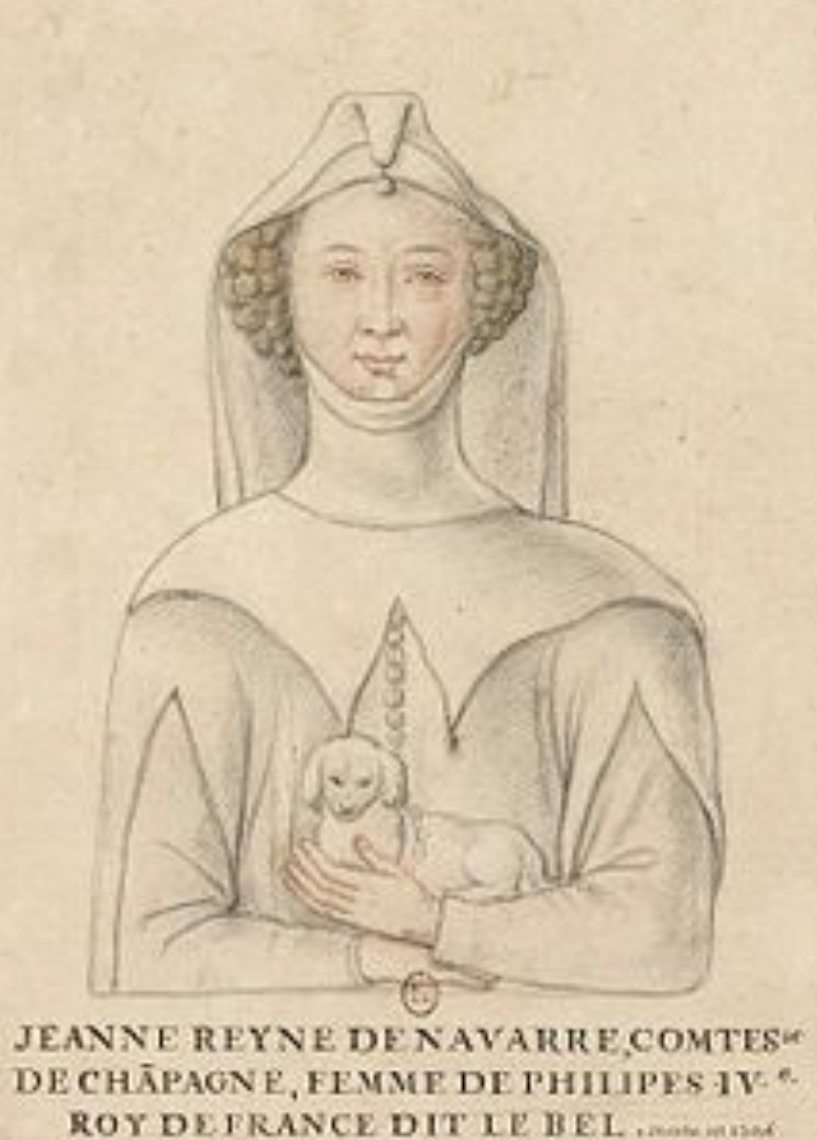
My direct ancestor, Jeanne de Navarra de Champagne (14 January 1273 – 2 April 1305, a bold, courageous and enterprising woman who led an army against the Count of Bar when he rebelled against her. It’s thought that Jeanne, like far too many of my ancestors, died in childbirth.

My direct ancestor, Gwenllian ferch Gruffydd (1090 – 1137). With her husband, Gruffydd ap Rhys, an outlaw who distributed wealth to the poor, ‘like Robin Hood.’ Academic Dr Andrew Breeze argued that Gwenllian wrote the Mabinogion, the tales that influenced Lord of the Rings.

The January 2022 issue of Mom’s Favorite Reads…

Author Features, Genealogy, Poetry, Puzzles, Recipes, Seasonal Articles, Short Stories, National Pharmacist Day and so much more!

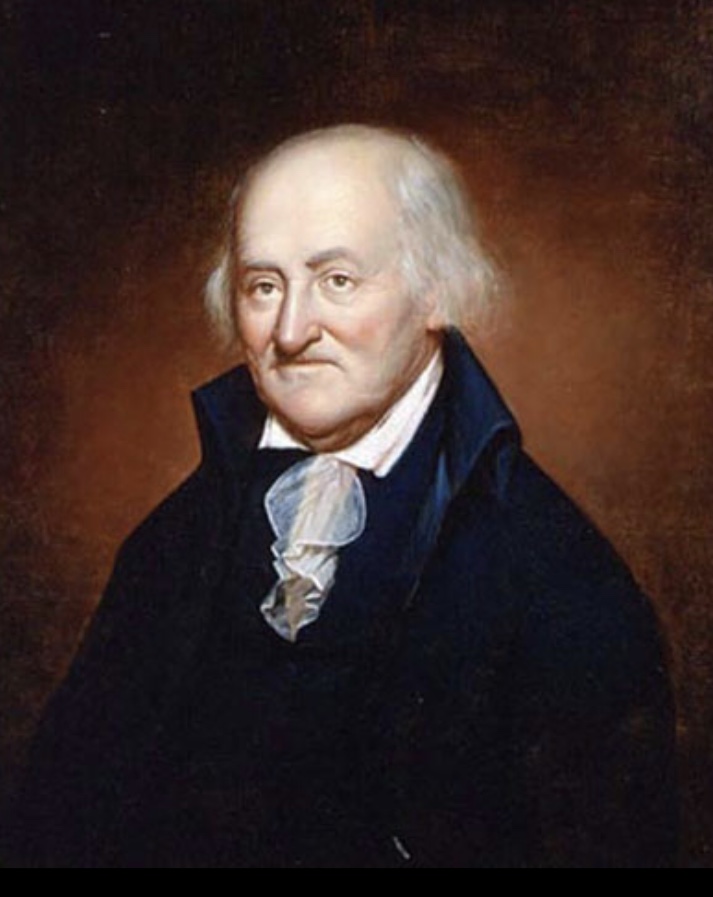
My ancestor, Christopher Gadsden (16 February 1724 – 28 August 1805) was an American politician and the principal leader of the South Carolina Patriot movement during the American Revolution. Furthermore, he was a delegate to the Continental Congress, a brigadier general in the Continental Army, Lieutenant Governor of South Carolina, a merchant, the designer of the Gadsden flag, a signatory to the Continental Association and a Founding Father of the United States.

Christopher Gadsden. Portrait by Charles Fraser.

The son of Royal Navy officer Thomas Gadsden, Christopher was born in 1724 in Charleston, South Carolina. After service in the Royal Navy, Thomas became a customs collector for the Port of Charleston, hence the family association with the area.

Christopher was schooled in England. He returned to America in 1740 and served as an apprentice at a Philadelphia counting house. When his parents died in 1741, he inherited a large fortune, which made him financially secure for life.

Between 1745 and 1746 Christopher served as a purser on a British warship during King George’s War. In 1747, he developed his mercantile ventures and a few years later he built Beneventum Plantation House. 

Slavery was common practice amongst plantation owners in South Carolina. Although Christopher was ambivalent towards this barbarity, nevertheless he did keep and trade in slaves.

As Christopher Gadsden’s businesses prospered, he invested in projects such as Charleston Wharf. Between 1767 to 1787 and 1803 to 1808, it is estimated that forty percent of enslaved people (about 100,000) were brought to America through this wharf.

The Gadsden flag

Christopher was captain of a militia company during a 1759 expedition against the Cherokee. He was first elected to the Commons House Assembly in 1757 and immediately clashed with the autocratic royal governors. His stance brought him to the attention of Samuel Adams of Massachusetts, which resulted in a long correspondence and friendship.

Christopher Gadsden became one of the founders and leaders of Charleston’s Sons of Liberty. In February 1776, South Carolina President John Rutledge named him a brigadier general in charge of the state’s military forces. He played an active roll in the military, often to great personal financial cost.

In 1778, Christopher was a member of the South Carolina convention that drafted a new state constitution. That year he also served as lieutenant governor, stepping down in 1780.

When the British besieged Charleston in 1780, John Rutledge, as president of the council, fled to North Carolina to ensure a ‘government in exile’. However, Christopher remained and representing the civil government he surrendered the city and was taken as a prisoner of war.

As a prisoner of war, Christopher spent forty-two weeks in solitary confinement in a prison room at the old Spanish fortress of Castillo de San Marcos. Gaining his freedom in 1781, he helped to restore South Carolina’s civil government.

Christopher Gadsden was returned to South Carolina’s House of Representatives. He was elected as the governor, but due to poor health sustained during his imprisonment, he declined. In 1788, as a member of the state convention, he voted for the ratification of the United States Constitution.

The Gadsden house in Charleston (Wikipedia).

In 1798, Christopher built an imposing house at 329 East Bay Street in Charleston, a house that remained in the family for more than a century. He married three times and had four children with his second wife. He died, the result of an accidental fall, on 28 August 1805, in Charleston, and was buried in St Philip’s Churchyard.

Christopher Gadsden was born into privilege. A capable and principled man, he achieved a great deal in his life. He was a man of his times and some of his attitudes look dubious today. 

The world of politics is murky at the best of times, and politics was Christopher’s world. To his credit, he wasn’t a populist. Even when it disadvantaged him personally, he stood up for his beliefs, and I feel that history should commend him for that.

As ever, thank you for your interest and support.

Hannah xxx

For Authors

#1 for value with 565,000 readers, The Fussy Librarian has helped my books to reach #1 on 32 occasions.

A special offer from my publisher and the Fussy Librarian. https://authors.thefussylibrarian.com/?ref=goylake

Don’t forget to use the code goylake20 to claim your discount 🙂

Categories
Dear Reader

Dear Reader #133

Dear Reader,

Written by my youngest son 🙂

Christmas at the Front by Rhys age 14.

My direct ancestor, Jeanne de Valois, c1294 – 7 March 1352), Countess consort of Hainaut, Holland and Zeeland. She married William I, Count of Hainault. A skilled mediator, she brokered peace between many warring factions during the first half of the fourteenth century.

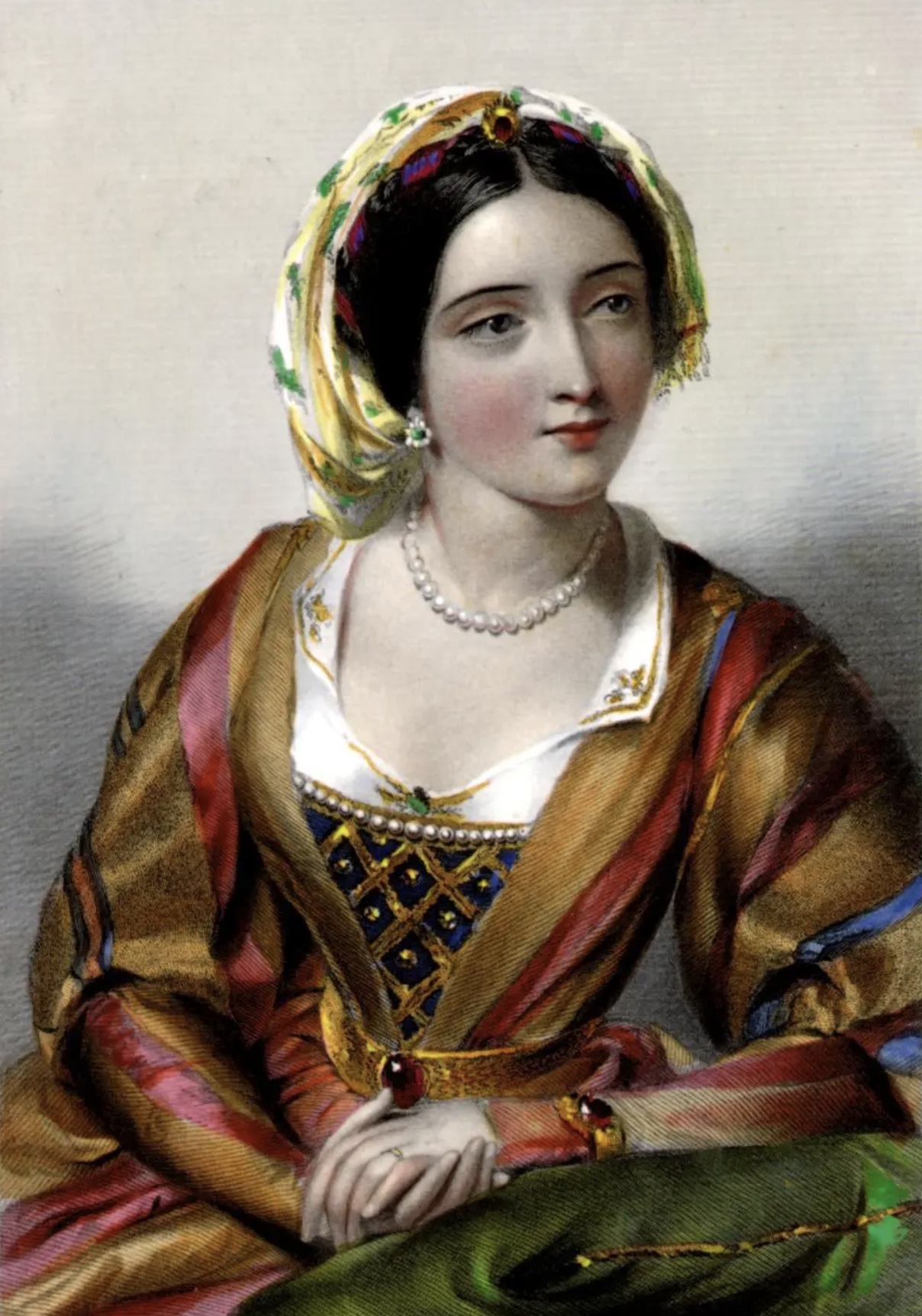
My direct ancestor, Eleanor of Castile, (1241 – 1290), wife of Edward I, a political match that developed into love. Well educated, Eleanor was a keen patron of literature and encouraged the use of tapestries and carpets in the Spanish style. She was also a keen businesswoman.

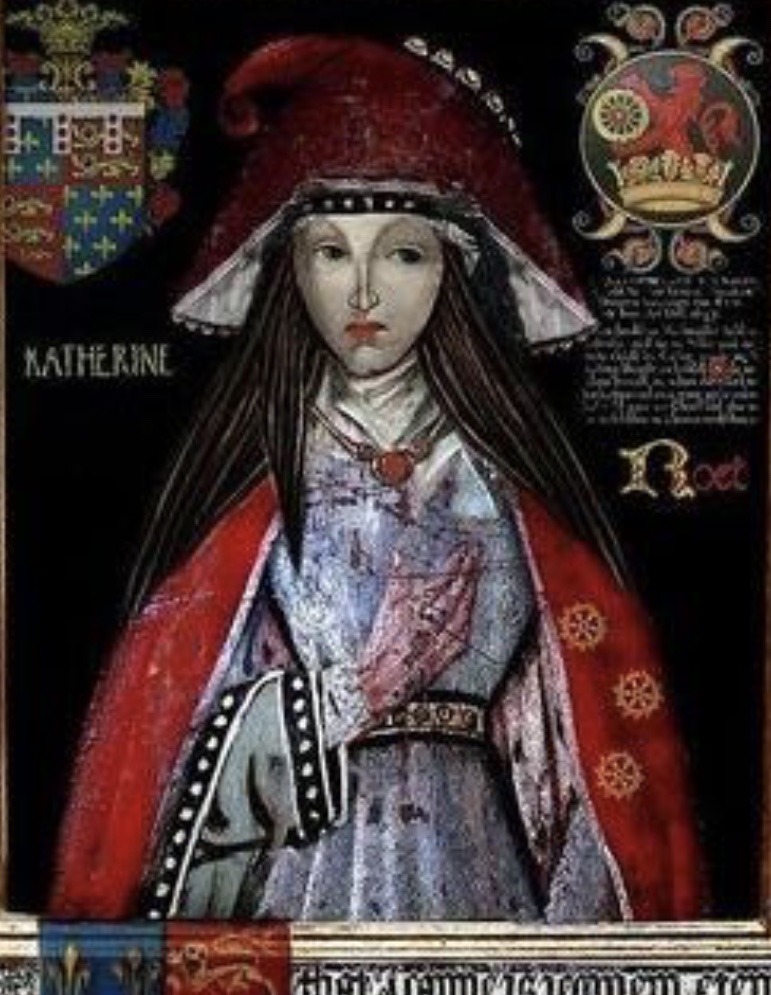
While tracing the Stradling branch of my family tree, I discovered a direct connection to Katherine Swynford, Duchess of Lancaster.

Born Katherine de Roet, Katherine is thought to be the youngest child of Paon (aka Payn) de Roet, a herald and later a knight. Her birthdate is uncertain, although some sources place it on 25 November 1350 in Hainaut, Belgium.

Katherine Swynford

Around 1366 at St Clement Danes Church, Westminster, Katherine married Sir Hugh Swynford. From Lincolnshire, Sir Hugh was in the service of John of Gaunt, a son of Edward III and arguably the most powerful man of his age. For Katherine, this was a political not a love match and we can only imagine her feelings as she embarked upon a new life with Sir Hugh.

As Lady Swynford, Katherine gave birth to the following children: 

Blanche (born 1 May 1367)

Sir Thomas (21 September 1368 – 1432)

And possibly Margaret Swynford (born c1369), later recorded as a nun in Barking Abbey

Katherine served John of Gaunt, a charismatic, chivalric knight, as governess to his daughters, Phillippa of Lancaster and Elizabeth of Lancaster. In turn, John of Gaunt was named as the godfather of Katherine’s daughter, Blanche. At this stage it was evident that Katherine and John of Gaunt were close. In due course, that relationship became more intimate.

John of Gaunt’s wife, Blanche of Lancaster, died on 12 September 1368 of the plague. A few years later, after the death of Sir Hugh on 13 November 1371, Katherine and John of Gaunt embarked upon a love affair that produced four children out of wedlock. The children were:

John, 1st Earl of Somerset (1373 – 1410)

Henry, Cardinal Beaufort (1375 – 1447) My direct ancestor.

Thomas, Duke of Exeter (1377 – 1426)

Joan, Countess of Westmorland (1379 – 1440)

The illicit relationship continued until 1381 when it was truncated for political reasons. The ensuing scandal damaged Katherine’s reputation, and we can only imagine her feelings at losing John of Gaunt, the man she truly loved, and the gossip around court.

John of Gaunt

Another union for political reasons followed: John of Gaunt’s marriage to Constance of Castile (1354 – 24 March 1394). On 13 January 1396, two years after Constance’s death, Katherine and John of Gaunt were married at Lincoln Cathedral. Subsequently, the Pope legitimised their four children.

Katherine lived through many of the major events of the fourteenth century including the Black Death, the Hundred Years’ War and the Peasants’ Revolt. At the royal courts she met the greatest personalities of her age. While the London courts were often flamboyant and licentious she was also familiar with the pastoral aspects of Lincolnshire. Both locations must have offered a sharp contrast to her childhood in Hainaut.

When John of Gaunt died on 3 February 1399, Katherine was then styled as ‘Dowager, Duchess of Lancaster’. She outlived him by four years, dying on 10 May 1403 in her early fifties.

Katherine’s descendants were members of the Beaufort family, the name assigned to her children. This family played a major role in the Wars of the Roses when Henry Tudor, the future Henry VII, derived his claim to the throne from his mother, Margaret Beaufort, a great-granddaughter of Katherine and John of Gaunt. Furthermore, five American presidents are descended from Katherine.

Katherine has been the subject of numerous novels, including Anya Seton’s Katherine, published in 1954, and non-fiction works including Katherine Swynford: The Story of John of Gaunt and His Scandalous Duchess by Alison Weir.

Geoffrey Chaucer

A footnote to Katherine’s story. Her sister, Phillipa, married Geoffrey Chaucer, thus placing the great poet on my family tree.

As ever, thank you for your interest and support.

Hannah xxx

For Authors

#1 for value with 565,000 readers, The Fussy Librarian has helped my books to reach #1 on 32 occasions.

A special offer from my publisher and the Fussy Librarian. https://authors.thefussylibrarian.com/?ref=goylake

Don’t forget to use the code goylake20 to claim your discount 🙂