
Thursday 27 December 1962
Boxing Day Rail Disaster – Express Ploughs Into Crowded Train. Seventeen Killed. Fifty Injured. The Glasgow to London train ploughed into the back of a mainline train. The crash came in a snow storm near Wingsford, Cheshire. An inquiry is ongoing.
The holiday road death toll was down 25%, but heavy snow, ice and slush brought new dangers last night. The RAC said, “There were few cases of bad driving and the 50mph speed limit has been observed.”
Nineteen football matches were called off and three abandoned because of frozen pitches. All ten Rugby League and most of the Rugby Union matches were called off.
Salvation Army bandsmen playing Christmas carols in Sunderland had to stop because of frozen trombones.
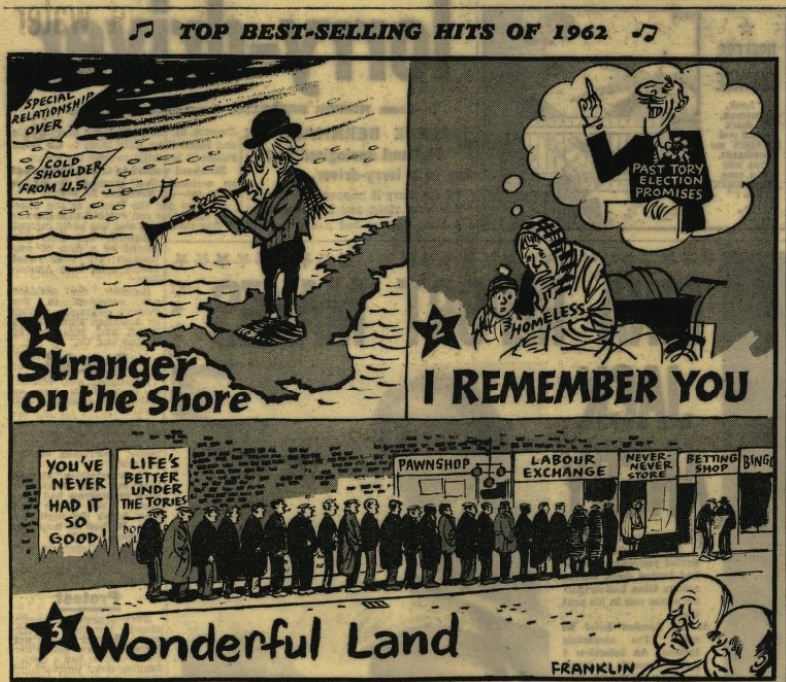
The disc they can’t forget – Frank Ifield’s I Remember You, which has just been voted the single of the year by disc columnists in a poll organised by Melody Maker. Acker Bilk came second with Stranger on the Shore. Let There Be Love by Nat Cole and George Shearing was third.
The women of Dungeness, Kent defeated their menfolk in the village’s annual tug o’ war.
Television highlights: Sooty and Sweep, Professional Boxing, The Royal Ballet.
Radio highlights: Housewives’ Choice, Smash Hits.
Weather: mainly cloudy with rain and sleet. 3c 37f.
Friday 28 December 1962
No Let-Up in White Nightmare. The Big Shiver Goes On Today. Threat To Sport at Weekend. The Big Freeze kept a firm grip on slip-slide Britain last night. And there is NO SIGN of a thaw. The roads were grim and grisly with snow up to a foot deep. The trains ran late with restricted services. A spokesman said, “We are in dire trouble.” And sport is faced with a big fade-out at the weekend.
The Duke of Windsor said “No comment” about his reported talks with Nazis in the mid-1930s. In official documents published today the Duke apparently spoke well of Hess and wished to meet Hitler. He disapproved of Britain siding with the French.
Television highlights: Johnny Mathis, A Suspicion of Poison – Chemical Fertilisers and Food, Gardening Club with Percy Thrower.
Radio highlights: Folk Weave, Time For Old Time, Refugee Conversations.
Agony Aunt. Is my husband right when he says that most men sleep on the left-hand side of the bed? Jane Adams’ reply: He’s wrong. Most men sleep on the right-hand side of their wives.
After being delayed on his journey from Merthyr to London, Howard Winstone, British featherweight champion, enjoyed a double-quick win over American Teddy Rand last night. It was all over half-way through the third round. I have never seen the Welshman in such a devastating mood.
On tour in America, singing star Shirley Bassey, 25, has lost her voice. Her friend, model Hazel Graham said last night, “It’s this wretched central heating. It’s not the temperature so much as the dryness.”
Weather: more snow, cold. Outlook – continuing cold with further snow.

Saturday 29 December 1962
There’s no sign of a let-up in the Big Freeze. Water shortages are expected and people are being warned to keep off the ice.
Days lost to strikes in 1962: 5,717,000. Days lost to strikes in 1961: 2,970,000.
A nightclub guitarist stopped at customs had 1 1/4 lb of Indian hemp – worth £500 – sewn into his waistcoat a court heard yesterday. The guitarist, Peter Watson, told the court: “I was bringing it in to sell in coffee bars.” He was fined £200, or four months in prison.
Between 1950 and 1961, the number of women working part-time in industry rose by nearly 100,000 to a total of 390,700 the Labour Ministry said. Most of these women were married.
One in every eight babies born in London last year was illegitimate. The number has soared over the past six years to reach 7,632 in 1961. This is twice the rate for the rest of the country. A London welfare worker blamed drink and higher incomes for the illegitimate births. “There are too many girls living in bedsits and throwing bottle parties,” she said.
Three masked men in shortie raincoats snatched about £1,100 in a raid at London’s docks yesterday. However, the gang missed a box containing a larger sum of money.
Television highlights: 77 Sunset Strip, The Adventures of Jane, Have Gun Will Travel.
Radio highlights: Requests, Transatlantic Tops.
It looks like being a weekend for the can opener as far as vegetables are concerned. The bad weather means that most greengrocer’s shelves are now bare.
Only nineteen matches in the four English football leagues have survived the weather – and some of them might be called off.
Weather: Very cold with snow and fog. 0c 32f.

Sunday 30 December 1962
Snow, ice, fog, frost, freezing rain. The old, cold year of 1962 is slipping and slithering out. The whole of Britain is in deep-freeze with every county hit by snow and ice. Last night, Devon Police were planning a helicopter drop of bread to Dartmoor Prison, which was cut-off by snow drifts. The River Thames was frozen for a quarter of a mile at Windsor, the first time such a stretch has been frozen since 1947.
At La Roche-sur-Yon in western France they had pink ice. A tanker overturned and 1,500 gallons of wine flowed into the river, turning the water pink.
Lessons on income tax and higher purchase agreements will be given to secondary school children next year. The aim of the lessons is to help older children with money matters and make them aware of the dangers of never-never agreements.
From Tuesday it will be illegal to keep mink without a £5 licence.
Television highlights: Z Cars. Sunday Night at the London Palladium with Vera Lynn. Music For Dreaming.
Radio highlights: Pick of 1962 Pops. Top Twenty.
Football: 42 matches called off. Only two games played in Division One: Burnley 4 Sheffield Wednesday 0, Nottingham Forest 3 West Ham 4.
Weather: cold or very cold with snow.

Monday 31 December 1962
Day of the Cruel Snow. Blizzard-lashed Britain is tackling the snow and ice chaos that has brought the country to a freezing halt. “It’s going to be grim,” say the AA. “Leave your car at home.” British Railways warn, “Expect delays and cancellations.”
The White Horror blocked 95,000 miles of road yesterday. Motorists abandoned snow-bound cars and many villages were cut-off. The heroes of the snow were still working early today – helicopter pilots, road rescue teams, ambulancemen, railmen and milkmen.
One fire in every seven is caused by an unstubbed cigarette end. Mr Denis Lawson, director of the Fire Research Station at Elstree said, “The burning cigarette end is certainly the villain of our piece. We don’t know why, but smokers appear to be increasingly careless with their butts.”
I spent half an hour yesterday cleaning the snow from my car – then I discovered that it belonged to the guy next door.
Television highlights: New Year Party at the White Heather Club, Hogmanay, Sing in the New with Ewan MacColl and Peggy Seeger.
Radio highlights: Big Ben at twelve. New Year Revels.
Sixty-seven football league games were knocked out of the programme between 22 and 29 December, and more than a million fans got the cold shoulder from the postponements. Now, another week of chaos threatens soccer. Should clubs install under-soil heating? Or is summer soccer the answer?
Weather: still cold with snow at times.

Coming soon, Songbird, my novel set in the winter of 1962-63
https://books2read.com/u/bMqNPG

New Release
Hollywood, 1948
My name is Dana Olsen. In my early twenties, I arrived in Hollywood with dreams of becoming a screenwriter. Instead, I found myself attached to a leading movie producer, running errands. Then, when a famous movie director was murdered, events embroiled me in the murder enquiry, and thrust me into the arms of a handsome detective who was investigating the case.
The murder enquiry was the sensation of the age, and its solution threatened to tear down the foundations of Hollywood itself.
***
For Authors
#1 for value with 565,000 readers, The Fussy Librarian has helped my books to reach #1 on over thirty occasions.
A special offer from my publisher and the Fussy Librarian. https://authors.thefussylibrarian.com/?ref=goylake
Don’t forget to use the code goylake20 to claim your discount 🙂










 Hannah Howe