
1920s Flapper Slang
Fire alarm – a divorced woman
Fire bell – a married woman
Fire extinguisher – a chaperone
Forty-niner – a man looking for a rich wife
Handcuff – an engagement ring
Hush money – a young woman’s allowance
Munitions – a woman’s make-up

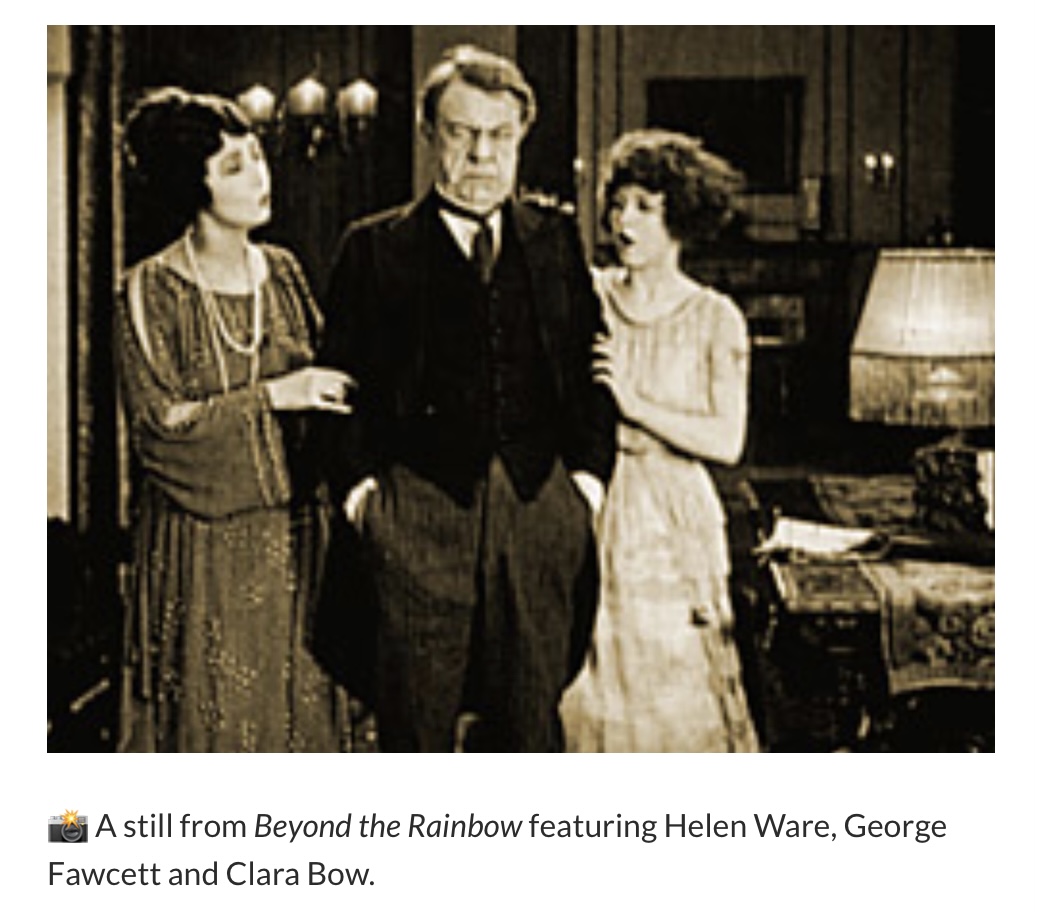
Clara Bow, the superstar of the era, made her debut in Beyond the Rainbow. Filmed in New York in 1921, when Clara was sixteen, the movie went on public release on February 19, 1922. A 16mm print of the film still survives.
The plot is a decent one: guests arrive at a party and are passed a mysterious note saying, ‘Consult your conscience. Your secret is common gossip.’ All the guests have something to hide, so panic and murder ensue.
The note was written by Clara’s character, Virginia Gardener, as a mischievous joke. It’s ironic that in her first movie Clara was the instigator of chaos because, in her own iconic way, that set the tone for her career.
Clara appeared in five scenes in Beyond the Rainbow, but strangely those scenes were cut from the final print, only to be restored when she became a star. Her billing also moved up from ninth to third when she achieved stardom.
Alvin ‘Shipwreck’ Kelly, 1893 – 1952, achieved fame in the 1920s and 1930s as a pole sitter. He calculated that he spent 20,613 hours sitting on flagpoles, including 210 hours in sub-freezing weather and 1,400 hours in the rain.
Kelly married Frances Vivian Steele, an elevator operator, a match clearly made in heaven, or at least close to it.

The #1 song in 1920, Dardanella, recorded by Ben Selvin and his Novelty Orchestra. Released in December 1919, the song reached number one the following month and remained there for thirteen weeks. Selvin’s recording broke records by becoming the first record to sell more than three million copies. It eventually sold five million and became the second-highest single of the 1920s.
Many artists covered the song, including Acker Bilk, Bing Crosby and Louis Armstrong, plus Geoff and Maria Muldaur.

Football
A talented Wales team featuring Willie Davies, Ted Vizard and Fred Keenor (pictured) won the 1923-24 British Home Championship thanks to victories over Scotland, 2 – 0 at home, 2 – 1 against England (away) and 1 – 0 against Ireland (away). The game against Ireland was a tumultuous affair decided by a Moses Russell penalty.
Scotland finished second, Ireland third, and England fourth.

Television
In 1921, Charles Francis Jenkins (pictured) incorporated Jenkins Laboratories in Washington D.C. with the purpose of “developing radio movies to be broadcast for entertainment in the home”.
In 1922, Jenkins demonstrated his television principles by transmitting a set of static pictures from Washington D.C. to a navy station in Anacastia by telephone wire.
In 1923, Jenkins demonstrated “true” television, transmitting 48-line moving silhouette images at 16 frames per second from Washington to Anacostia Navy station.
A year later, enter John Logie Baird who demonstrated a semi-mechanical television system, transmission moving silhouette images in Britain.
Literature
Published in 1922, The Beautiful and the Damned by F. Scott Fitzgerald. Set in New York City, the plot follows a young artist Anthony Patch and his flapper wife Gloria Gilbert who become “wrecked on the shoals of dissipation” while excessively partying at the dawn of the hedonistic Jazz Age.
Fitzgerald modelled the main characters on himself and his wife Zelda, detailing their tempestuous marriage. Three years later, the author covered similar themes of self-absorption and hedonism in his novel The Great Gatsby.

Tula, my novel set in the 1920s
For Authors
#1 for value with 565,000 readers, The Fussy Librarian has helped my books to reach #1 on 32 occasions.
A special offer from my publisher and the Fussy Librarian. https://authors.thefussylibrarian.com/?ref=goylake
Don’t forget to use the code goylake20 to claim your discount 🙂

 Hannah Howe