
Music Notes
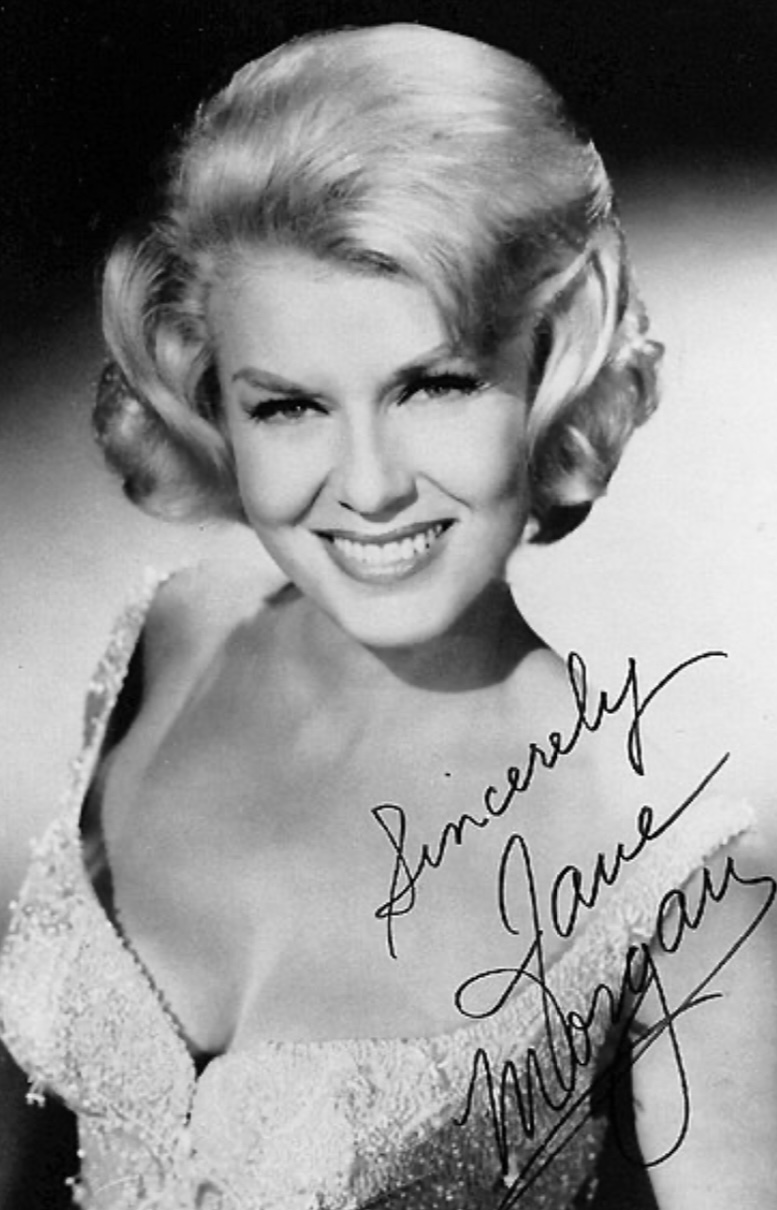
Jane Morgan (pictured) enjoyed a long career on Broadway, on record, on television, and in nightclubs and movies. Her career blossomed in America and Europe, and featured a number of million sellers including The Day the Rains Came (number one in Britain in 1959), which she released as a double A side, an English version of the song and a French version – Le jour où la pluie viendra.
Later in her career, Jane Morgan released an answer song to Johnny Cash’s A Boy Named Sue called A Girl Named Johnny Cash. She performed this song on Cash’s television show, 1971. Check it out, it’s clever and amusing.
Jane married twice and her second husband, Jerry Weintraub, was instrumental in Elvis Presley’s re-emergence in the early 1970s.
Jane Morgan celebrated her 100th birthday on 3 May 2024.
Some artists write and record a song in half an hour. With ‘More Than a Feeling’, Boston’s Tom Scholz took five years. During that time, Scholz worked for Polaroid, and used his wages to build a recording studio in his basement. Boston’s rich sound, built around Scholz’s harmonised guitars and Brad Delp’s long-held notes, arguably, created the blueprint for the American rock sound of the mid to late seventies.
Incidentally, Scholz cited ‘Walk Away Renee’, the Left Banke version, as his main ‘More Than a Feeling’ influence.
***
A pop music curiosity: The Specials’ Too Much Too Young (1980), at just under two minutes, was the shortest number one since the Beatles’ From Me to You (1963).
“And every song was short and sweet, and every beat was fast
And every paper in the land said rock-and-roll won’t last
You know it just won’t last, it’s such a rapid burn.”
Class of ‘58 – Al Stewart
***
Originally established in 1931 to broadcast in German and French, in 1933 Radio Luxembourg began Sunday broadcasts in English on 208 metres medium wave. After 1945, the station broadcast an English service daily and introduced a new feature – a top twenty based on sheet music sales.
With the BBC indifferent to popular music, Radio Luxembourg’s evening shows became an important source for British listeners. Indeed, the station dominated the pop music airwaves until the arrival of pirate radio ships in 1964.

In 1971 Radio Luxembourg abandoned its pre-recorded shows and adopted an “all live” format with disc jockeys presenting their programmes from Luxembourg.
In the late sixties and early seventies strong competition from BBC Radio 1 and British commercial radio stations reduced Radio Luxembourg’s audience. Listeners also preferred the cleaner sound of the BBC programmes to Radio Luxembourg’s “fade in-fade out” reception.
Despite the heavy hand of sponsors interrupting the music, and the dodgy reception, Radio Luxembourg played an important part in the development of 1960s pop culture.
For Authors
#1 for value with 565,000 readers, The Fussy Librarian has helped my books to reach #1 on 36 occasions.
A special offer from my publisher and the Fussy Librarian. https://authors.thefussylibrarian.com/?ref=goylake
Don’t forget to use the code goylake20 to claim your discount 🙂


 Hannah Howe