Categories
Dear Reader

Dear Reader #106

Dear Reader,

Where there’s a will there’s a murder, and my 12 x great grandfather Thomas Brereton (born 1555) was implicated 😱 The case reached the Star Chamber, who produced a report covering 106 large sheets of parchment. Was Thomas innocent or guilty? More research required…
My latest translation, the Portuguese version of A Parcel of Rogues.

My 7 x great grandfather Sandford Brereton was a Norwegian rug maker in Cheshire in the 1730s. Here’s a design from that period. I shall endeavour to discover how he became involved in that trade.

A scene familiar to my London ancestors, London Bridge looking north to south, 1890.

Many of my Welsh ancestors were agricultural labourers. A local view, taken today, and an image they would be familiar with.

The Dent branch of my family dates back to Sir Roger Dent, born in 1438, a Sheriff of Newcastle in the north-east of England. The line continued through his son, also Sir Roger and a Sheriff of Newcastle, to Robert, William, James and Peter until we arrive in the seventeenth century with the birth of my 12 x great grandfather the Rev Peter James Dent.

Peter was born in 1600 in Ormesby, Yorkshire. In 1624, he married Margaret Nicholson the daughter of the Rev John Nicholson of Hutton Cranswick in the East Riding of Yorkshire. Margaret was baptised on 8 March 1602 at Horton in Ribblesdale, Yorkshire.

The couple had five children:

William, my direct ancestor, born 1627

Peter, born 1629

Thomas, born 1631

George, born 1633

Stephen, born 1635

Dorothy, born 1637

In 1659, Thomas emigrated to Maryland with his cousin John Dent and his nephew Nicholas Proddy.

The Rev Peter James Dent was a Professor of Natural Sciences at Cambridge University and practiced medicine as an apothecary.

An apothecary. Image: Science Museum.

In addition to dispensing herbs and medicines, an apothecary offered general medical advice and a range of services that nowadays are performed by specialist practitioners. They prepared and sold medicines, often with the help of wives and family members. In the seventeenth century, they also controlled the distribution of tobacco, which was imported as a medicine.

Medicinal recipes included herbs, minerals and animal fats that were ingested, made into paste for external use, or used as aromatherapy. Some of the concoctions are similar to the natural remedies we use today. 

Along with chamomile, fennel, mint, garlic and witch hazel, which are still deemed acceptable, apothecaries used urine, fecal matter, earwax, human fat and saliva, ingredients discredited by modern science.

Experimentation was the name of the game. Detailed knowledge of chemistry and chemical properties was sketchy, but if something worked, such as drinking coffee to cure a headache, it became the elixir of the day.

A page from the Voynich Manuscript a book, possibly, used by apothecaries.

Peter left a Will, which I include here in his own words, for they offer a great insight into his life and times.

In the name of the Lord God my heavenly father and of Jesus Christ my sweet Saviour and Redeemer, Amen.

I, Peter Dent of Gisbrough in the County of York, apothecary, being in health and perfect memory, blessed be the name of God, doe make this my last will and testament the ffifth day of August one thousand six hundred seventy and one, hereby revokeing and making void all wills by me formerly made.

Ffirst, I give and bequeath my soule into the hands of the Allmighty, my blessed and heavenly Creator and Maker, fullly believing to be saved by faith in his mercy throught the meritts of Jesus Christ my alone redeemer and Saviour, my advocate, my all in all.

Item, I bequeath my body to the earth whereof it was made and the same to be buried in the parish of Gisburne aforesaid at the discrecon of my wife and friends.

Item, my will is first that my debts be paid and discharged out of my estate which being done, I give and bequeath unto my sonne Wm Dent all the estate and interest that I have in the dwelling house in Gisbrough aforesaid, wherein he, the said Wm Dent doth now inhabitt, he paying the rent and taxes lyable for the same.

Item, I give and bequeath to my wife, my house & garden and backside, which is in northoutgate called northoutgate house and garden, as alsoe the shep and stock in itt under the tollbooth and the two closes called the Turmyres and which I hold under Edward Chaloner of Gisbrough, Esq.

Item, I give and bequeath to my sonne Peter Dent halfe of all my goods belonging to my Apotheray trade or the value of them, with all the instrunts and other things belonging to itt, my debt books, all other my bookes, one great morter excepted.

Item, I give to my said sonne Will’m Dent the somme of ten pounds.

Item, I give to my sonne Thomas Dent tenn pounds.

Item, I give to my sonne George Dent the sume of tenn pouonds.

Item, I give to my sonne in law Oliver Prody my great brasse morter now in his shop as alsoe the summe of tenn pounds.

Item, I give to my daughter Dorothy Prody, wife of the said Oliver Prody, the summe of ten pounds and thirteen shilllings and foure pence to buy her a mourning ring.

Item, I give to each of my grandchildren which shall be living at my death tenn shillings as a token of my fatherly blessing upon them.

Item, I give to my daughters in law every one of them a mourneing ring about thirteene shillings foure pence a piece.

Item, I give to the poore of Ormsby five shillings.

Item, I give to Sarah & Abigail Nicholson, James Paul & Elizabeth Dugleby, each of them five shillings.

Item, I give to my sister Eliz. Prody 10s, to Kath Clark & Jane Con each of them 5s & to Eliz & Jane Prody 5s a piece.

Item, I give to (Christ)inna Dent, daughter of my brother Geo Dent, dec’ed, the sume of 10s.

Item, all the rest of my goods, moveable and unmoveable, I give & bequeath to my wife & desire her to discharge my funerall charges & expences not exceeding, but in a decent maner. And I give to the poore of Gisbrough ten pounds to be disposed as she shall think fitt.

Item, I do make my wife Margret Dent sole Executrix of this my last will and testa’nt & desireing her that my daughter Dorothy Proddy if living at my death may have after her mothers death the Northoutgate house and garden and all that belongings to it, except a lodging to my sonne George Dent in the said house dureing his batchlourship onely.

Item, I desire, nominate and appoint my cozen Thomas Proddy and my cozen Thomas Spencer to be sup’visors of this my last will and to each of them I give tenn shillings.

In witness whereof I have here unto sett my hand and seale the day and yeare above written.

Peter Dent

Sealed and published in the p(re)sence of

Ger. Ffox

Ja Wylnne

5 Oct 1671 – probate issued

As ever, thank you for your interest and support.

Hannah xxx

Bestselling psychological and historical mysteries from £0.99. Paperbacks, brand new in mint condition 🙂
https://hannah-howe.com/store/
Categories
Dear Reader

Dear Reader #94

Dear Reader,

On the trail of my 4 x great grandmother Sarah Foreman who packed her bags in the 1820s and left rural Lincolnshire to nurse in London. On 24 March 1834, Sarah married John Glissan, a surgeon. When John died in 1854, Sarah established herself as a dentist, chemist and monthly nurse, looking after newborn babies.

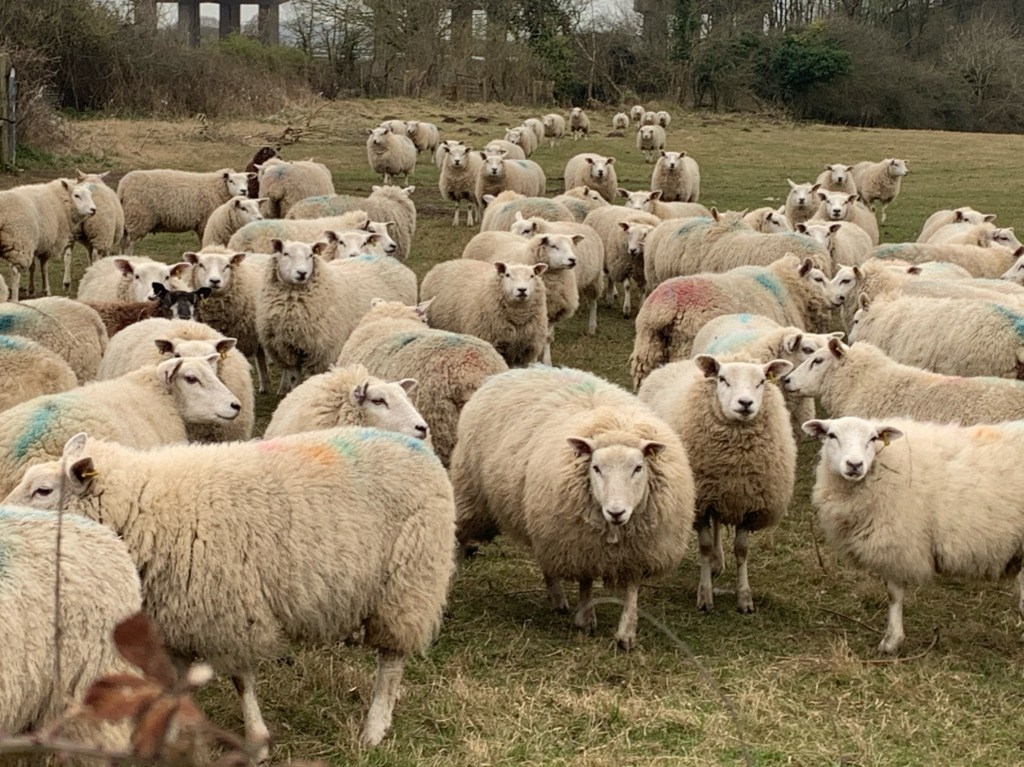
We’ve got the builders in 😉 And here’s some sheep 🐑


The Stokes branch of my family were carpenters for centuries, with fathers handing on the skills of the trade to their sons. 

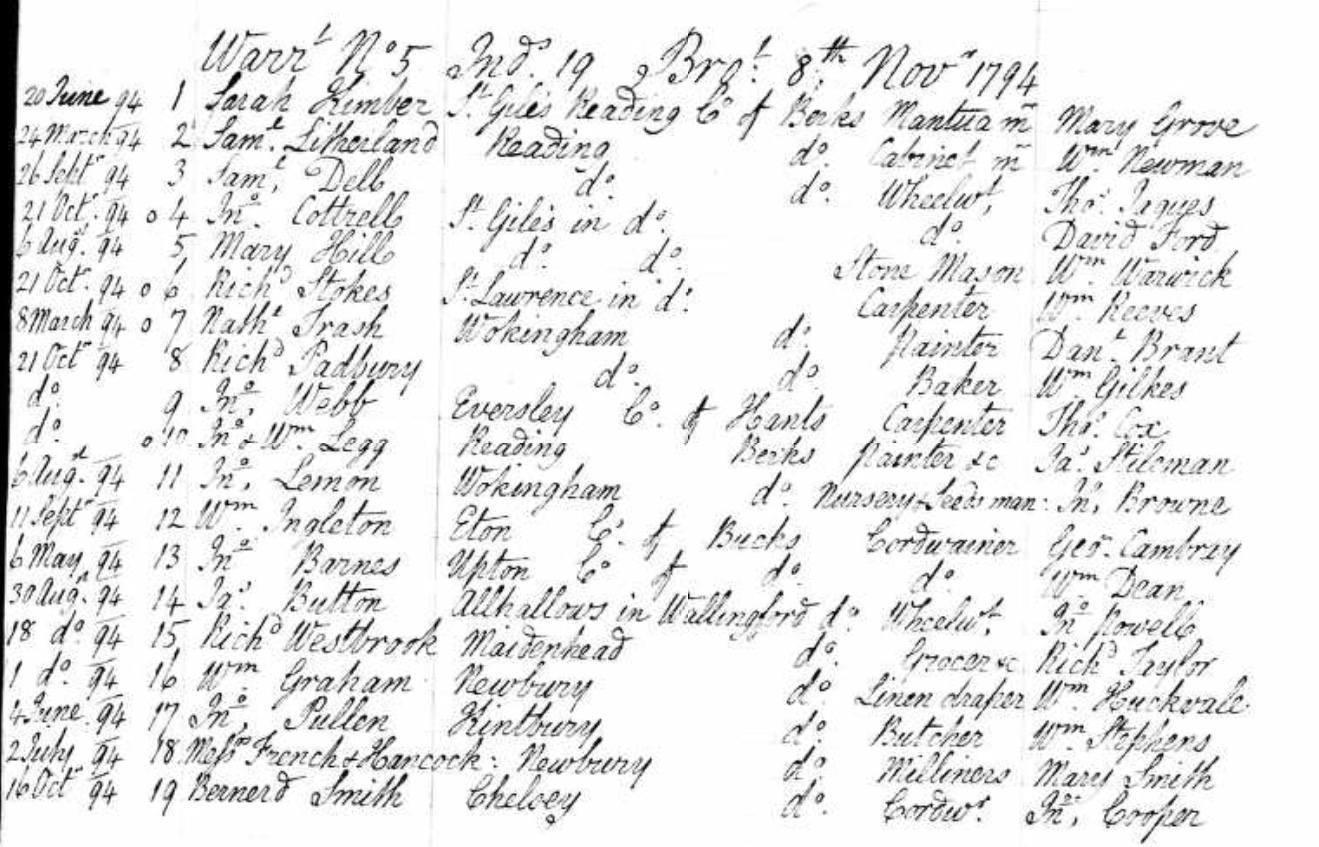
Here is a document from 21 October 1794 when my 5 x great grandfather Richard Stokes took on an apprentice, William Reeves.

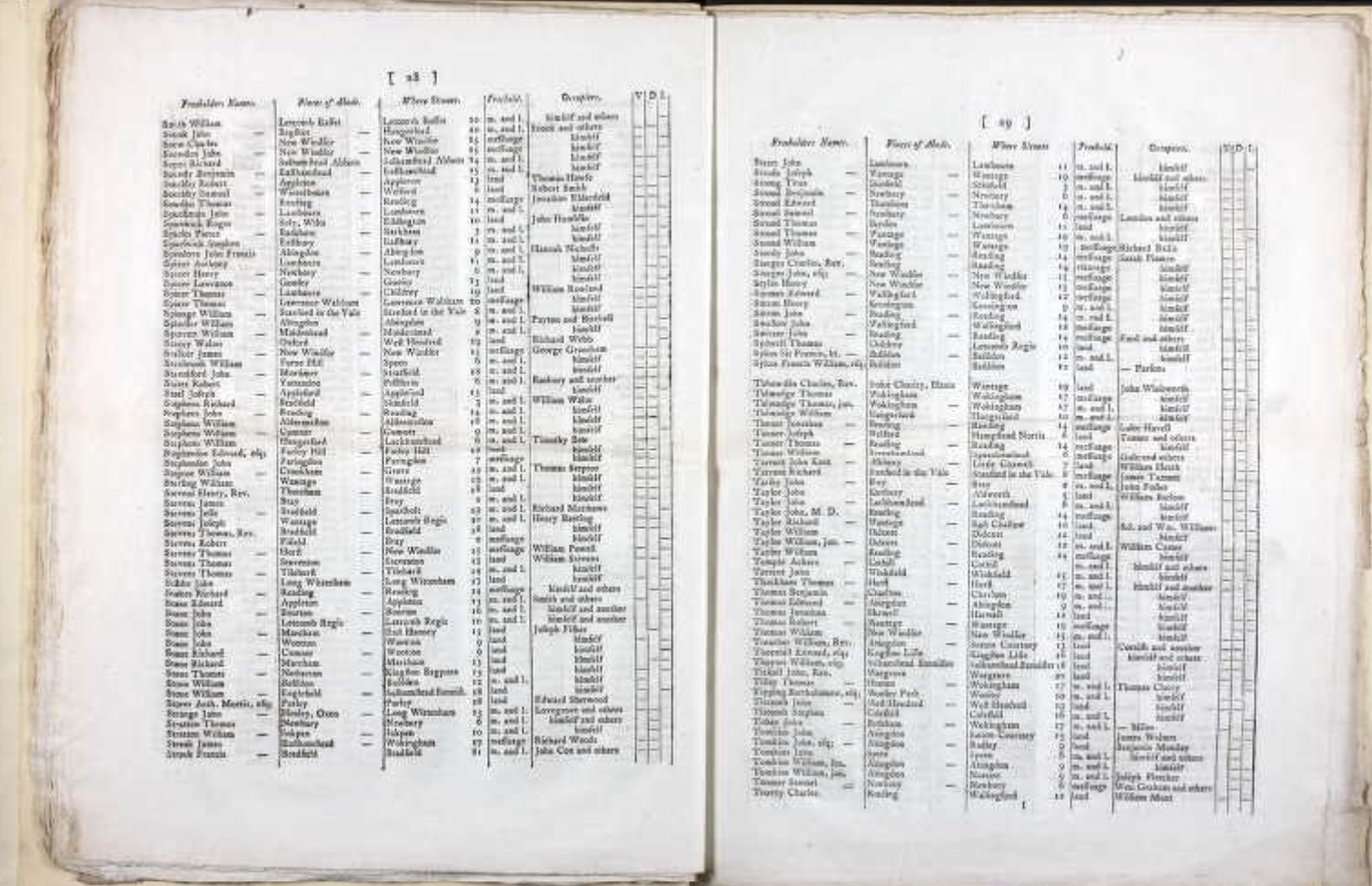
Along with his carpentry business in Pangbourne, Berkshire, Richard also owned a messuage in nearby Reading.

Richard married Martha in 1800. Unfortunately, Martha’s surname was not recorded on marriage or birth records so it isn’t possible to explore her branch of my family tree. She died young, in 1817.

Richard and Martha only had two children: Martha, who sadly died aged ten, and my direct ancestor, William. William broke the family tradition, which went back to the 1600s, when he turned his back on carpentry and moved to London. However, his son and my direct ancestor Richard resumed the trade.


From the 1930s. Hefty girls wanted. Must be ‘fairly good looking’ with no interest in marriage.


My 4 x great grandfather Henry Wheeler was born on 29 November 1797 in Westminster, London to Thomas Wheeler and Ann Fluin.

Henry married twice. First to Elizabeth Mitchell on 19 August 1817 then when Elizabeth died in 1844 he married Mary Ann Thorp of Colchester, Essex, a woman eighteen years his junior. Henry’s first marriage produced eight children while his second produced four, including my 3 x great grandmother Nancy Wheeler who changed her name to Annie Noulton.

Various censuses describe Henry as a labourer while Mary Ann’s mother, Hannah, was a straw hat maker, so maybe Mary Ann followed that trade. However, Henry also had another line of ‘work’, which resulted in regular visits to the Old Bailey.

The first evidence of Henry’s brushes with the law appear in 1817 when aged twenty in association with William Murray aged sixteen he was accused of stealing a set of harnesses value 20 shillings from Serach Atkinson. Henry duly stood trial and from the Old Bailey website https://www.oldbaileyonline.org/ here is an account of that trial.

Eighteenth century trial at the Old Bailey

HENRY WHEELER and WILLIAM MURRAY were indicted for stealing, on the 13th of January, one set of chaise harness, value 20 shillings the property of Serach Atkinson.

SERACH ATKINSON. I am a plasterer, and live in New court, Chapel-street, Westminster. On the 13th of January, between six and seven o’clock, I missed my harness from my passage, where it usually hung. My brother had it out that day. That is all I know.

JAMES GILLMORE. On Monday evening, the 13th of January, the prosecutor came to me, stating that he had lost his harness, and who he suspected to have stolen it. About twenty minutes afterwards the prosecutor came to me with part of the harness, (the collar and traces), after that he sent for me to take Murray into custody-which I did. I went with Murray to Wheeler’s house, and took him into custody. Wheeler’s friends threatened to prosecute Murray, for inducing Wheeler to commit the robbery. The next morning the prosecutor brought me the other part of the harness, which he said, in the prisoner’s presence, was delivered to him by Wheeler’s friends.

(Property produced and sworn to).

J’Accuse Henry Wheeler

ATKINSON re-examined by the Court. I got the harness from Murray. I had seen him that night. I do not know where the harness hung up that night. I do not know where it was.

Q. Did you never say, it hung behind the street door in the passage – A. I might. I do not know that it did

Q. Will you swear that it was not hanging there – A. I do not know. I did not see it there at all. I did not see it there that day; my brother had it out.

Q. Did you not tell the magistrate, that it hung up in the passage leading to the street door, and that the prisoner must go through that passage to go out – A. I do not know. I suspected Murray, by his calling on me; I missed it about half an hour afterwards. I had not seen it that evening.

Q. After you had seen Gillmore, where did you go to – A. Into Tothill-street, to Murray’s, he is a harness-maker, Wheeler was selling the harness there.

Q. How came you to tell me that you knew no more about it – A. It did not strike me then; I met him at this end of Tothill-street, the sadler’s is in the middle.

Q. Will you swear he was at the end of the street – A. Yes.

Q. How came you to swear that Murray was waiting at the other side of the street – A. Wheeler gave me part of the harness, and brought the other part home.

Q. Why did you not tell me this story before – A. I do not know.

Q. Is what you swore before the magistrate true or not? Which story do you stick by, what you swore before the magistrate, or what you say here – A. I stick by what I say here.

NOT GUILTY.

Second Middlesex Jury, before Mr. Recorder.

Acquitted (on this occasion) Henry Wheeler

Henry disappeared from the historical record for gaps of several years. This is not unusual. However, the gaps between his first and second born children with Elizabeth Mitchell and Mary Ann Thorpe, nine years on each occasion, are very unusual. These women were fertile and produced children on average every two years. So why the infertile periods? The records don’t offer conclusive proof, but given Henry’s background it seems certain that he was in prison on each occasion. 

The situation is easy to imagine: Henry married Elizabeth then she gave birth. Surviving on a pauper’s wages and with a wife and baby to feed he resorted to stealing. This exact pattern was repeated with Mary Ann. Stealing is of course criminally and morally wrong, but when societies encourage vast gulfs between the rich and poor then the poor are often forced to step outside the law simply to survive.

Dorset Street, London, photographed in 1902 for Jack London’s book The People of the Abyss.

The Victorians were worried about the rising crime rate for good reason because offences shot up from around 5,000 per year in 1800 to around 20,000 per year in 1840. They were firm believers in punishment for criminals, but faced a problem: what should the punishment be?

Options included the often small and badly-run prisons, transportation to America, Australia or Van Diemen’s Land (Tasmania), or execution: hundreds of offences carried the death penalty. By the 1830s society was having its doubts about these punishments and favoured the building of new, larger prisons.

The Victorians also insisted that these prisons should be unpleasant places, to deter people from committing crimes. Inmates had to face up to their crimes and to encourage this they were placed in solitary confinement or when in company restricted to vows of silence. Work too was hard and boring with spells on the treadmill and picking oakum as common punishments.

Millbank Prison in London by Thomas Hosmer Shepherd, 1829.

As my ancestor, I would like to think the best of Henry, and the pattern of his prison sentences suggest that he was stealing to support his wives and children. That said, he was an habitual criminal who did not feel inclined, or maybe did not have the opportunity, to mend his ways.

With Henry in prison, Elizabeth and Mary Ann must have struggled to survive. Yet, survive they did. There is no record of them entering the workhouse so somehow these women kept their families together.

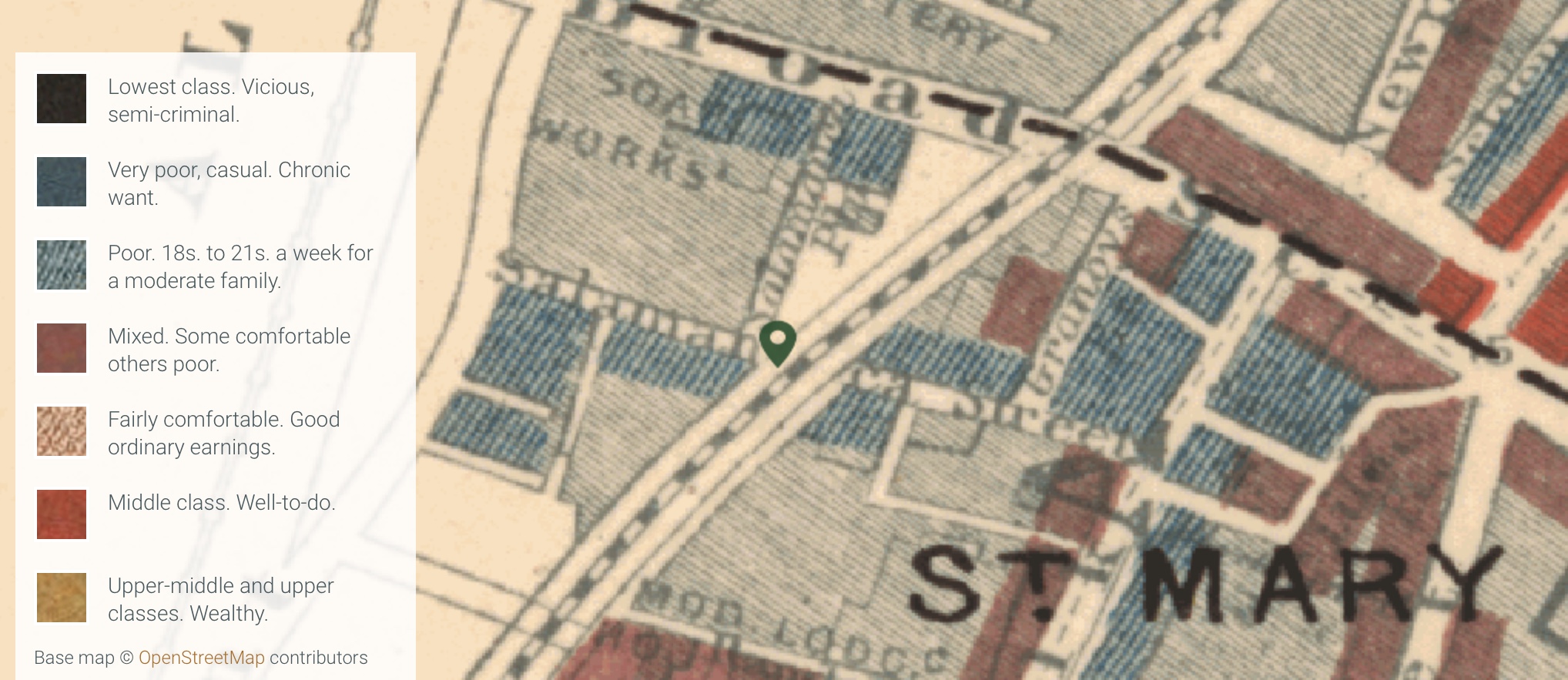
Salamanca Court and Salamanca Street, deprived areas and home to various generations of the Wheeler family.

Henry was buried on 19 October 1874. At 76, he lived a long life considering his background and periods of hardship. In the Regency era life expectancy for poor people was extremely low – in cities a lifespan of 13% for poor people compared to the wealthy. From medieval times, through Henry’s time to our time the ratio is 85% life expectancy for the poor compared to the rich.

A widow, Mary Ann lodged with relatives until her death in 1903, aged 87. Another remarkable age given her background. You wonder what attracted Mary Ann to Henry. Maybe it was love. Or maybe she sought companionship and freedom from loneliness. If it was the latter, this is ironic because Mary Ann and Henry spent at least a third of their married lives apart.

As ever, thank you for your interest and support.

Hannah xxx