Categories
1963

Social History 1963 #3

The compact cassette, launched by Dutch company Philips at the Berlin Radio Show on 28 August 1963.

The audio cassette first appeared in 1888 when Oberlin Smith invented a method of recording sound by magnetising wire. Fritz Pfleumer invented magnetic tape in 1928 and this led to the first reel-to-reel tape recorders, in 1935.

Lou Ottens and his Philips team miniaturised the initially bulky and expensive system and made it commercially viable. Although designed for dictation, music lovers soon realised that they could use the compact cassette to compile their own albums, and a new way of listening to music was born.


The Mercedes-Benz W 113 was introduced at the 1963 Geneva Motor Show. The company produced 48,912 W 113s and sold 40% of them to the American market. 

At the car’s launch, technical designer Fritz Nallinger said, “It was our aim to create a very safe and fast sports car with high performance, which despite its sports characteristics, provides a very high degree of travelling comfort.”

My narrator, enquiry agent Elinor Mansfield, will drive a Mercedes-Benz W 113 in my forthcoming novel, Songbird.

📸 Wikipedia

As listed by the Office of National Statistics, the most popular names in Britain in 1963

Susan

Julie

Karen

Jaqueline 

Deborah

Tracy

Jane

Helen

Diane

Sharon 

David

Paul

Andrew

Mark

John

Michael

Stephen

Ian 

Robert

Richard

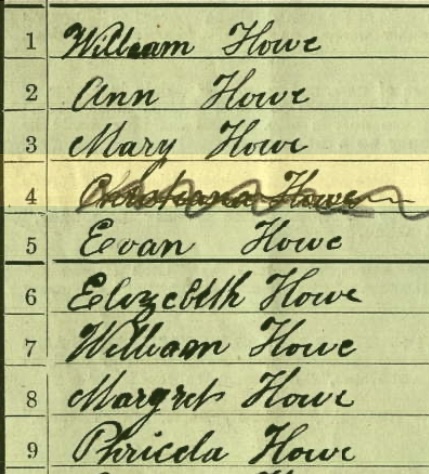
🖼️ My Howe ancestors in 1911
The coins we used – the halfpenny. Originally minted in copper, from 1860 until decimalisation in 1969, the halfpenny was minted in bronze. 

Along with an image of the monarch, the halfpenny featured an image of Britannia, from 1672 until 1936, and an image of the Golden Hind, from 1937 until 1969. 

Halfpenny was colloquially written as ha’penny, and it’s a rare example of a word in the English language containing a silent f. 

Apparently, you could buy sweets like white mice, fruit salad and liquorice for a halfpenny – a small coin with a big appeal.

La Planète des singes, known as Planet of the Apes in America and Monkey Planet in Britain, was published in 1963. Written by Pierre Boulle, the novel was adapted into a film in 1968 and launched an ongoing media franchise.

La Planète des singes is a story about three human explorers who visit a planet orbiting the star Betelgeuse. On Betelgeuse great apes are the dominant, intelligent and civilized species, whereas humans are IQ-challenged savages. It’s total fiction, of course.

Coming soon, Songbird, my novel set in 1963

https://books2read.com/u/bMqNPG

For Authors

#1 for value with 565,000 readers, The Fussy Librarian has helped my books to reach #1 on 32 occasions.

A special offer from my publisher and the Fussy Librarian. https://authors.thefussylibrarian.com/?ref=goylake

Don’t forget to use the code goylake20 to claim your discount 🙂

Categories
1963

Social History 1963 #2

After the Second World War, Britain’s education system suffered a setback when a child’s future depended on the result of the Eleven-plus exam. Success meant a place in a grammar school, with the prospect of higher education. Failure meant relegation to a Secondary Modern school, stifling the prospects of late developers.

Here’s a sample question from the Eleven-plus exam.

A train leaves London at 10.30am and arrives in Birmingham at 12.40pm. It stopped from 12.10pm to 12.20pm at Coventry, which is 100 miles from London. It travelled throughout at the same speed. Find the distance from London to Birmingham.

The Flying Scotsman (Wikipedia)

Introduced in 1963, the crème egg. Originally named Fry’s Crème Egg, the product changed its name to Cadbury’s Crème Egg in 1971. The egg consists of a thick chocolate shell containing a sweet white and yellow filling that mimics the albumen and yolk of a soft boiled egg. If you like your sweets very sweet, this one’s for you.

📸 Wikipedia

Number one singles in 1963 with the number of weeks at number one

Return to Sender – Elvis Presley – 1

Bachelor Boy – Cliff Richard and the Shadows – 3

Dance On – The Shadows – 1

Diamonds – Jet Harris and Tony Meehan – 3

The Wayward Wind – Frank Ifield – 3

Summer Holiday – Cliff Richard and the Shadows – 3

Foot Tapper – The Shadows – 1

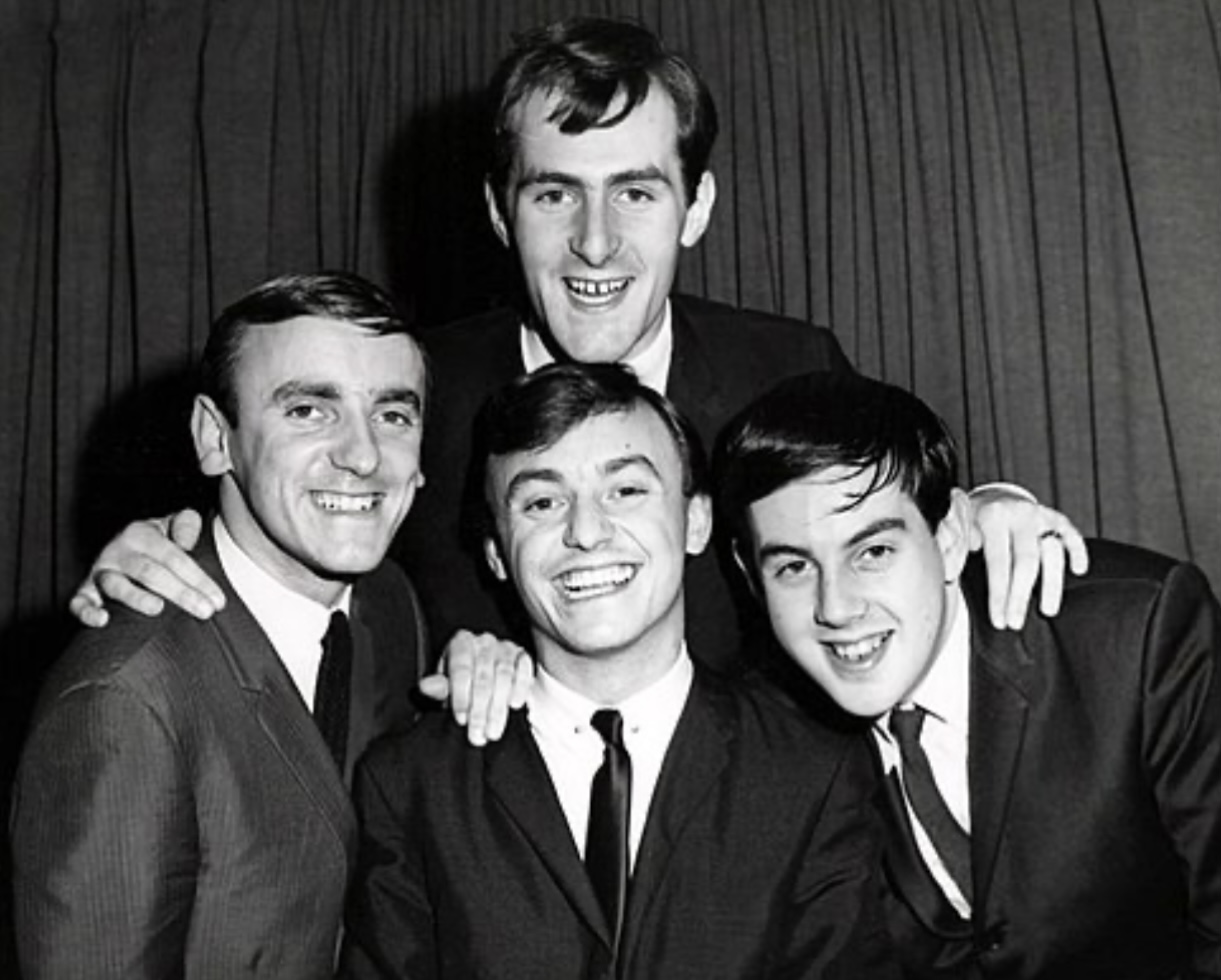
How Do You Do It – Gerry and the Pacemakers (pictured) – 3

From Me to You – The Beatles – 7

I Like It – Gerry and the Pacemakers – 4

Confessin’ – Frank Ifield – 2

Devil in Disguise – Elvis Presley – 1

Sweets for My Sweet – The Searchers – 2

Bad to Me – Billy J Kramer and the Dakotas – 2

She Loves You – The Beatles – 6

Do You Love Me – Brian Poole and the Tremeloes – 3

You’ll Never Walk Alone – Gerry and the Pacemakers – 4

I Want to Hold Your Hand – The Beatles – 3

Published on 18 March 1963, Cat’s Cradle by Kurt Vonnegut, a satirical novel with science fiction elements. The humour is morbid, the characters flawed and absurd, reflecting the insanity of their world. The novel’s themes include religion, power and the, hilarious, idea that technology will solve all of humanity’s problems.

On 25 January 1963, in “The Surprise”, Wilma Flintstone (pictured) announced to her husband Fred that she was pregnant, the first portrayal of a pregnant cartoon character. On 22 February 1963, in “The Blessed Event” Wilma gave birth to Pebbles Flintstone.

Eleven-plus answer: 120 miles.

Coming soon, Songbird, my novel set in 1963

https://books2read.com/u/bMqNPG

For Authors

#1 for value with 565,000 readers, The Fussy Librarian has helped my books to reach #1 on 32 occasions.

A special offer from my publisher and the Fussy Librarian. https://authors.thefussylibrarian.com/?ref=goylake

Don’t forget to use the code goylake20 to claim your discount 🙂

Categories
Cherry Wainer

Cherry Wainer #6

I’m researching the career of musician Cherry Wainer and the 1950s-1960s music scene.

In January 1956, the media reported that Cherry owned 25 pairs of shoes, and loved collecting them. In January 1959, however, the Birmingham Weekly Post revealed that Cherry now owned more than 120 pairs of shoes. Success, it seemed, had gone to her feet…

This advertisement from April 1959 highlights Cherry’s career at that time, sharing a bill with Cliff Richard and the Shadows (then billed as the Drifters) and other regulars from the television series Oh Boy!

In 1959, Cherry featured in the Royal Variety Performance, at the Palace Theatre, Manchester. A year later, she appeared in a musical, Girls of the Latin Quarter. Her career in Britain had reached an apex and, ever ambitious, she looked for new challenges.

In the 1960s, Cherry released several solo albums and singles. However, with the Beatles and the “new sound” dominating the British charts, Cherry’s records struggled to find an audience.

Along with drummer Don Storer, Cherry moved to Germany where she appeared as a regular in a television series, Beat! Beat! Beat! That was in 1967. A year later, Cherry and Don settled in Las Vegas where they performed in cabaret. 

Cherry made Las Vegas her home. After a long and varied career in music, she died there on 14 November 2014.

My latest article for the Seaside News appears on page 42 of the magazine

Coming soon, Songbird, my novel set in 1963

https://books2read.com/u/bMqNPG

For Authors

#1 for value with 565,000 readers, The Fussy Librarian has helped my books to reach #1 on 32 occasions.

A special offer from my publisher and the Fussy Librarian. https://authors.thefussylibrarian.com/?ref=goylake

Don’t forget to use the code goylake20 to claim your discount 🙂

Categories
1963

Social History 1963

The winter of 1962-63, aka the Big Freeze of 1963, was one of the coldest British winters on record. Temperatures plummeted. Lakes, rivers, and the sea at Herne Bay, Kent froze over.

Dating back to 1659, only the winters of 1683-84 and 1739-40 were colder than 1962-63. The winter of 1962–63 remains the coldest since at least 1895 in all meteorological districts of Britain.

The cold weather continued until 6 March, the first morning of the year without frost in Britain.

Snow in Lancashire, January 1963 (Wikipedia)

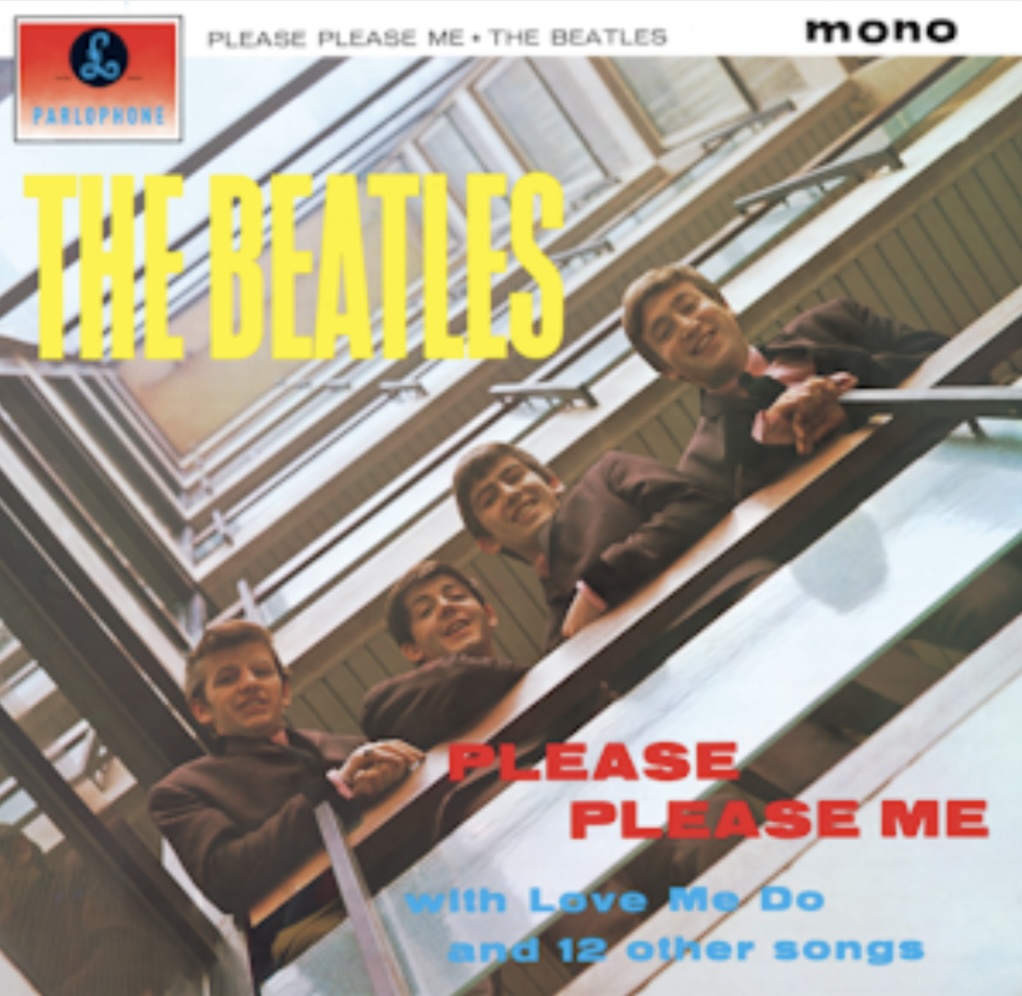
On 11 February 1963 the Beatles recorded their debut album Please Please Me in a single day at Abbey Road Studios, London. They released the album on 22 March. It reached number one on 11 May and remained in the top ten for over a year.

In 1963, Edward Craven-Walker produced the lava lamp (📸 Wikipedia). A reconnaissance pilot during the Second World War, Craven-Walker saw an egg timer in a pub. The device used two immiscible fluids, and he noted the potential for future development. In a shed, Craven-Walker experimented and adapted the original idea. One of his experiments involved a squash bottle and its shape defined the lava lamp.

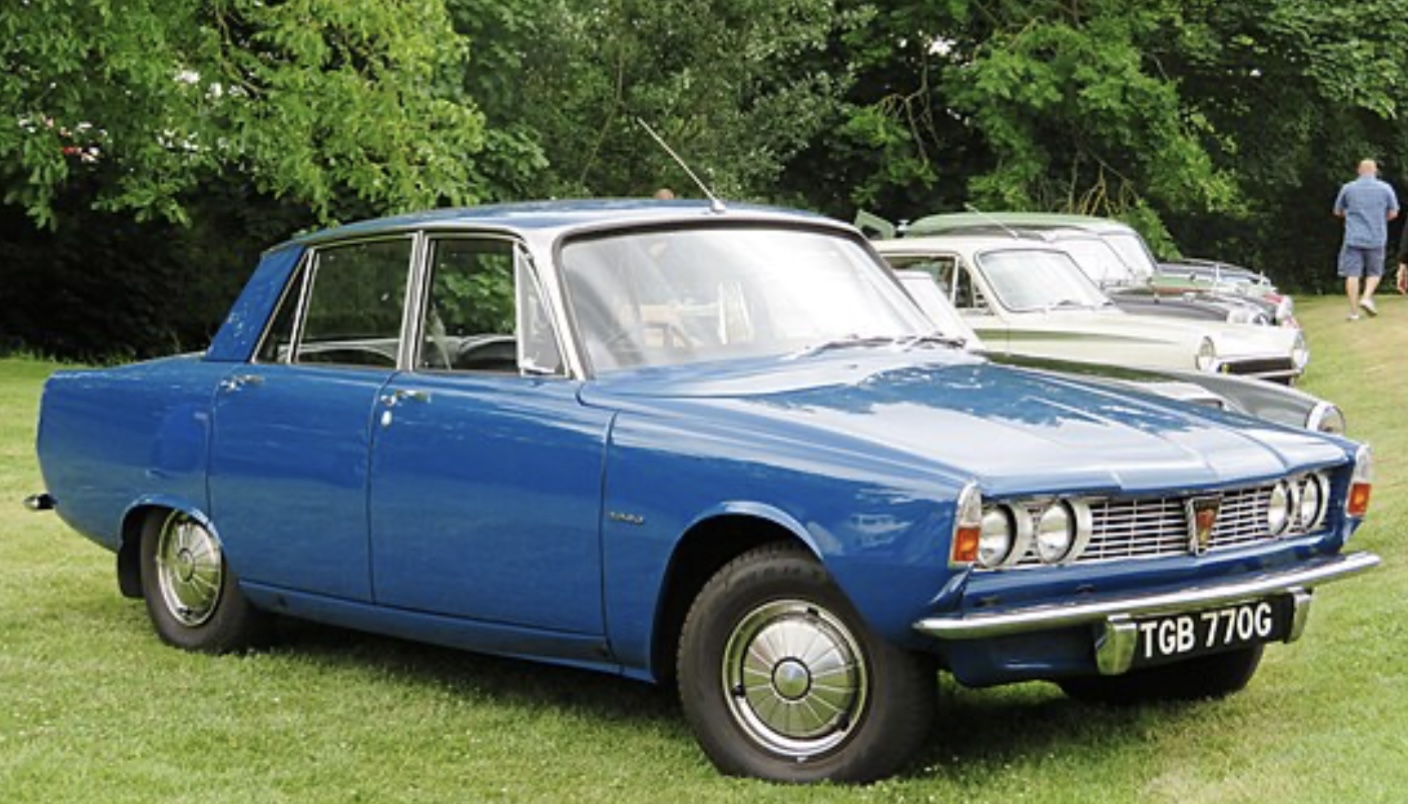
In 1963, the Rover P6 (📸 Wikipedia) became the first winner of the European Car of the Year award. Meanwhile, the motorway network in Britain continued to develop with the opening of the first section of the M4 in Berkshire, the M6 in Lancashire, and the M2 in Kent.

In 1963, Ice Station Zebra by Alistair MacLean was published. The novel became a film starring Rock Hudson, Patrick McGoohan and Ernest Borgnine. 

Although MacLean did not write the screenplay for Ice Station Zebra, he did write screenplays in the 1960s and 1970s, often adapting those screenplays into novels. If you study the structure of these stories, the transition of MacLean’s style is obvious.

After covering 2.08 million miles, the Flying Scotsman, “the world’s most famous steam locomotive” retired from British Railways in 1963.

Built in 1923 for the London and North Eastern Railway (LNER), the Flying Scotsman was employed on long-distance express passenger trains on the East Coast Mainline. It became the flagship locomotive for the LNER, representing the company twice at the British Empire Exhibition. 

On 30 November 1934 the locomotive became the first to reach the officially authenticated speed of 100 miles per hour and, on 8 August 1989 while on tour in Australia, it set the longest non-stop run of a steam locomotive, covering 422 miles.

📸 Wikipedia

Coming soon, my novel set in 1963

For Authors

#1 for value with 565,000 readers, The Fussy Librarian has helped my books to reach #1 on 32 occasions.

A special offer from my publisher and the Fussy Librarian. https://authors.thefussylibrarian.com/?ref=goylake

Don’t forget to use the code goylake20 to claim your discount 🙂
Categories
Cherry Wainer

Cherry Wainer #5


I’m researching the career of musician Cherry Wainer and the 1950s-1960s music scene.

In October 1958, a Daily Herald reporter caught up with Cherry as she emerged from a shop in Shaftesbury Avenue clutching five-guinea sweaters and three boxes of expensive cuff-links. “For my friends,” she said, scurrying towards her pink low-slung sports car before the approaching policemen noticed the “no parking” sign.

“On ‘Oh Boy!’ we are all friends and the musicians treat me as one of the boys.” Accelerating away, Cherry added, “That’s Cliff Richard – our new boy. He’s a nice kid, not a ruffian like lots of singers these days. He thinks about things. Willing to learn. He’ll get to the top and stay there.”

“I’ve got four record players and hundreds of records – Sinatra, Ella, Duke, rock and roll…Some people say rock’s no good. Some of it is. No good being a snob.”

“I played Peggy Lee’s Fever night after night before I sang it on ‘Oh Boy!’ The big thing with that song is the eyes. I kept still and put all the actions into my eyes.”

“I couldn’t stand the political set-up (at home) in South Africa. Here (in Britain), I work with people I like. Who cares what colour they are?”

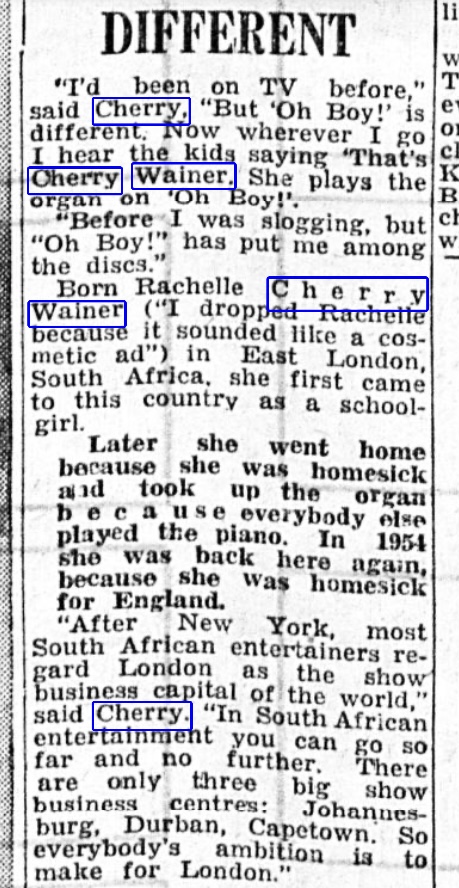
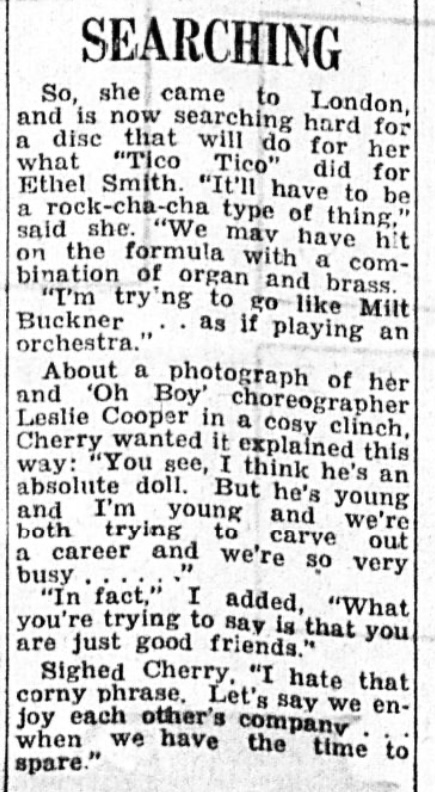
From 30 October 1958, part one of Cherry Wainer’s syndicated media interview.

Part two

Part three

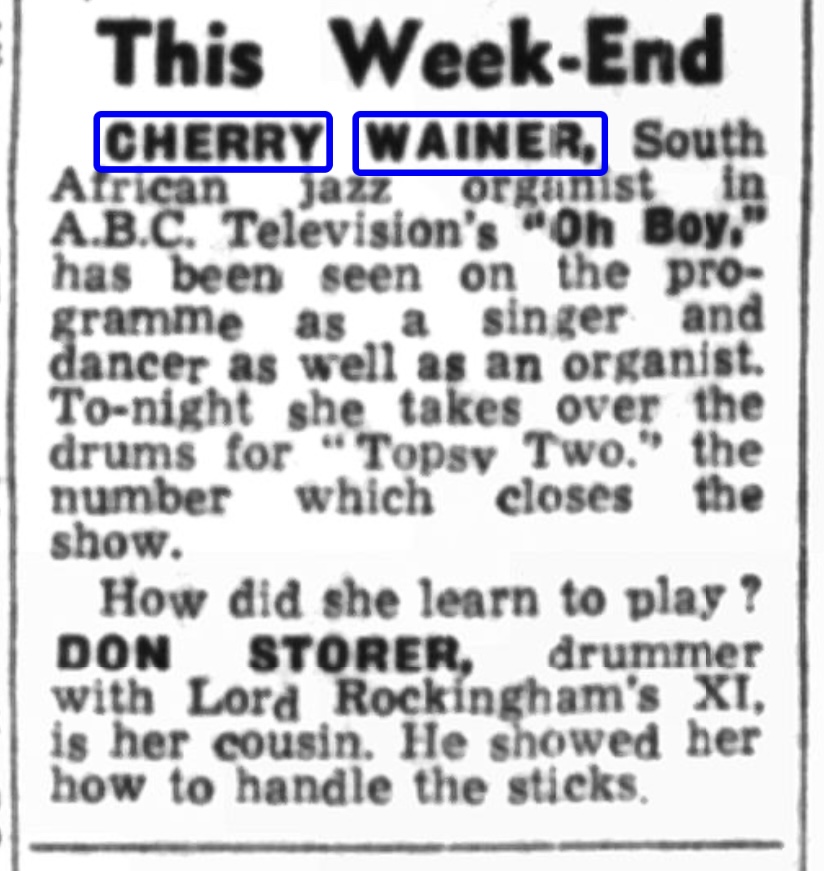
At this stage of my research, I’m not clear about Cherry’s relationship with drummer Don Storer. They arrived in Britain together, shared the same agent, and performed together as an organ-drum duet. This report from November 1958 stated that they were cousins. They married, but not until 12 June 1992 when they were in their sixties. Maybe more details will emerge, or maybe this aspect of Cherry’s life will remain a mystery.

For Authors

#1 for value with 565,000 readers, The Fussy Librarian has helped my books to reach #1 on 32 occasions.

A special offer from my publisher and the Fussy Librarian. https://authors.thefussylibrarian.com/?ref=goylake

Don’t forget to use the code goylake20 to claim your discount 🙂