
Categories
Dear Reader

Dear Reader #188

Dear Reader,

Clara Bow’s twenty-seventh movie was The Best Bad Man, released by Fox, November 29, 1925. Clara played Peggy Swain. A co-star was ‘Tony the Wonder Horse’ who played himself.

Loaned out by B.P. Schulberg, Clara was hopelessly miscast as a frontier gal in a vehicle for cowboy star Tom Mix. After the success of Clara’s previous movie, The Plastic Age, The Best Bad Man was a backward step.

B.P. Schulberg was a ‘dollars and cents’ producer with no real feel for artistry or a person’s career. Schulberg helped Clara to become a star, but without his help she would have become a star sooner.

Why did Clara Bow quit Hollywood at the height of her fame? I believe there were numerous reasons, and I will explore them in a future article. Certainly, Hollywood did not abandon Clara. The offers continued to roll in. They included three offers for long-term contracts with major film companies ranging from $100,000 to $175,000 per picture, an offer of $150,000 plus a percentage for one picture, and two profit-sharing offers from independent producers. Clara also rejected product endorsements, radio shows, personal appearances and Broadway productions, turning her back on $10,000 – $20,000 a week.

My latest translations, the Dutch version of Operation Sherlock, book five in my Eve’s War Heroines of SOE series, and the Afrikaans version of Love and Bullets, book two in my Sam Smith Mystery Series.

My 10 x great grandparents Thomas Papillon and Jane Brodnax.

In 1667, Thomas was in Breda, Holland as a representative of the East India Company to observe progress in the Treaty of Peace between England and Holland. Thomas exchanged a number of letters with Jane. Her letters survived and have been transcribed. 

In this letter of May 31, 1667, Jane talks about their children: Elizabeth, Philip, Sarah and Ann Mary/Anna Maria, my direct ancestor.
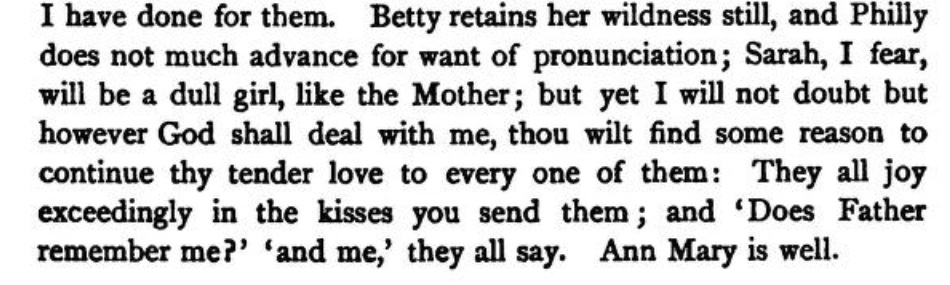
Later in the letter, Jane requests that Thomas returns home with some fresh linen. And “a little cheese.”

My 5 x great grandmother Grace Austin was born on 22 July 1786 in Barking, Essex and baptised on 20 August 1786 in St Margaret’s, Barking (pictured, Wikipedia). She was the fourth born of eight children. Her family lived in relative comfort although, in common with many females of her time, she was not taught how to read and write.

My 5 x great grandparents Samuel Axe and Grace Austin married on 22 September 1803 in Saint Luke Old Street, Finsbury, London (pictured, Wikipedia). Both bride and groom were seventeen years old. Grace’s parents, Isaac Austin and Mary Chetwynd, were also seventeen when they married. Maybe seventeen was the family’s lucky number.

Married to Samuel Axe, between 1805 and 1821 my 5 x great grandmother Grace Austin gave birth to eight children. However, in September 1815, Samuel had an affair with Maria Hammant. We know this because Maria claimed parish relief for her baby. Grace forgave Samuel and gave birth to two more children.

On 25 July 1823, at the age of 37, my 5 x great grandmother Grace Austin died. Her birthing pattern suggests that she was due to give birth to her ninth child, so maybe that was a factor. Grace was buried in Bunhill Fields, Islington (pictured, Wikipedia) alongside such notables as John Bunyan, Daniel Defoe and Susanna Wesley. The common factor: nonconformity. This branch of my family, along with many others, was very strong on nonconformity.

My 6 x great grandmother Mary Chetwynd was born on 7 June 1759 in Barking, Essex and baptised three days later in St Margaret’s, Barking. On 30 January 1777, Mary married Isaac Austin in St Margaret’s. Mary gave birth to at least eight children. 

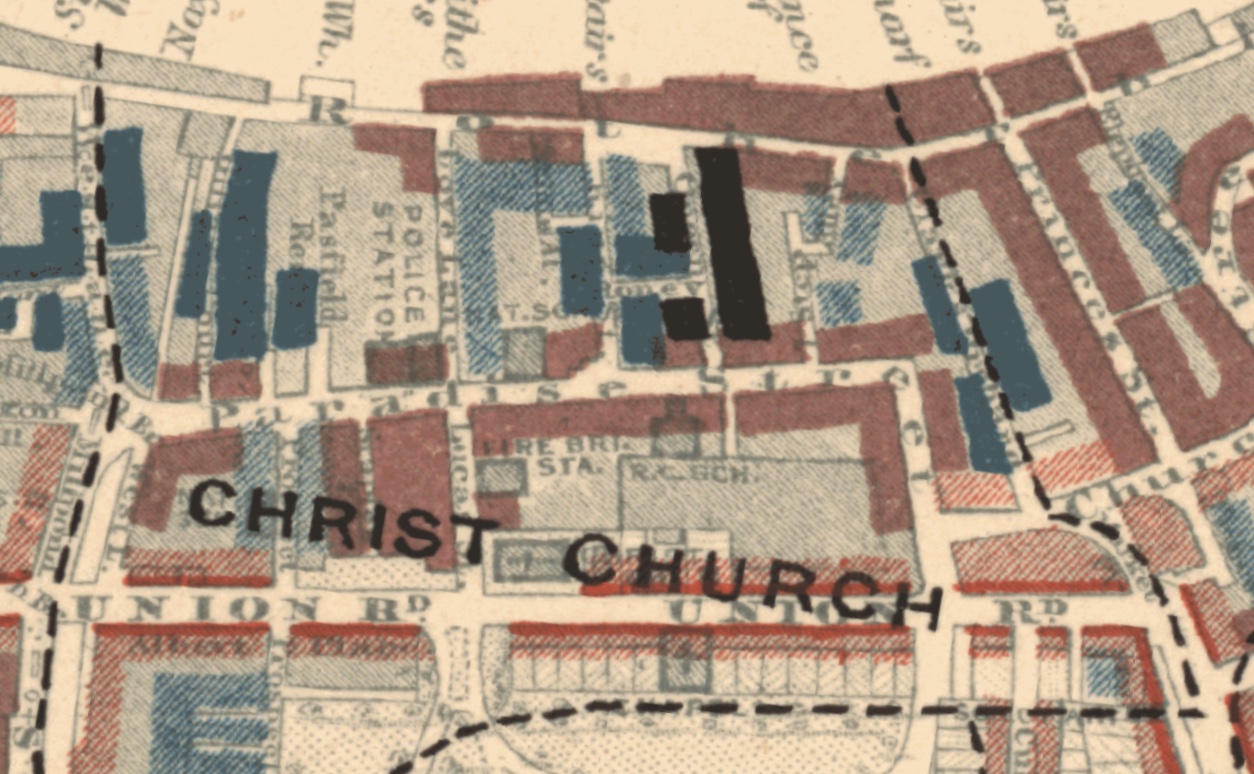
Mary lived on Paradise Street, just south of the River Thames. In his maps of London, Charles Booth described Paradise Street as a ‘well-to-do, middle-class’ street.

Mary died on 25 July 1823, five days after her daughter, Grace, died. Almost certainly, Grace’s death was a factor in Mary’s death. Mother and daughter were buried alongside each other in the nonconformist graveyard of Bunhill Fields, Islington.
My latest article for the Seaside News, about Gloria Swanson, features on page 35 of the magazine.

It’s a Wonderful Life 50% v 50% Butch Cassidy and the Sundance Kid
It’s a Wonderful Life won on tie-break

Some Like it Hot 57% v 43% Touch of Evil

On the Waterfront 57% v 43% From Here to Eternity
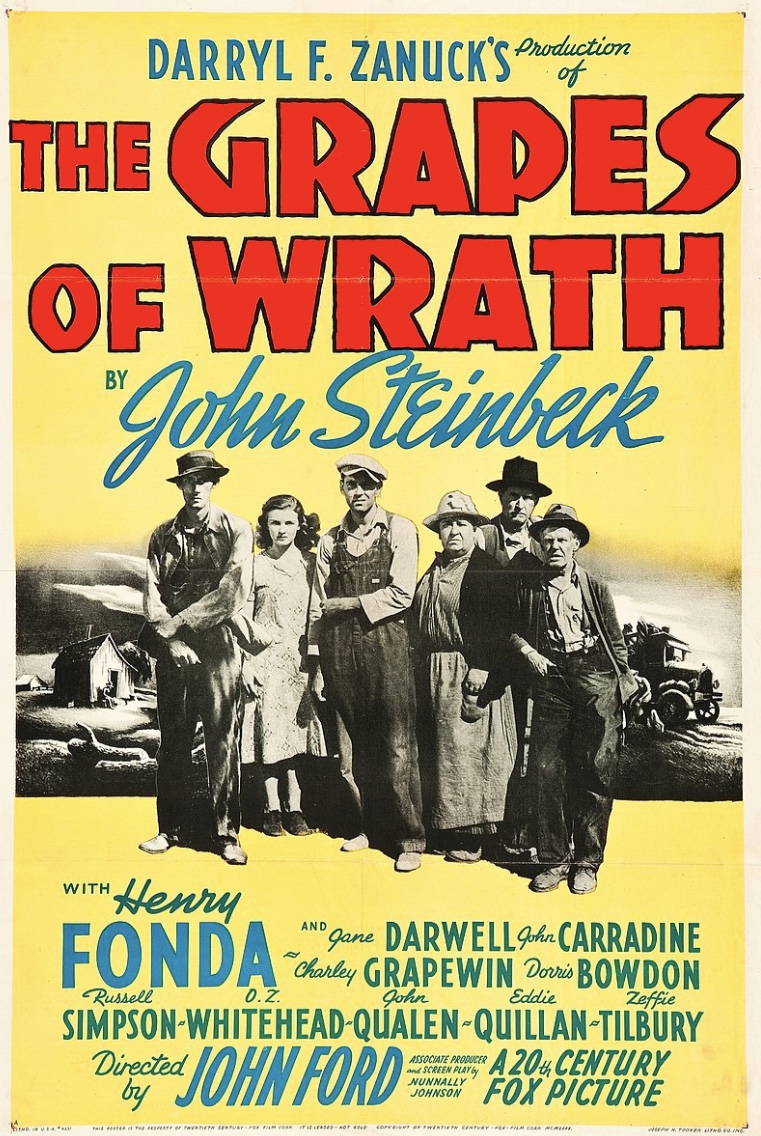
The Grapes of Wrath 59% v 41% Midnight Cowboy

The General 53% v 47% Fantasia
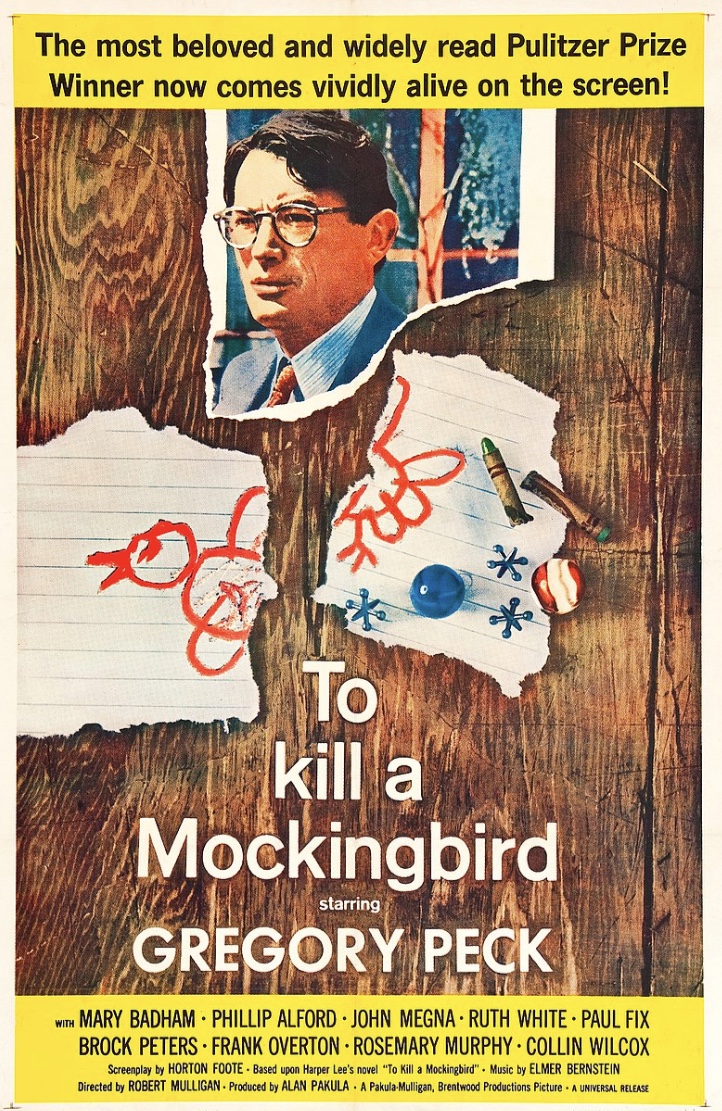
To Kill a Mockingbird 51% v 49% The Philadelphia Story

The Graduate 42% v 58% The Manchurian Candidate

I’m exploring the life and career of Virginia Cherrill, the person who, along with Charlie Chaplin, delivered the “Greatest single piece of acting ever committed to celluloid.”

When she was seventeen, Virginia caught the eye of a handsome young lawyer, Irving Adler. Irving invited her to dances and the theatre. From a high-society Chicago family and with good prospects, Irving had a lot going for him. He proposed marriage, repeatedly, and eventually Virginia said, “yes”.

In the summer of 1926 Virginia and Irving married in secret, often a portent of things to come. Sheltered by an over-protective mother, Virginia’s wedding night came as a shock to her, and the events of that night set the tone for her marriage. 

Irving was often away on business. Lonely, and after seventeen months of marriage, Virginia admitted her mistake. She sought a divorce and on 25 November 1927 made her way west, to friends in Hollywood.
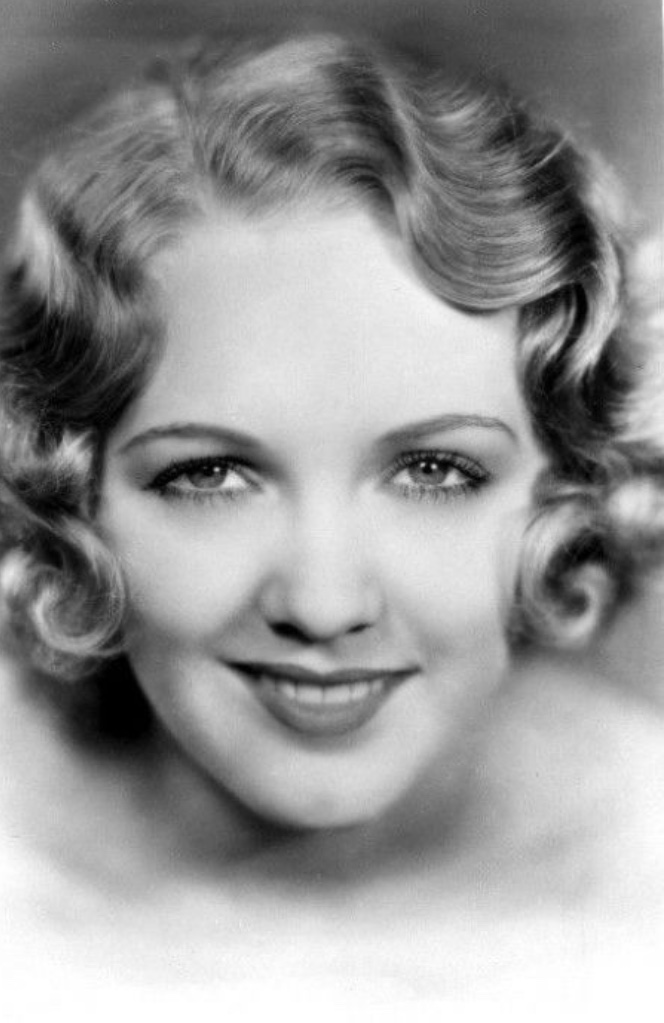
I’m researching material for Sunshine, the second book in my Golden Age of Hollywood series. Sunshine is the nickname of the main character, Abigail Summer. The story is set between 1938 and 1946. 

The theme song for the novel, so to speak, is “You Are My Sunshine”. The Pine Ridge Boys (Marvin Taylor and Doug Spivey) recorded the song on August 22, 1939, and released it on October 6, 1939 for Bluebird Records. Here’s the iconic recording.

This week’s featured title: Sunshine, book two in my Golden Age of Hollywood series.

As ever, thank you for your interest and support.

Hannah xxx

For Authors

#1 for value with 565,000 readers, The Fussy Librarian has helped my books to reach #1 on 36 occasions.

A special offer from my publisher and the Fussy Librarian. https://authors.thefussylibrarian.com/?ref=goylake

Don’t forget to use the code goylake20 to claim your discount 🙂

Categories
Dear Reader

Dear Reader #168

Dear Reader,

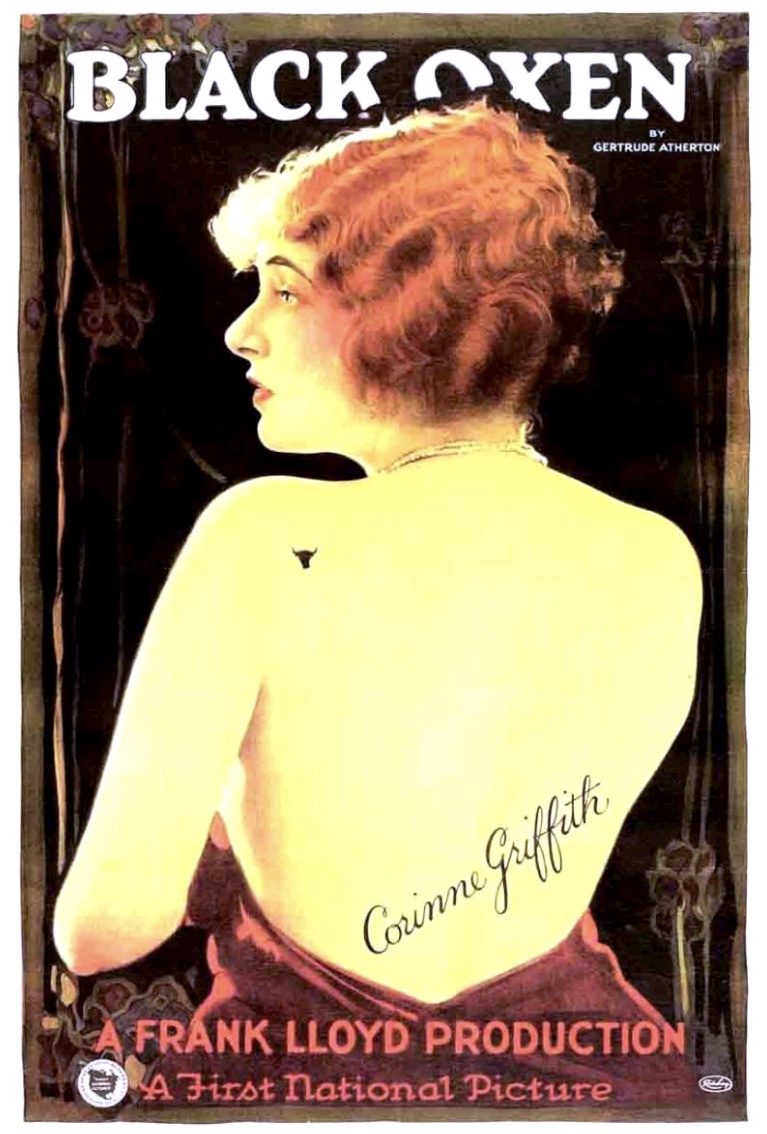
Clara Bow’s seventh movie was Black Oxen a silent fantasy/romantic drama produced during October 1923 and released on December 29, 1923 in San Francisco.

Black Oxen starred Corrine Griffith and Conway Tearle. Corinne Griffith was one of the big names of the day. As well as a successful acting career, she also excelled as a producer, author and businesswoman. Dubbed ‘The Orchid Lady of the Screen’, she was widely regarded as one of the most beautiful actresses of the silent era.

Clara excelled in this movie to the extent that she gained more parts immediately, and the studio quadrupled her salary to $200 a week, the equivalent of $2,900 today.

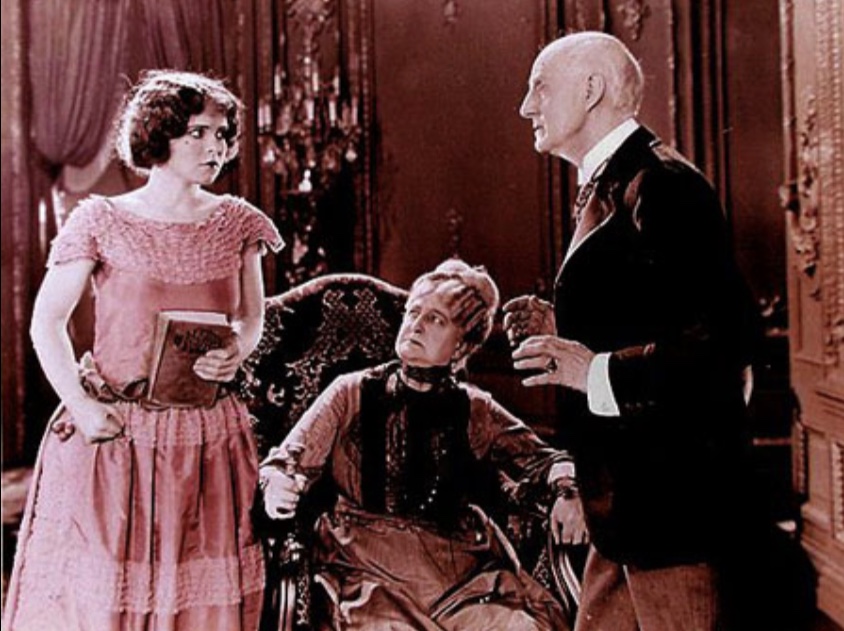
📸 Clara Bow as Janet Oglethorpe, the flapper in Black Oxen, holding a copy of Flaming Youth. Also pictured, Kate Lester and Tom Ricketts.

Highest Grossing Movie of 1927Wings.

A silent war movie set during the First World War, Wings won the first Academy Award for Best Picture, the only fully silent film to win the award. Because of her status, Clara Bow received top billing, but the film mainly concentrates on Charles Rogers and Richard Arlen’s characters.

The movie was designed as an action-war picture, but romantic elements were included to accommodate Clara Bow, Paramount Pictures’ brightest star at the time. The film featured nudity, one of the first to do so.

Wings was shot on location in San Antonio on a budget of $2 million, $30 million today. Shooting ran from September 7, 1926 to April 7, 1927. The antics at the actors’ hotel have become the stuff of legend, and they will feature in a future article.

Hundreds of extras and around 300 pilots were involved in the filming. The highlights of Wings are its realism and its stunning air-combat sequences. Indeed, the pilots and their planes are the stars of this movie. Many of the flying sequences required extraordinary courage and skill.

My latest translation, the Dutch version of Operation Treasure, Eve’s War Heroines of SOE book four.

Clara Bow Quotes: “What advice would you endeavour to give a girl who was trying to make good in Hollywood? I can give my viewpoint with absolute frankness and understanding. I was ambitious and at the same time I was shy and super-sensitive. I saw Hollywood as Utopia. I see Hollywood now as it really is. I’ve tasted fame and wealth and love – true love – and I’ve also suffered heartbreak and disappointment as much as any other person in the motion picture world. Some scars I shall carry on my soul forever. Through recklessness, thoughtlessness and impulsiveness, I have made many mistakes. But I’ve profited from such errors and that is why I am attempting to assist those who will take the advice of one who knows.”

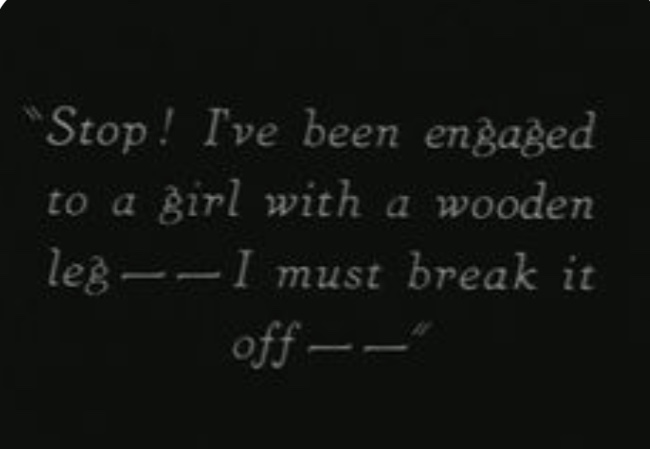
Intertitle #8

As ever, thank you for your interest and support.

Hannah xxx

For Authors

#1 for value with 565,000 readers, The Fussy Librarian has helped my books to reach #1 on 33 occasions.

A special offer from my publisher and the Fussy Librarian. https://authors.thefussylibrarian.com/?ref=goylake

Don’t forget to use the code goylake20 to claim your discount 🙂
Categories
Dear Reader

Dear Reader #158

Dear Reader,

Delighted to say that my books are now available in twelve languages. Here’s my latest, the Dutch version of Operation Broadsword, Eve’s War Heroines of SOE book three, my 112th translation 🙂

Continuing my research into Eva Marie Saint’s ancestry using public records. I’m looking to answer two questions: was Eva’s talent the result of nurture, or nature? And why am I drawn to her as an actress? Can I find the answers to these questions in her roots?

John Merle Saint. Picture courtesy of Eva Marie Saint.

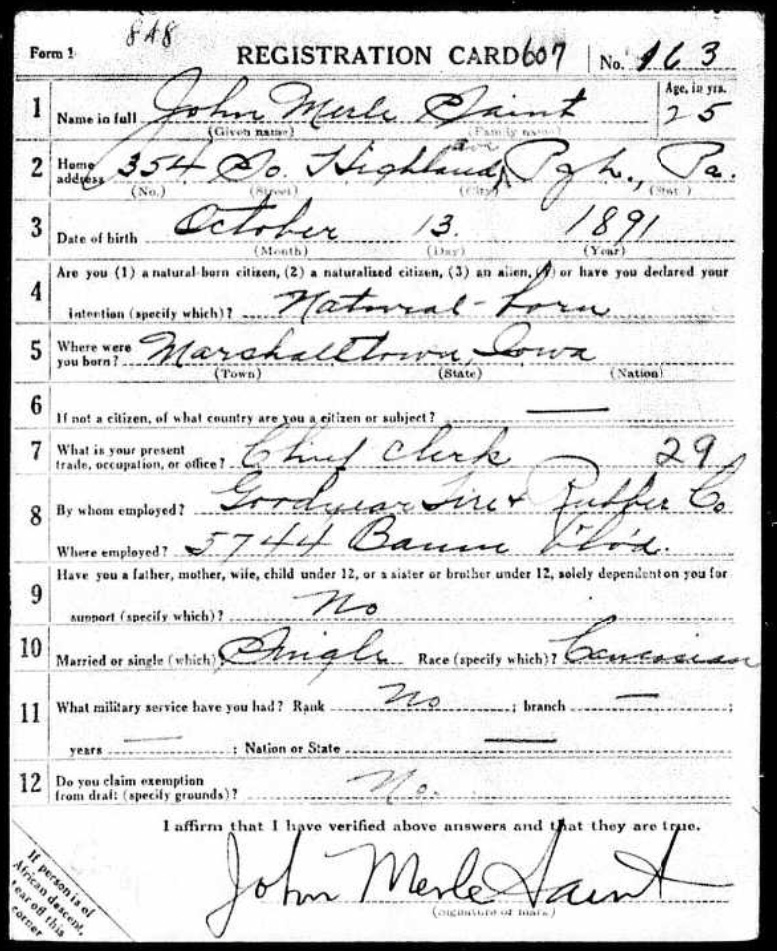
I’ve discovered that John Merle Saint was Eva Marie’s father and that he served in World War One. Today’s record is a US World War One Draft Registration Card. This card provides the following information:

John Merle Saint
RaceCaucasian (White)
Marital StatusSingle
Birth Date13 Oct 1891
Birth PlaceIowa
Residence Date1917-1918
Street Address354 So. Highland
Residence PlacePittsburgh, Allegheny, Pennsylvania, USA
Draft Board06
Physical BuildSlender
HeightMedium
Hair ColorBrown
Eye ColorBrown

So, John Merle Saint was born in Iowa, another good lead, one which should enable me to locate his parents. This record also led me to other World War One records that featured John, including his burial record. John was buried, on 18 July 1965, at Bala Cynwyd, Montgomery County, Pennsylvania. This name strongly suggests that the region was developed by Welsh settlers, so does that mean that Eva Marie has Welsh roots? More research required.

***

Profit and Loss, Series 1, Episodes 12 & 13 of The Rockford Files is a two-parter. Written by John Thomas James and Stephen J. Cannell this is the strongest Rockford story to date. If you are new to the series, start with this one.

Profit and Loss contains a great storyline with sparkling dialogue. James Garner is having a ball with this story; his comic timing is perfect while his casual asides are sublime. Also, some social commentary about business corruption adds depth to the story.

There’s a great running joke about the trash dispenser, plus Beth and Becker make an appearance. If the writers could have included Angel, this would have been the perfect Rockford episode. As it is, it comes very close.

The answer machine message is brilliant too: (Slightly manic voice) “Hey, Jimmy – this here’s Teeter Skerritt. Remember me? From the Army. I’m stuck here in town. How ‘bout I come over and bunk with you, buddy?”

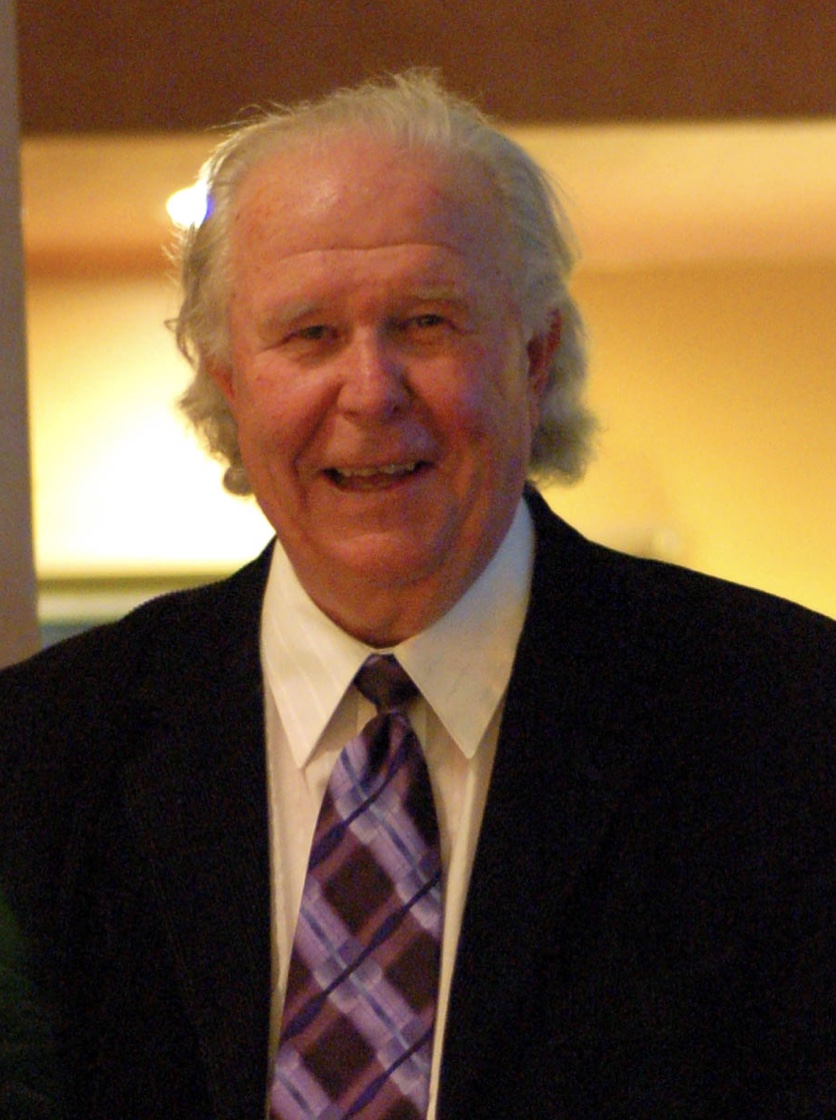
Ned Beatty, who co-starred in Profit and Loss. 📸 Wikipedia.

My latest article for the Seaside News appears on page 34 of the magazine.

Henry VIII’s Dissolution of the Monasteries in effect closed London’s hospitals because most hospitals at that time were run by the Church.

Henry VIII’s successors re-founded some of these hospitals, although their purpose differed from the hospitals of today. In the seventeenth century hospitals served the poor and destitute; they were places of shelter rather than centres of medical treatment.

Some hospitals specialised. For example, St Mary Bethlehem, pictured, was established for ‘lunatic people’ while St Thomas’ in Southwalk was established for the ‘sick and aged’. 

People of means were expected to pay for their upkeep. However, many hospitals provided the poor with bedding, clothes, food and three pints of ale a day.

Mel Charles was born on 14 May 1935. The brother of the legendary John Charles, Mel was a versatile player. He played as a centre-half, centre-forward and wing-half.

In 1952, Mel turned professional with his local club, Swansea Town. After seven years at the Second Division club, he secured a lucrative move to First Division Arsenal. However, injury blighted his period at the Gunners and, in February 1962, he joined Cardiff City, enjoying a three-year spell with the club. In total, Mel scored 122 goals in 401 league and cup matches.

At international level, Mel represented Wales on 31 occasions, scoring six goals. He captained Wales and was a member of his country’s 1958 World Cup squad. He also represented Wales in the British Home Championship over eight seasons.

In the BHC, Mel scored four goals in a 4 – 0 win over Northern Ireland, becoming only the third Welshman to score four goals in an international game.

One other remarkable fact about Mel: throughout his illustrious career he was never booked or sent off.

Mel Charles 📸 Arsenal.com

Clara Bow was born into a family of alcoholics and psychologically damaged people. Abuse, in all its ugly forms, was common. Clara’s family needed help, but in New York in 1905 few people, and certainly not the authorities, were prepared to offer a helping hand.

Clara’s neighbourhood was a network of slums and brothels, populated by the likes of ‘Submarine’ Mary – her name speaks for itself. House fires were common. Cholera, diphtheria, scarlet fever, smallpox and tuberculosis were rife. Violence was a way of life. 

During the summer heatwave of 1905, the New York infant mortality rate was estimated at eighty percent. Clara’s parents, Robert and Sarah, were convinced that she would die, so they didn’t even bother obtaining a birth certificate.

To understand Clara’s later choices in life, you need to understand where she came from: a hellhole where love was just a four-letter word. 

Welcome to the world, Clara Bow. 

Next week, news about my new project, Tula, plus background information.

As ever, thank you for your interest and support.

Hannah xxx

For Authors

#1 for value with 565,000 readers, The Fussy Librarian has helped my books to reach #1 on 32 occasions.

A special offer from my publisher and the Fussy Librarian. https://authors.thefussylibrarian.com/?ref=goylake

Don’t forget to use the code goylake20 to claim your discount 🙂
Categories
Dear Reader

Dear Reader #151

Dear Reader,

My latest translation, the Dutch version of Operation Locksmith, Eve’s War, Heroines of SOE book two.

Tall Woman in Red Wagon, Series 1, Episode 5 of The Rockford Files is a ‘flashback’ story with Rockford recalling events after a bullet-inducing concussion. 

Rockford’s printing press appears in this episode. One of the main features of The Rockford Files was the way Rockford teased information out of various people by impersonating numerous officials, his credentials always supported by cards freshly minted by his printing press.

There is no neat ending to this episode. I like that format and sometimes use it in my stories. In the main, readers and viewers like the author to wrap up all the lose ends, but in real life lose ends often roll on, and on…

📸 A still from Tall Woman in Red Wagon.

The Great Fire of London in 1666 destroyed 436 acres of land and made thousands of people destitute. The fire began on Sunday 2 September 1666 in Thomas Farriner’s bakery on Pudding Lane. By 7 am 300 houses had burned down.

The fire raged for four days consuming 13,200 houses, 87 churches, St Paul’s Cathedral, the Guildhall, and 52 livery company halls. Amazingly, the death toll did not reach double figures. However, the fire did make 100,000 people homeless.

London in 1666 was a tinderbox. Timber houses crowded the narrow streets. A dry summer had parched the ground. On the morning of the fire, a strong easterly wind fanned the flames, which leapt from building to building.

Each parish was equipped with axes and hooks to pull down buildings and create firebreaks. However, the fire was so intense that most people grabbed their belongings, tossed them on to boats and fled via the river. Others ran for the city gates.

Looters ran riot. Charles II travelled through the city on his horse, imploring people to fight the flames. The Lord Mayor, Thomas Bludworth, dithered fearing that if he ordered people to pull down their houses, they would respond with compensation claims.

From Pudding Lane, the fire spread to warehouses, then Cheapside, London’s principal street, then St Paul’s Cathedral. John Evelyn reported that the cathedral’s stones exploded like grenades, while molten lead flowed like a stream.

The fire reduced 80% of the city to ruins. For days, the ground was too hot to walk on. Without familiar landmarks, people wandered around, lost. Many camped in nearby fields. 

Charles II, and many Londoners, blamed the fire on an Act of God. Sin was its source, particularly the sin of gluttony. The reasoning for this? – The fire started in Pudding Lane. Indeed, an enquiry concluded that the fire was an accident, delivered by the Hand of God.

Thomas Farriner, the baker, escaped the fire. England was at war with France and the Netherlands at the time so, looking for a human scapegoat, the population persecuted a Frenchman, Robert Hubert, a man who suffered from mental health problems. 

After a trial, the authorities hung Hubert. However, evidence later proved that Hubert’s ship arrived in London after 2 September 1666. 

My ancestors – adults, children, babies – experienced the Great Fire. That horror must have remained with them for the rest of their days.

🖼 Painted in 1675, the Great Fire of London (artist unknown). This scene depicts the evening of Tuesday, 4 September 1666. To the left is London Bridge; to the right, the Tower of London. Old St Paul’s Cathedral is in the distance, surrounded by the tallest flames. The accuracy suggests that the artist had local knowledge.

Welsh Football Legends

Derek Tapscott was born on 30 June 1932 in Barry, Wales to Stanley and Florence Tapscott. He was one of sixteen children. 

Derek attended High Street Junior School. Upon leaving school he worked as a delivery boy for a butcher, an assistant to a television repairman then as an apprentice bricklayer.

At a time of National Service, Derek received his call in October 1950. He joined 4 Training Regiment of the Royal Engineers. At 18 Derek was already playing for Barry Town and the Royal Engineers granted him permission to link-up with the club on match days. During his National Service, Derek became a member of the drill staff and was promoted to the rank of corporal. 

After his National Service, Derek returned to bricklaying. His appearances for Barry Town continued. His skill caught the eye of the Tottenham Hotspur scouts and they invited him for a trial. However, Derek didn’t sign for Tottenham Hotspur. Instead, in October 1953, he joined their rivals, Arsenal. His transfer fee: £4,000.

Derek began his Arsenal career with a prolific run in the reserves, scoring 13 goals in 15 matches in the London Combination League. On 10 April 1954, he made his first-team debut against Liverpool and scored twice. He scored five more goals in five further matches that season.

During the 1954-55 season Derek established himself in the Arsenal first team. In 1955-56 from inside-forward he became the club’s top scorer, a feat he emulated the following season. He scored 21 and 27 goals respectively. 

European competition, in the form of the Inter-Cities Fairs Cup, beckoned. On 4 May 1956, Derek played for a London XI that defeated a Basel XI 1 – 0. 

Manchester United’s final domestic match before the tragic Munich air disaster was against Arsenal. That game developed into a nine-goal thriller with Manchester United taking the honours, 5 – 4. Later, Derek described the game as “the best I ever played in.”

Derek’s 1957-58 season was blighted by injury and he lost his first team place to Vic Groves. This resulted in a move, in September 1958, to Cardiff City. The transfer fee: £10,000. Derek left Arsenal with the impressive record of 68 goals in 132 matches.

Derek made his Cardiff City debut in a 4–1 win over Grimsby Town. The club continued to record impressive results and in 1960 they 

won promotion to the First Division. During this period, Derek scored six goals during a 16 – 0 victory over Knighton Town in the Welsh Cup, a club record.

Derek featured in Cardiff City’s first venture into European competition. He played in the team that reached the quarter-finals of the UEFA Cup Winners’ Cup scoring the winning goal against Sporting Clube de Portugal in the second round.

Further injuries curtailed Derek’s appearances for Cardiff City. At the beginning of the 1965-66 season he joined Newport County. However, he left that club at the end of that season and moved into non-league football where he played until his retirement in 1970.

On his retirement, Derek could look back at successful spells with Arsenal and Cardiff City, for whom he scored 102 goals in 234 appearances. He could also look back at an illustrious international career, representing Wales.

After only one appearance for Arsenal, Derek was named in the Wales squad for a match versus Austria. He made his debut on 9 May 1954 in Vienna. Austria won 2–0. Nine consecutive appearances followed as Derek established himself in the Wales team.

Derek scored his first international goal on 22 October 1955 during a 2–1 win over England. In the 1959 British Home Championship he scored in the final two matches of the competition, against England and Northern Ireland. From 14 appearances for Wales, Derek scored one other goal, at the Racecourse Ground, Wrexham on 23 November 1955 against Austria. 

After football, Derek worked for sports goods companies Gola and Diadora. He published his autobiography, Tappy: From Barry Town to Arsenal, Cardiff City and Beyond, in 2004.

Derek died on 12 June 2008. In 2012, Barry Town inducted him into the club’s Hall of Fame.

As ever, thank you for your interest and support.

Hannah xxx

For Authors

#1 for value with 565,000 readers, The Fussy Librarian has helped my books to reach #1 on 32 occasions.

A special offer from my publisher and the Fussy Librarian. https://authors.thefussylibrarian.com/?ref=goylake

Don’t forget to use the code goylake20 to claim your discount 🙂

Categories
Dear Reader

Dear Reader #144

Dear Reader,

My latest translation, the Dutch version of Operation Zigzag, Eve’s War Heroines of SOE, book one.

My latest article for the Seaside News.

John Howe, my 5 x great grandfather, was baptised on 28 April 1761 in St Hilary, Glamorgan. He was one of only ten children baptised in the village that year, including a set of twins. John’s parents were farmers so he spent his formative years learning the business of farm management.

John Howe married Cecily Lewis on 1 January 1785 in Cowbridge, Glamorgan. Cowbridge was the nearest market town to John’s home in St Hilary and it’s likely that he met Cecily there during a social event connected to the market.  

Cecily was born in Cowbridge in 1764 and it was the custom that marriages took place in the bride’s parish.

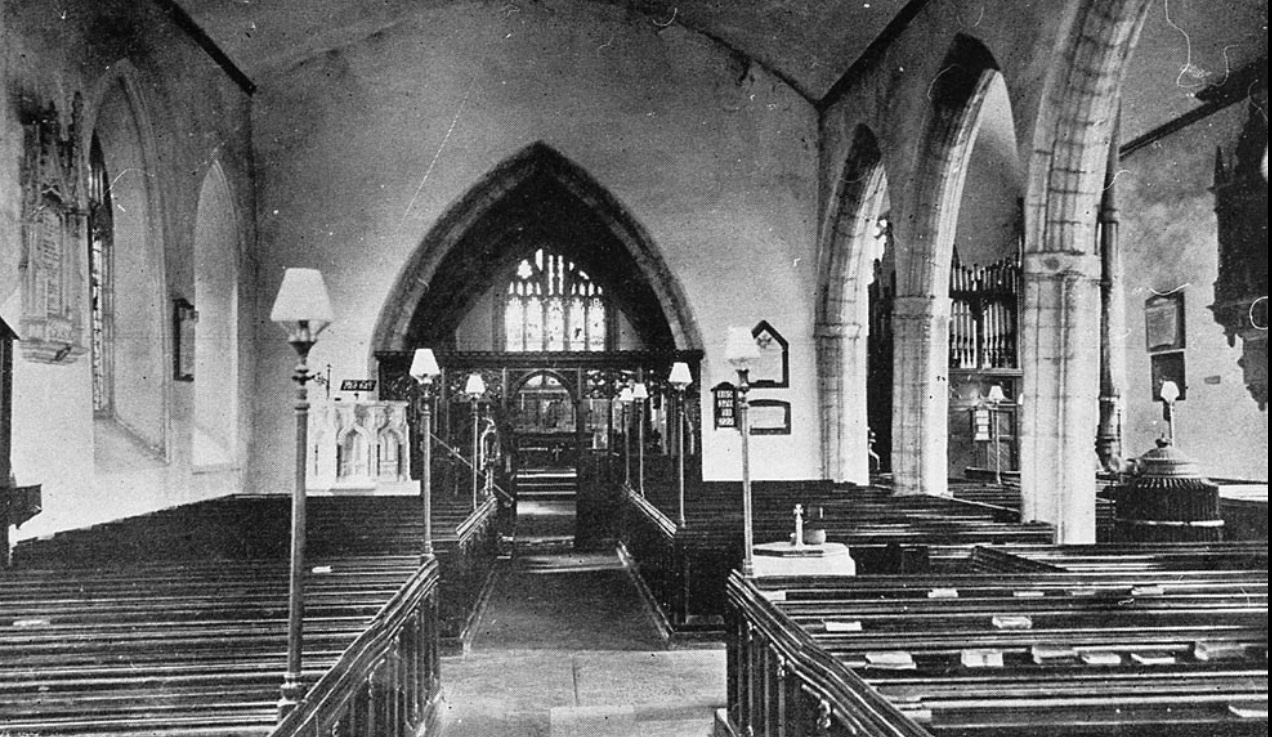
The interior of Holy Cross Church, Cowbridge (People’s Collection Wales).

Like his father before him, my 5 x great grandfather John Howe was an Overseer of the Poor. In 1797 he paid 2s 6d to ‘Ten men in distress coming from the sea.’ The Vale of Glamorgan coast is beautiful, but dangerous due to hidden rocks.

Le Vainqueur, which sank off Sker Rocks on 17th December 1753.

Taxes greatly affected the direction of the Howe family. In 1798, my 5 x great grandfather John Howe featured in the Land Tax Redemption register for St Hilary ten times (out of twenty-seven entries). Most people featured once while John’s brother, William, featured twice. 

John wasn’t ‘Lord of the Manor’, that title fell to the Bassets (although their influence was on the wane), but he was certainly ‘Mr St Hilary’.

The Land Tax became a permanent charge on the land in 1798 and was fixed at 4/- in the pound (20%). However proprietors were given the option to pay a (considerable) lump sum or purchase government stock to free themselves from future liability.

By 1799, the Napoleonic wars had taken their toll on Britain. The British royal treasury was running out of money to maintain the royal army and navy. Soldiers were starving and His Majesty’s navy had already mutinied. For Prime Minister William Pitt the Younger, the solution was simple: impose an income tax.

Under the Act of 1799, all citizens who earned above £60 were to pay a graduated tax of at least one percent. Those with an income of over £200 were taxed ten percent. Some people regarded the tax as a patriotic duty while others complained. 

I don’t know what John Howe thought of the taxes, but it seems they were the reason why he moved his family ten miles west to Coity breaking the Howe connection with St Hilary, which had lasted over 200 years.

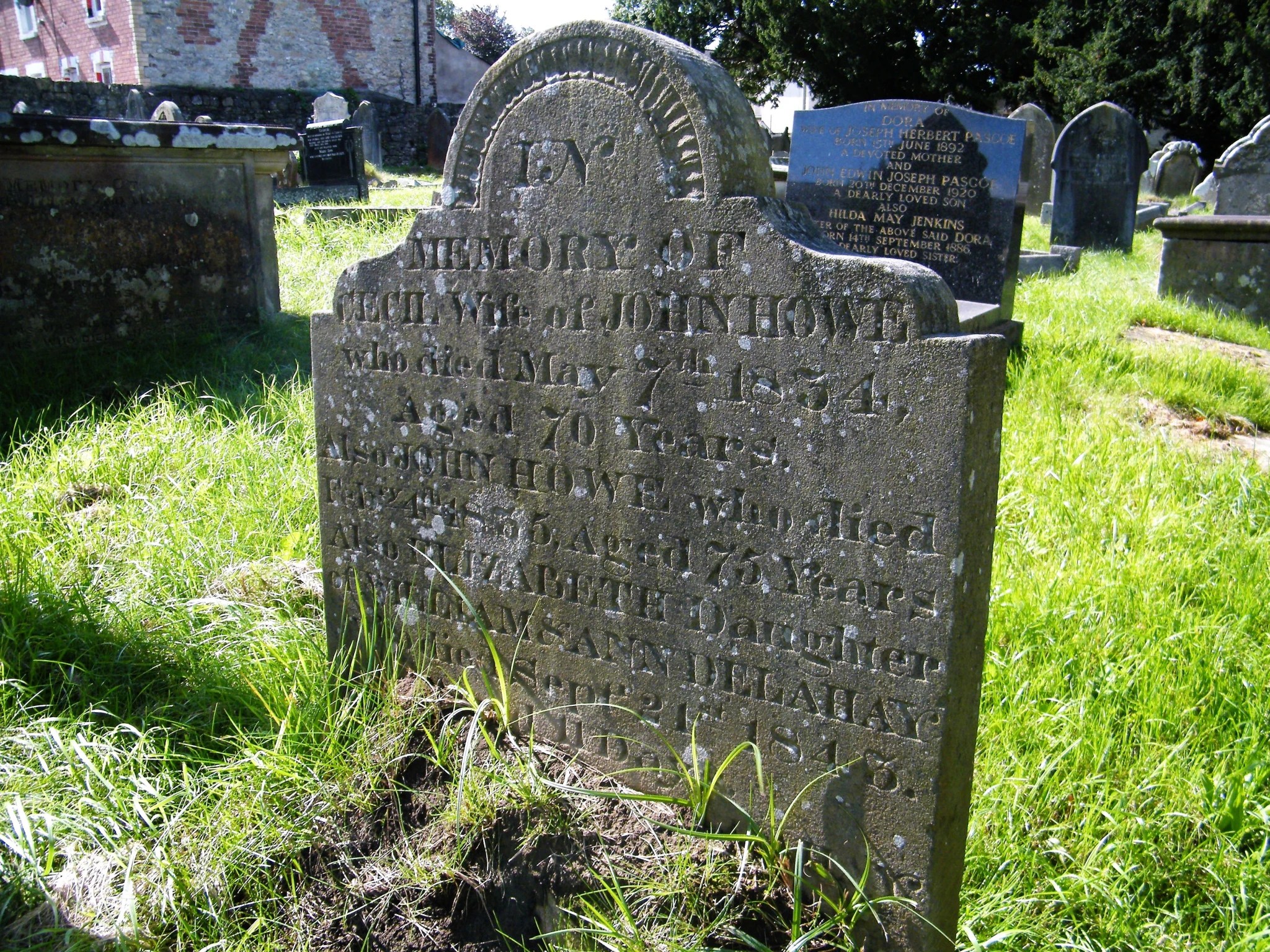
After 49 years of marriage, Cecily died  on 7 May 1834, aged 70 while John died on 4 February 1835, aged 73. The couple are buried together in Coity.

John and Cecily’s grave in Coity.

On Wednesday 4 April 1787 Cornelius Gordon and his wife Mary Bevan were gardening, and arguing, at their house in Crichton, Llanrhidian when Mary collapsed. A servant, Thomas Westley, and a neighbour, Elizabeth Long, helped Mary to bed. She slept while Cornelius continued his gardening.

The following morning, Cornelius told his servant Thomas to get Mr Thomas Williams, surgeon and apothecary, from Swansea. Surgeon Williams arrived at Crichton to find Mary dead. Relatives arrived. Accusations were made.

On Friday 6 April 1787, Gabriel Powell, Coroner, summoned twenty-four ‘honest and lawful men’ and held an inquest into Mary’s death. Evidence was taken. The servant, Thomas, “didn’t see anything” while Surgeon Williams stated that “the deceased did not die from a violent blow.”

A second surgeon, Thomas Sylvester, supported Surgeon Williams. The coroner’s inquest concluded that Mary died ‘by the visitation of God’, and she was buried the following day. However, Mary’s family were not happy and they intervened.

On Tuesday 10 April 1787, Rowland Pritchard, a Justice of the Peace, ordered Charles Collins, a surgeon from Swansea, to exhume and examine Mary’s body. He discovered a fractured skull, consistent with a violent blow, possibly caused by a spade. 

Surgeon Sylvester changed his tune and supported Surgeon Collins. Servant Thomas was questioned. His statement revealed that Cornelius had struck his wife about the head, and that during their marriage they had ‘frequently had words’.

Cornelius Gordon was tried four days later, found guilty, and sentenced to death. He was hanged on Stalling Down, Cowbridge, on 20 April 1787, a fortnight after the murder. This was the last hanging to take place at Stalling Down.

In the mid-1800s a Mrs Howe (first name sadly not recorded) spoke to David Jones an antiquarian. She said that as a young child she was taken up to Stalling Down to witness the execution of Cornelius Gordon.

Mrs Howe recalled the scene as Gordon’s family stood by with a coffin ready to transport his body back to Crichton. Mrs Howe stated that at the moment of the execution “the whole ground trembled, as with an earthquake.”

Next week, the Howes in America.

As ever, thank you for your interest and support.

Hannah xxx

For Authors

#1 for value with 565,000 readers, The Fussy Librarian has helped my books to reach #1 on 32 occasions.

A special offer from my publisher and the Fussy Librarian. https://authors.thefussylibrarian.com/?ref=goylake

Don’t forget to use the code goylake20 to claim your discount 🙂