My latest Golden Age of Hollywood article for the Seaside News appears on page 42 of the magazine.
Movie News – January 1, 1948
A party to announce the engagement of Lana Turner (pictured) to tinplate millionaire Henry J. Topping was hastily cancelled when Topping discovered that he couldn’t make the event. Four hundred invitations had been sent out to “the cream of Hollywood society and the international social world”.
Topping had proposed to Lana Turner at the 21 Club in New York City by dropping a diamond ring into her martini. The couple married in April 1948, and divorced in 1952.
Movie News – January 2, 1948
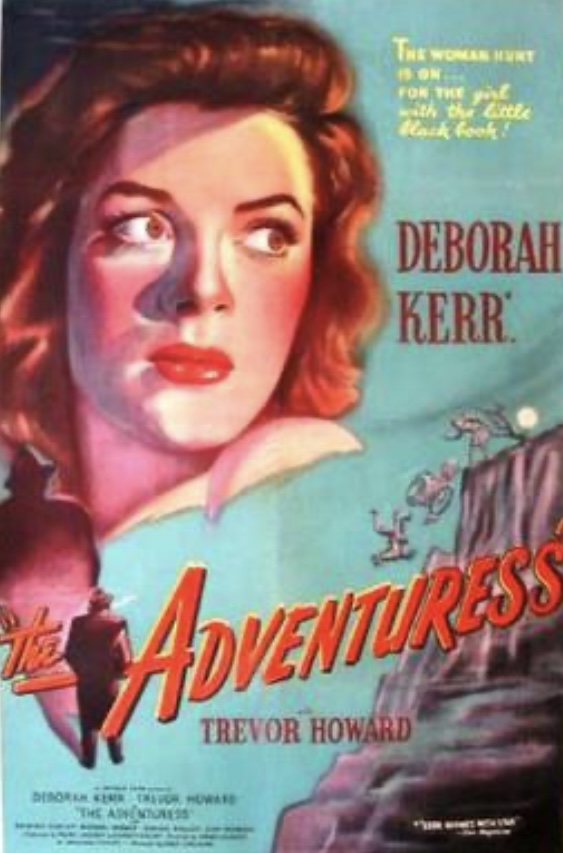
Film critics in New York named Deborah Kerr as the actress of the year for her performances in Black Narcissus and The Adventuress, a Second World War spy movie with comic touches. Released in Britain as I See a Dark Stranger, The Adventuress also featured Trevor Howard.
Movie News – January 3, 1948
Bing Crosby (pictured) was the silver screen’s box office favourite for the fourth successive year, Motion Picture Extra announced, after polling exhibitors. The runners up: Betty Grable, Ingrid Bergman, Gary Cooper, Humphrey Bogart, Bob Hope, Clark Gable, Gregory Peck, Claudette Colbert and Alan Ladd.
Movie News – January 4, 1948
Evacuated from London to Pasadena during the Second World War, and now taking Hollywood by storm after her appearance in National Velvet. many in the film industry, including Mickey Rooney, predicted that Elizabeth Taylor would be the “sensation of 1948”.
Movie News – January 5, 1948
“Only about fifteen percent of film made in Hollywood in 1948 will be based on original stories. The remainder will be based on ‘sure-fire successes’ – sixty-five percent will be remakes of old successes and the remaining twenty percent will be new versions of successful stage plays.”
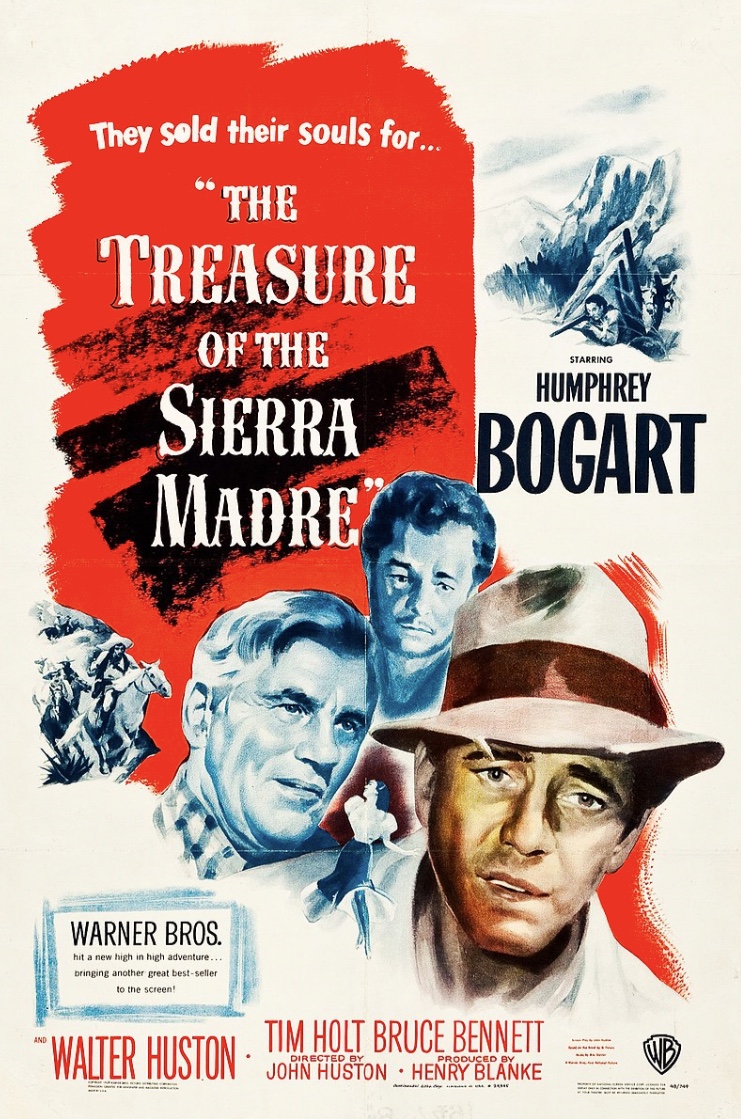
One of the sure-fire successes, The Treasure of the Sierra Madre, an adaptation of B.Traven’s 1927 novel of the same name.
Movie News – January 6, 1948
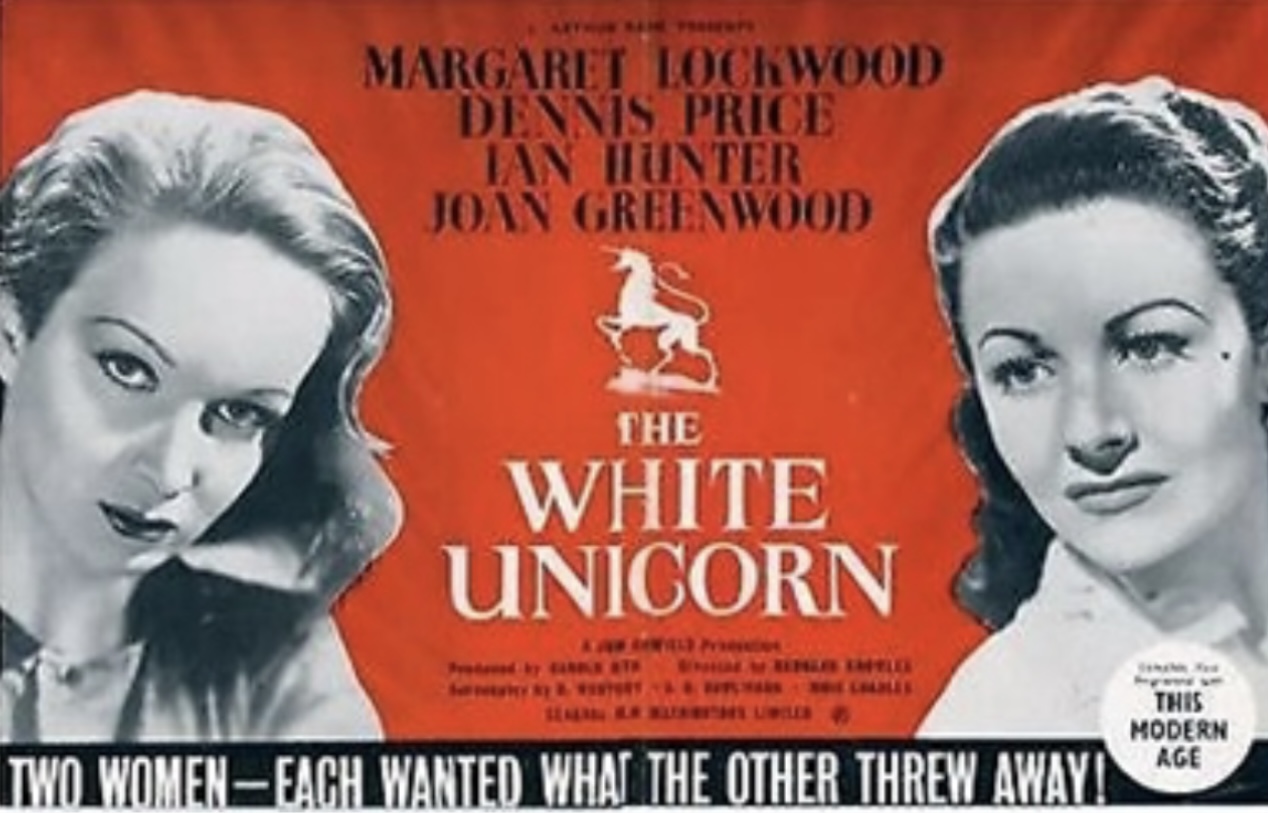
Films showing in British cinemas this week included The White Unicorn (also known as Bad Sister in America) starring Joan Greenwood and Margaret Lockwood, Duel in the Sun starring Jennifer Jones, Desert Fury starring Burt Lancaster, Uncle Silas starring Jean Simmons and Ivy starring Joan Fontaine.
Movie News – January 7, 1948
Sunday’s double feature at the Grand Theatre, Banbury: Tarzan’s Secret Treasure starring Johnny Weissmuller and Maureen O’Sullivan, and Man From Music Mountain with Roy Rogers.
My Latest Book News
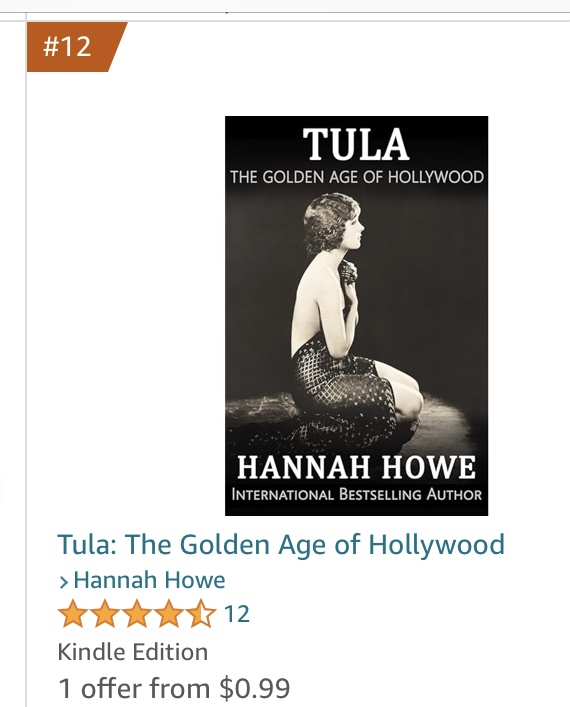
Amazon charts. Betrayal, Ann’s War Book One, is #1 this weekend, Tula, The Golden Age of Hollywood Book One, is #12, and Sunshine, The Golden Age of Hollywood Book Two, is #10 on the Hot New Releases chart.
As ever, thank you for your interest and support.
Hannah xxx
For Authors
#1 for value with 565,000 readers, The Fussy Librarian has helped my books to reach #1 on 38 occasions.
On 3 January 1887, at the age of thirty, my 3 x great grandmother Annie Wheeler gave birth to Samuel, her sixth child, and fourth son. Samuel was baptised on 19 January 1887, and the family continued to live at 25 Salamanca Street.
Meanwhile, Annie’s brother Charles lost his home in Salamanca Street due to the widening of the South-Western Railway. And the newspapers featured the following local tragedy, reported below. The women of Salamanca Street, including Annie, must have wondered if this was a future that awaited them.
In June 1888, James Noulton, husband of my 3 x great grandmother Annie Wheeler, fell ill. As well as tending to her baby, Samuel, and five other children, Annie nursed James. He was unable to continue in his job as a porter at the cement works, so the family lost his income. A hard life became even harder.
By the autumn of 1888, it was clear that James was suffering from tuberculosis, and unlikely to see the new year.
At the age of thirty-one, and with six children to support, amongst the disease and deprivation of Salamanca Street, Annie had to contemplate life as a widow.
Salamanca Street
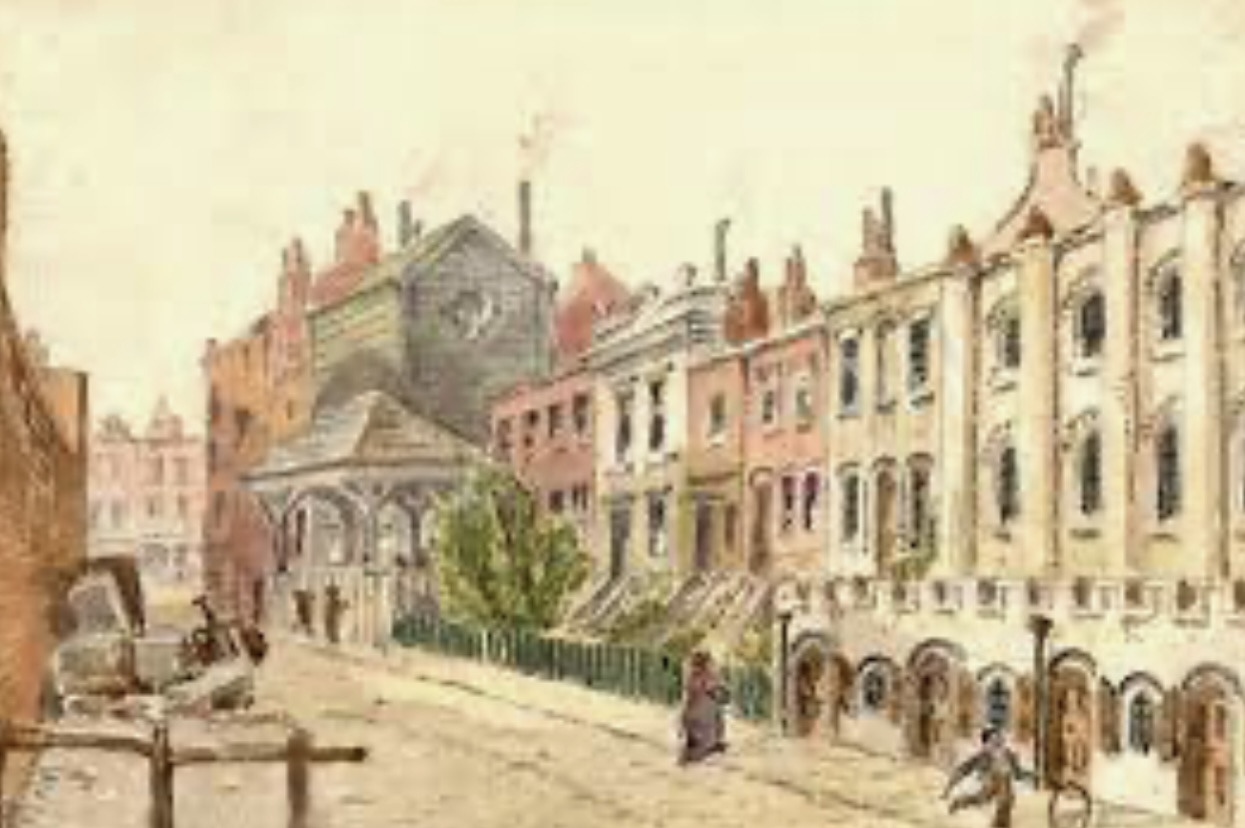
In the autumn of 1888, my 3 x great grandmother Annie Wheeler, her six children, and sick husband, James Noulton, moved around the corner from Salamanca Street to 12 Salamanca Court (pictured). There, Annie nursed James who was suffering from tuberculosis.
On 20 December 1888, at the age of forty, James died of tuberculosis. Annie was present at his passing.
With a baby and five other children in the house, and no breadwinner, even the deprivation of Salamanca Street was out of Annie’s financial reach. The workhouse beckoned. Could Annie find a way to stay out of that hated institution? Could she keep her family together?
My 3 x great grandmother Annie Wheeler entered 1889 a widow having lost her husband James Noulton to tuberculosis. She found a new home, in York Street, Southwark. Doubtless, she was looking across to neighbouring Whitechapel (pictured) and wondering if Jack the Ripper’s reign of terror had come to an end, and maybe her sons were aware of the birth of professional football.
In need of funds to support her six children, Annie found work as a laundress. A survivor since birth, somehow she kept her children healthy and out of the workhouse.
While Buffalo Bill’s Wild West Show was touring Britain, on 22 May 1893, at Saint John The Evangelist, Walworth, Larcom Street, Southwark (pictured, Wikipedia), my 3 x great grandmother Annie Wheeler married her second husband, Frederick Thomas Canty. Annie’s eldest son, twenty-year-old James Noulton, was a witness.
Frederick was 46, ten years older than Annie, and a widower. He worked as a stoker at the local gas works – backbreaking work. With Annie’s six children, the couple set up home in 1 Salisbury Row, York Street. This wasn’t paradise, but after the tragedy of her first husband’s death, Annie had recovered and taken a step toward.
In September 1893, Mary Ann Campin, mother of my 3 x great grandmother Annie Wheeler, died. Mary Ann was the daughter of Charles Campin. Charles was a policeman, ironic given that Annie’s father and first husband spent time in prison for stealing.
Born in Colchester, Mary Ann gave birth to three children: Charlotte, Joseph and Annie. She lived in 12 Salamanca Court, Lambeth, the house where Annie’s first husband, James Noulton, died. The proximity to Annie’s home and the likelihood that Mary Ann helped to nurse James suggests a close family bond.
Also in 1893, the Elementary Education (School Attendance) Act raised the school leaving age to eleven, which affected George and Samuel, Annie’s youngest sons. A further act made education compulsory for deaf and blind children, with provision for the establishment of special schools.
On 11 November 1894, at the age of 37, my 3 x great grandmother Annie Wheeler gave birth to her seventh child, a daughter, Elizabeth Canty. By the time of Elizabeth’s baptism, on 2 January 1895 at St Mary the Less, Lambeth, the family had moved again, to 11 Fryers Street in Lambeth.
Also in 1894, the Royal Mail permitted publishers to print and distribute picture postcards. For those who could afford it, day trips to the seaside had become a feature of life, thanks to the expanding railway network. Collecting postcards from the seaside soon developed into a popular pastime. Annie was still living in the deprived neighbourhood of St Mary the Less, so it’s likely that such excursions were beyond her means.
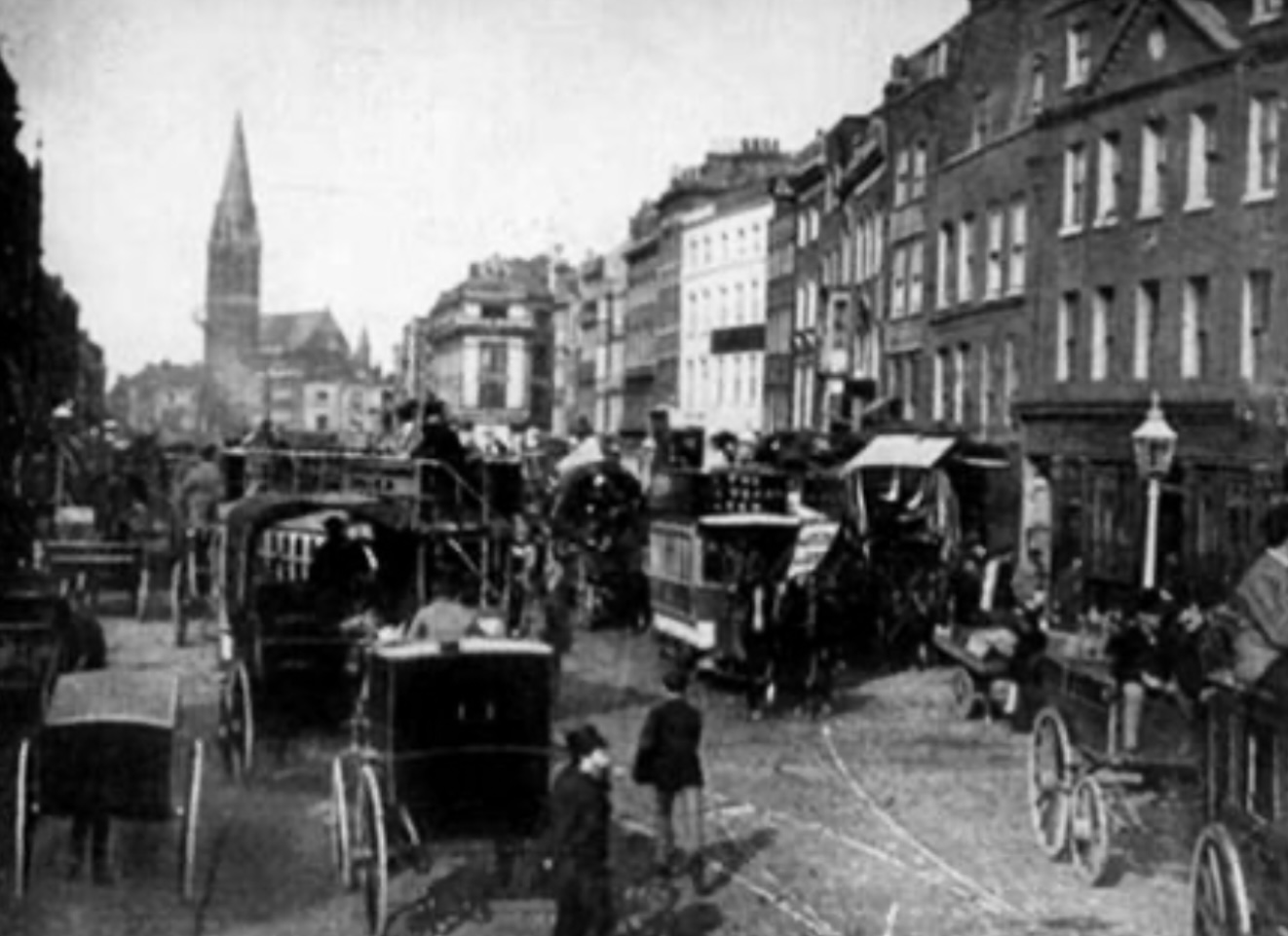
The buildings opposite St Mary’s, a familiar sight to Annie
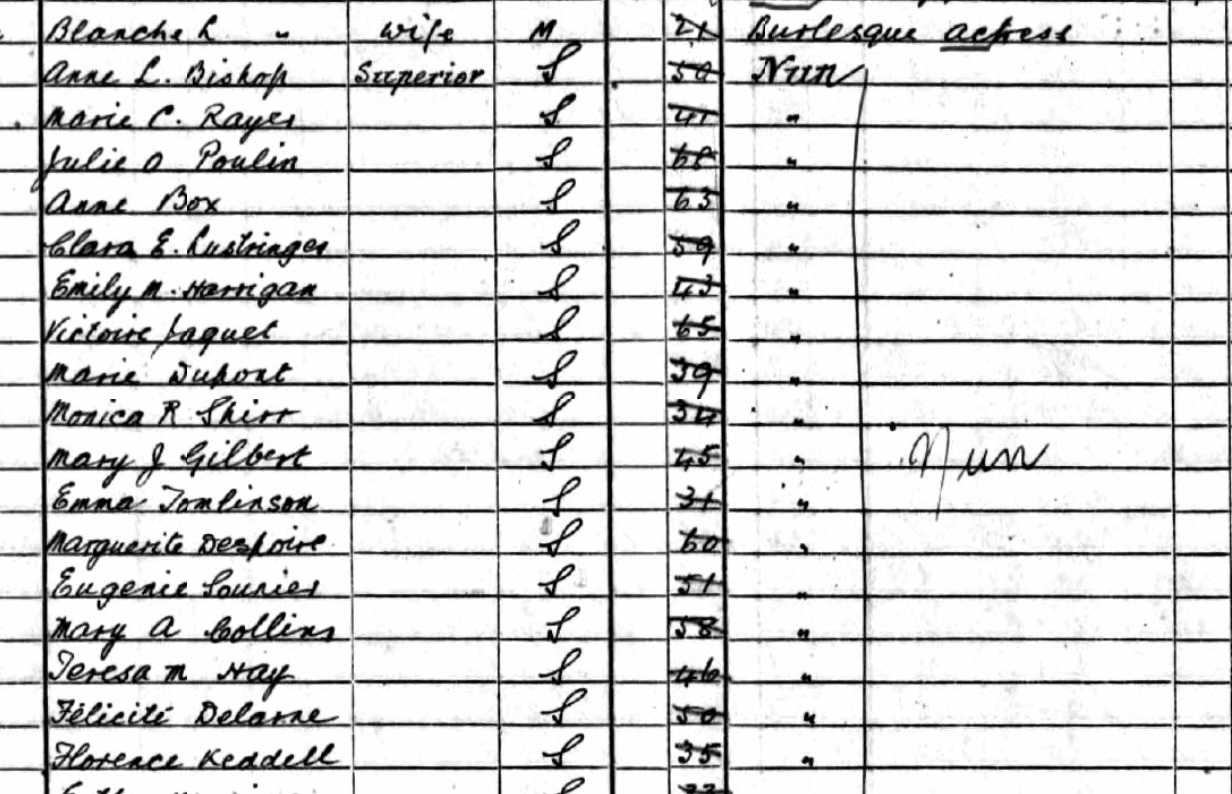
You find some wonderful things in the censuses. Lambeth, 1891, here’s a burlesque actress living next door to a convent of nuns.
As ever, thank you for your interest and support.
Hannah xxx
For Authors
#1 for value with 565,000 readers, The Fussy Librarian has helped my books to reach #1 on 38 occasions.
On 5 August 1879, my 3 x great grandmother Annie Wheeler gave birth to her third child, her first daughter, Charlotte. Annie was twenty-two. She named her daughter after her older sister, who was a neighbour in Salamanca Street.
Annie’s husband James was still labouring, working in the nearby factories and on the docks. Salamanca Street was still blighted by brawls, accidents, and untimely deaths.
Sadly, the rate of childhood mortality was very high in the Victorian era, and that was especially true in Salamanca Street. But, somehow, against the odds, Annie and her family continued to survive.
A market scene in Victorian Lambeth, a sight familiar to Annie and her family
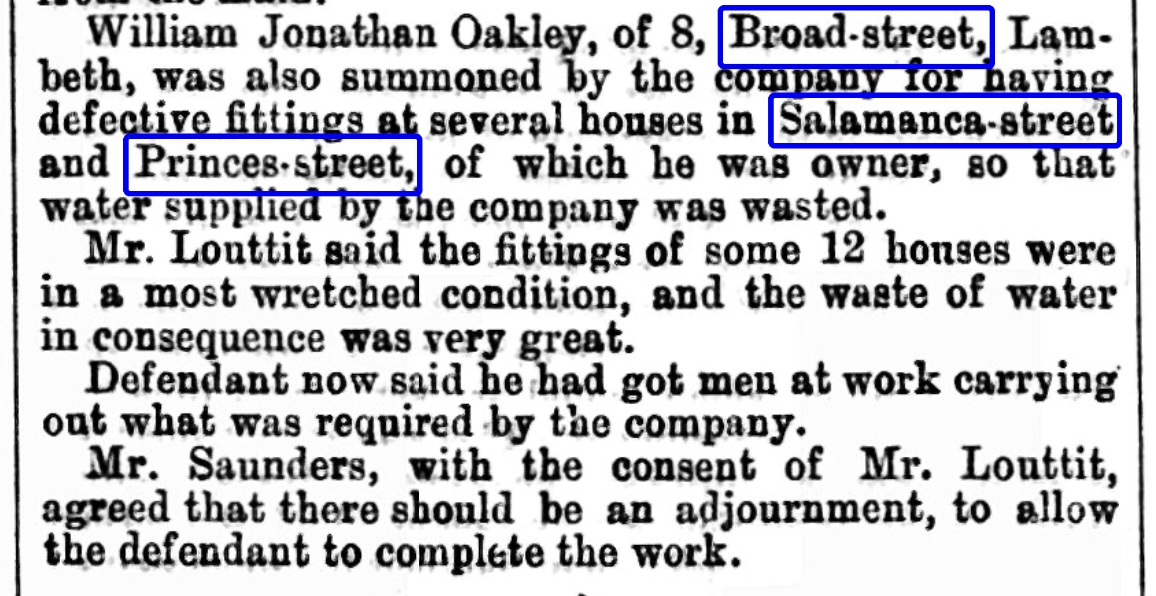
Newspapers in August 1879 reported on the state of the water system in my 3 x great grandmother Annie Wheeler’s street, Salamanca Street. Living conditions were far from ideal. Assaults, and serious fires in the industrial buildings in the street were also commonplace.
On the 16 August 1881, my 3 x great grandmother Annie Wheeler gave birth to her fourth child, and second daughter, also named Annie (pictured later in life, c1920, with two of her daughters). This was a significant event for me because daughter Annie is my 2 x great grandmother 🙂
Salamanca Street, 1881. Living in number twelve, Charles Wheeler (my 3 x great grandmother Annie’s brother), along with his wife and daughter. Charles was a carman. Number thirteen: Annie, her husband James (a cement porter) plus their children James, Henry, Charlotte and Annie. James and Henry were in school. Charlotte and Annie were too young to attend at that stage.
Also in number thirteen, Samuel Noulton, Annie’s father-in-law and a widower, who worked with husband James as a cement porter. You would think that seven people made for a crowded house. However, there were more: Charlotte (Annie’s sister), Thomas Miles, a general dealer (Charlotte’s husband) plus their three sons James, Joseph and Thomas.
Thomas Miles’ brother, William, and his family lived at number fifteen, so you can see how Annie and her extended family had a significant presence in Salamanca Street.
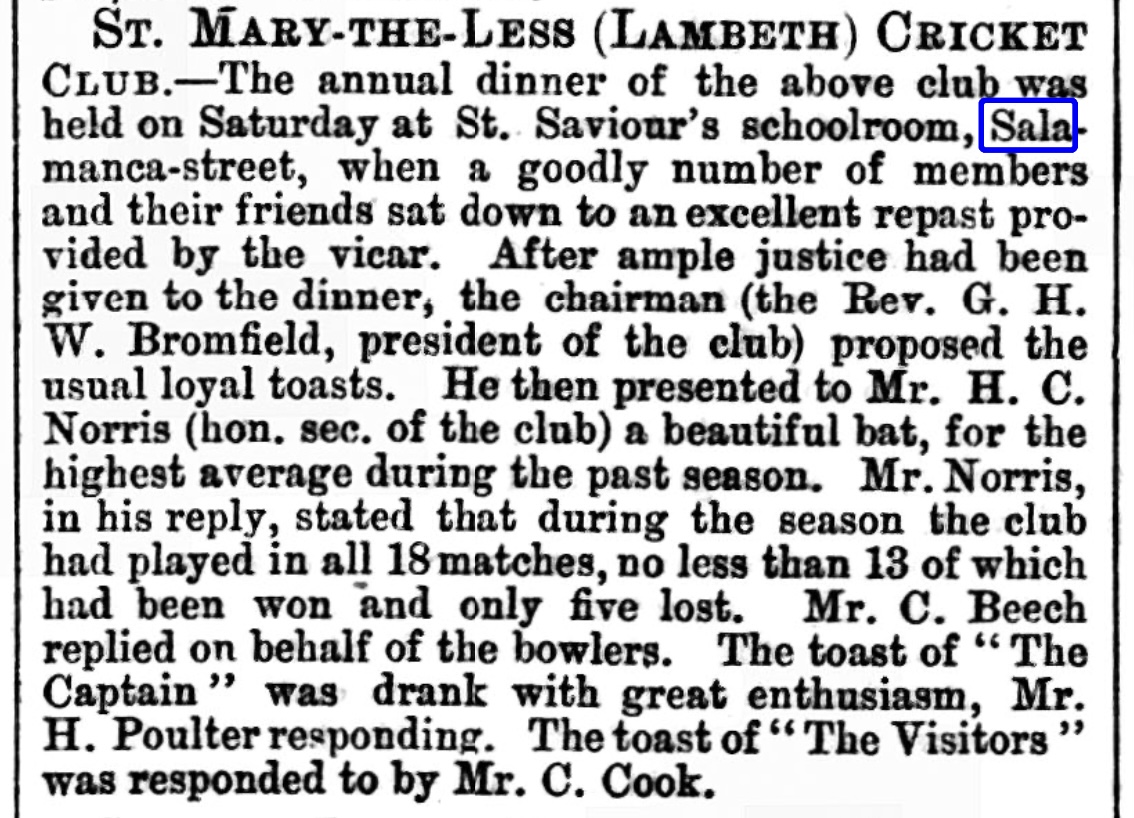
With the rats, leaking water pipes, crumbling floorboards and overflowing sewers in my 3 x great grandmother Annie Wheeler’s street, Salamanca Street, it seems incongruous that in December 1881 the local cricket club were holding their annual dinner in the local school, only a stone throw’s away. Yet, they were. A snapshot of the dichotomy of the Victorian era.
In 1884, the newspapers reported transport developments near my 3 x great grandmother Annie Wheeler’s street, Salamanca Street, including widening the South-Western Railway. These reports offered a reminder of how noisy and polluted the street could be.
Meanwhile, at the age of twenty-seven, in 1884 Annie gave birth to her fifth child, a third son, George. By the time George was baptised, on 13 August 1884, Annie and her family had moved to 1 Albert Buildings. However, this was a brief stay – the family returned to Salamanca Street, albeit to number twenty-five.
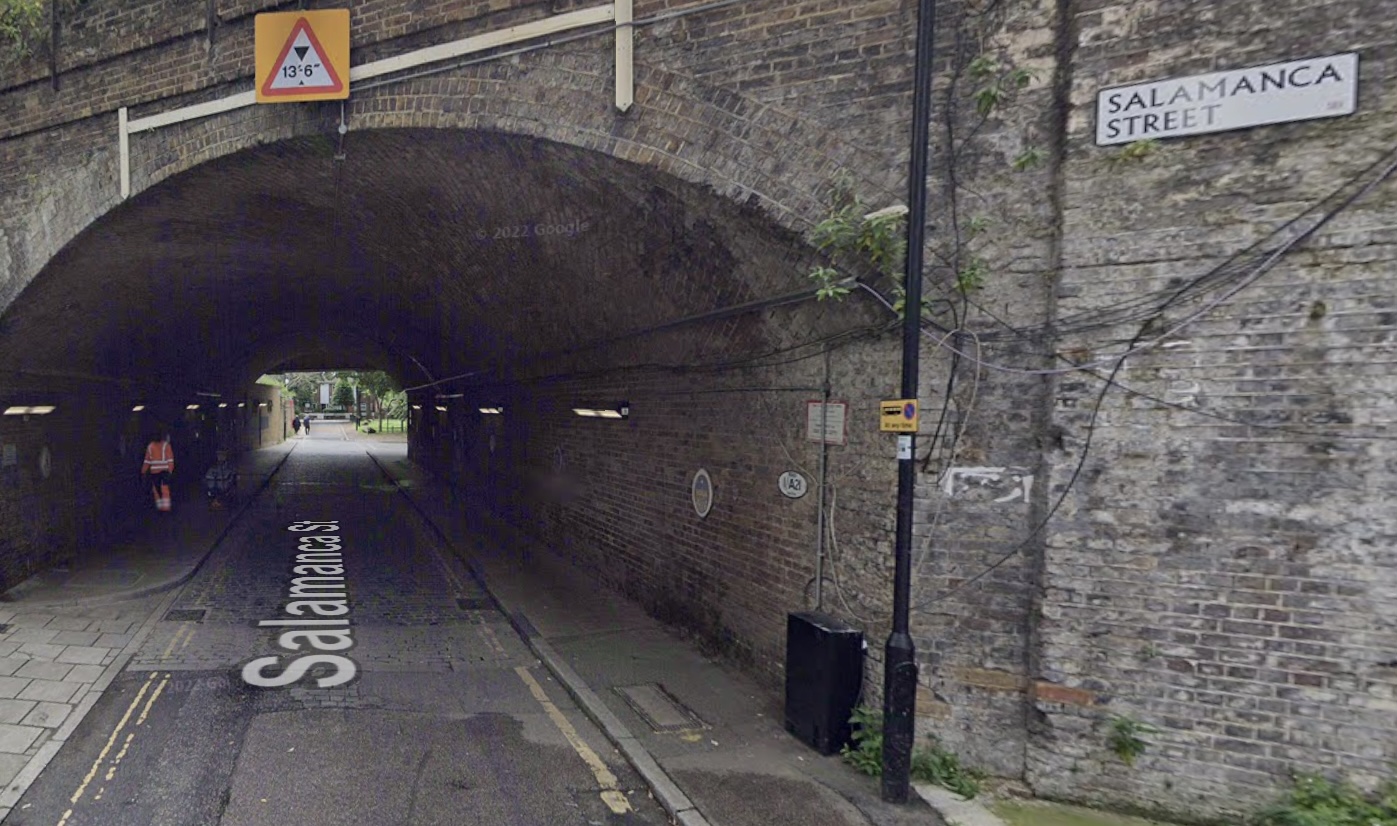
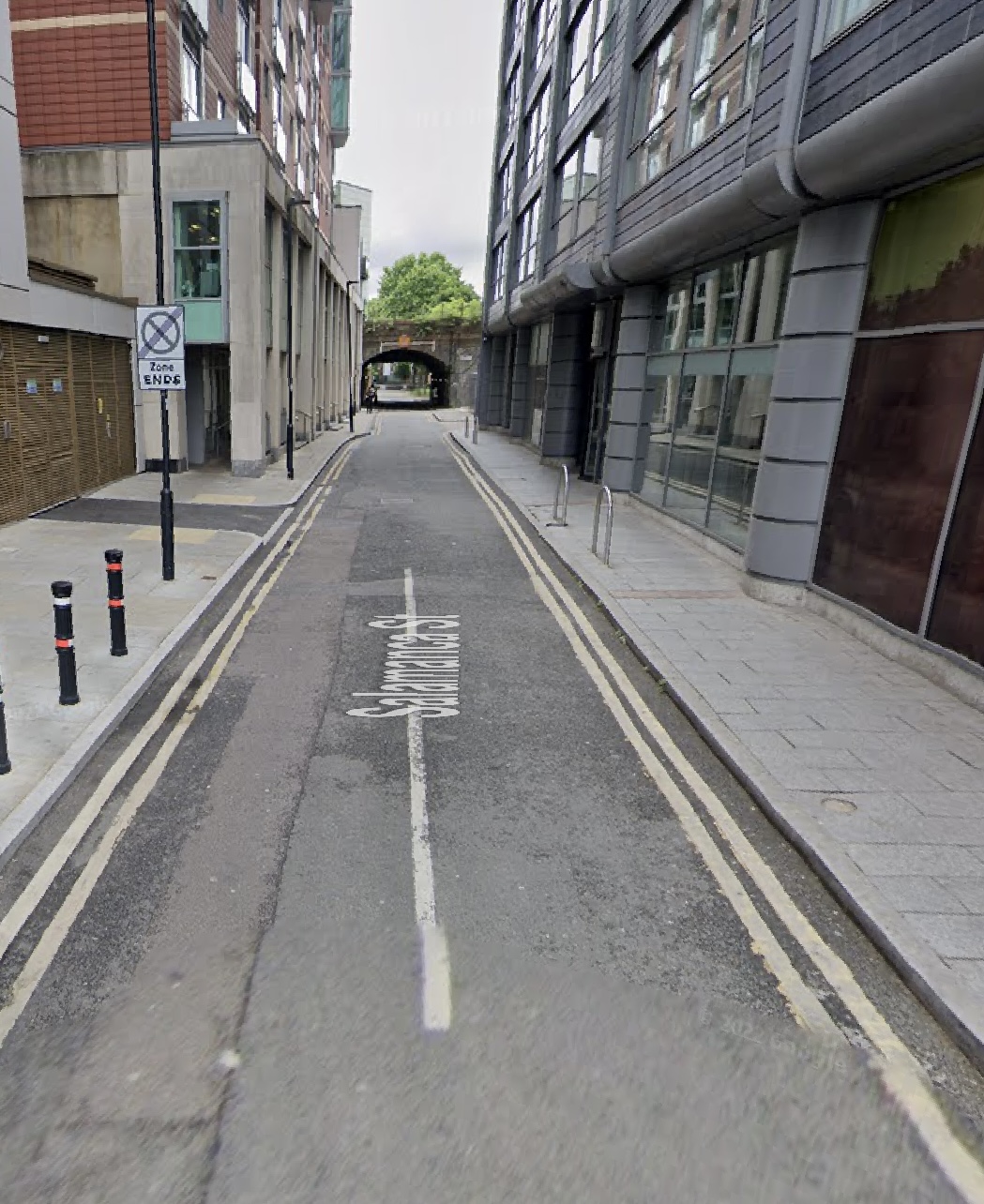
📸 The railway bridge at Salamanca Street (note the width of the road and the depth of the bridge). Courtesy of Google Maps.
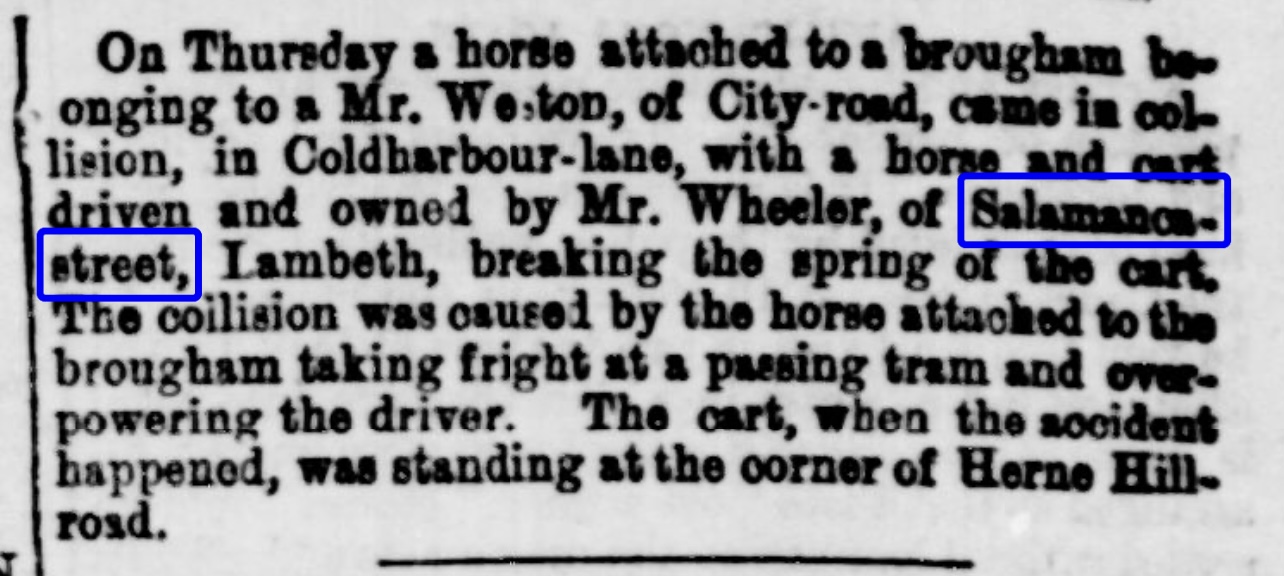
On 20 December 1884, the newspapers reported that Charles Wheeler, a carman and my 3 x great grandmother Annie Wheeler’s brother, was involved in an accident.
As ever, thank you for your interest and support.
Hannah xxx
For Authors
#1 for value with 565,000 readers, The Fussy Librarian has helped my books to reach #1 on 38 occasions.
In 1871, at the age of fourteen, my 3 x great grandmother Annie Wheeler glimpsed the prospect of escaping from the Lambeth slums – she secured a job, as a servant, with a respectable family, the Micklefields – James and Jane, and their children Eliza, aged two, and John aged one. James was a lighterman, a highly skilled boatman who transported people and trade on the River Thames.
The Micklefields were not rich, but they did live in Mead Row, Lambeth, a street described by Charles Booth in his Map of London as “middle-class, well-to-do”. Compared to her childhood home in the rat-infested dwellings on Lower Fore Street, Annie was in paradise.
Picture credit: Mead Row – musgroves.co.uk
In November 1872, at the age of fifteen, my 3 x great grandmother Annie Wheeler discovered that she was pregnant. Consequently, she lost her job as a servant to the Micklefield family.
The baby’s father was twenty-four-year-old James Noulton. James’ mother, Sarah May, died when he was four and she was twenty-five. His father, Samuel, was the leader of a gang of thieves, the “Riverside Pirates”, who stole coal from barges and warehouses. Thus, both James and Annie’s fathers were criminals.
Earlier, in 1866, eighteen-year-old James fell foul of the authorities and spent three months in Wandsworth Prison. His crime: he stole fifteen feet of lead. James’ prison record reveals that he was 4’ 10” tall with scars on his left leg and forehead. Blue eyed and fair-haired with a fresh complexion, he worked in the local pottery. James entered Wandsworth Prison weighing 6st 12lbs and left weighing 6st 8lbs. A year later, he stole 200lbs of lead – more than twice his body weight – and spent six months in prison.
Annie’s choices were now grim – she faced life as a single mother, or the wife of an ex-convict.
Lambeth High Street, c1860, a sight familiar to Annie
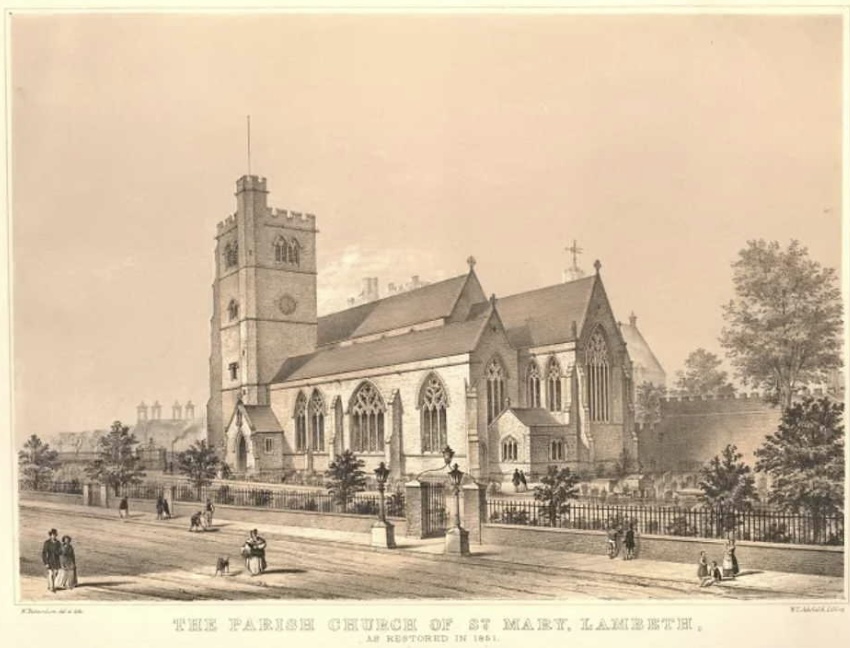
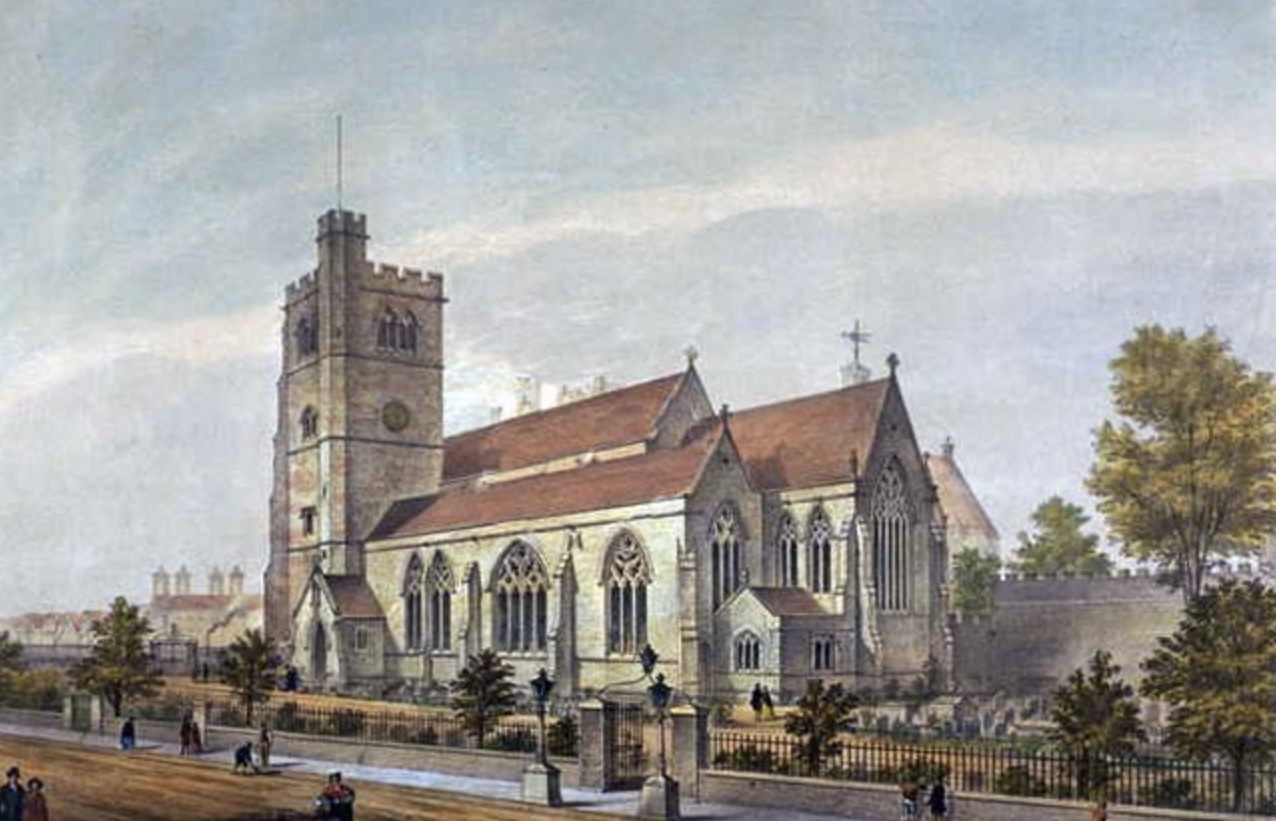
On 1 June 1873, six months pregnant, my 3 x great grandmother Annie Wheeler married the baby’s father, James Noulton, in the splendid surroundings of St Mary’s Church, Lambeth (pictured). Both Annie and James were illiterate, so they signed their names with crosses.
On her wedding certificate, Annie used her birth name, Nancy. Over the years that name changed to Nan, Ann, then Annie, a name that was handed down through the generations of the Noulton family.
On 10 August 1873, my 3 x great grandmother Annie Wheeler gave birth to a son, James Henry Noulton (pictured in later life). She named him after her husband and father. James Henry was baptised on 31 August 1873 in St Mary’s Church, Lambeth.
A labourer, husband James accepted any job that was available. Meanwhile, at the age of sixteen, Annie looked after her son and ran the family home. Annie, James and James Henry needed somewhere, low rent, to live. They found that accommodation in Salamanca Street, opposite the bone, manure and soap works, a hotbed of disease. Once again, the struggle was on for Annie and her family to survive.
My 3 x great grandmother Annie Wheeler’s home in Salamanca Street, St Mary’s, Lambeth was situated opposite the bone, manure and soap works. Pollution was chronic while mites from the bone works bit the locals and spread disease.
Charles Booth’s Poverty Map of London described Salamanca Street as “poor with 18s income a week for a moderate family”. That income converts to £73 a week in today’s money.
Surviving on 18s a week was bad enough. However, there were lower categories on Charles Booth’s map: “very poor, chronic want” and “vicious, semi-criminal”. Annie’s situation was not great. However, some people in her neighbourhood were living in even worse conditions.
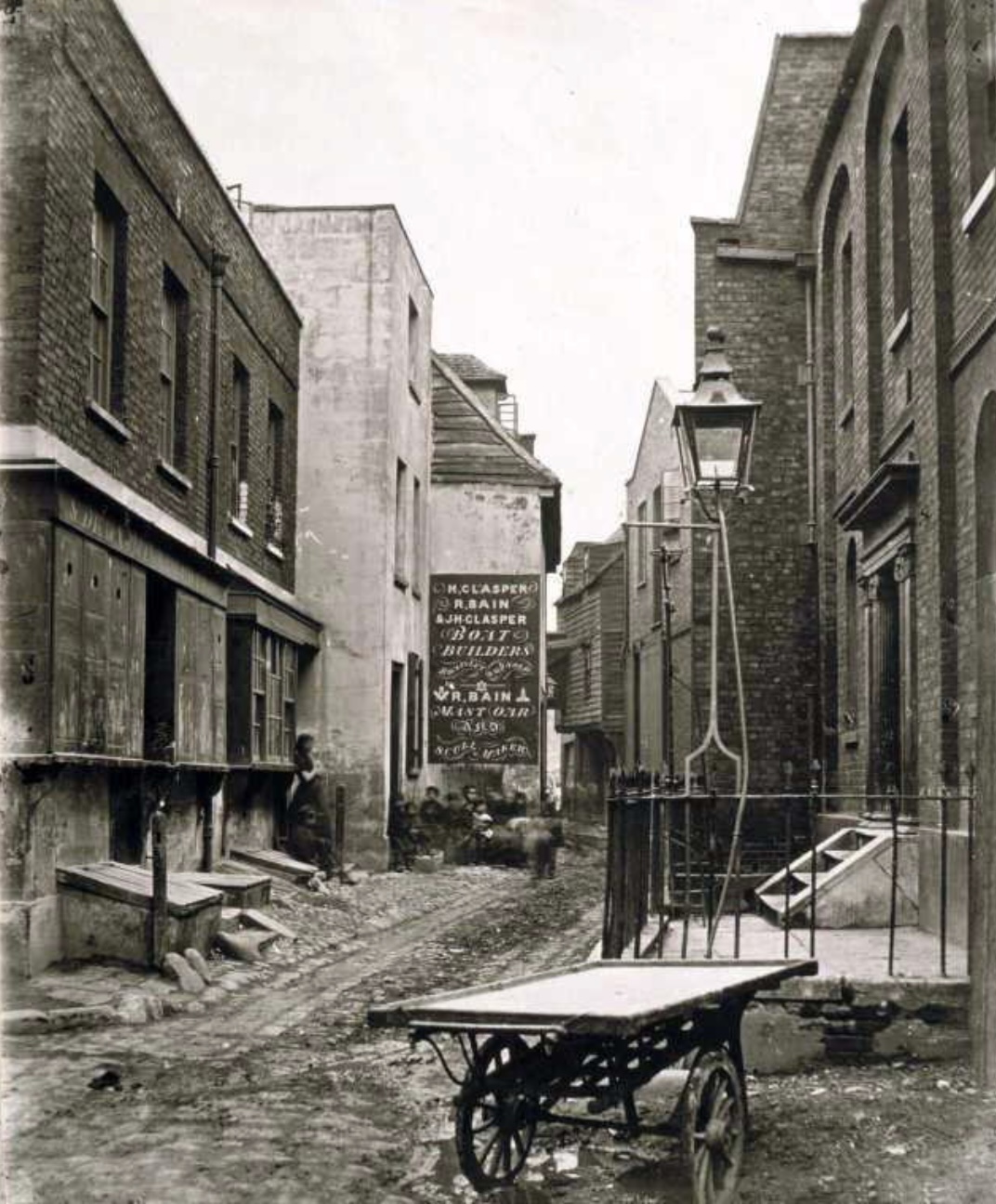
📍Salamanca Street at the time Annie was living there. Note the railway bridge that crossed the street.
In September 1874, the newspapers reported that the soap works adjacent to my 3 x great grandmother Annie Wheeler’s house was for sale. The soap works offered employment. However, it also generated a lot of pollution and spread disease.
Annie’s father-in-law Samuel Noulton worked as a bone chopper in the soap works. After the sale of the soap works he worked as a cement porter at the docks. Annie’s husband James also worked as a cement porter.
Despite the wretched living conditions, Annie’s son James Henry was prospering, but her father, Henry, was in poor health.
In October 1874, Henry, the father of my 3 x great grandmother Annie Wheeler, died. He was seventy-seven. Henry and Annie were close. He lived around the corner from his daughter, in Salamanca Court, and was staying with her at 13 Salamanca Street when he died.
A labourer, Henry was involved in a number of petty crimes. As such, he was not the ideal role model. I get the impression that he stole to feed his family. A notable gap of nine years between the births of his first and second children suggests he spent seven years in prison.
In total, Henry fathered twelve children, nine with his first wife Elizabeth Mitchell and three with his second wife Mary Ann Campin. Annie was his youngest child.
Henry was buried on 19 October 1874 in a common grave in Brompton Cemetery, at a depth of seven feet. A number of other coffins, strangers to Henry, were buried with him. Meanwhile, in harsh conditions, Annie struggled on. Many women in her position turned to drink. Would she follow that route?
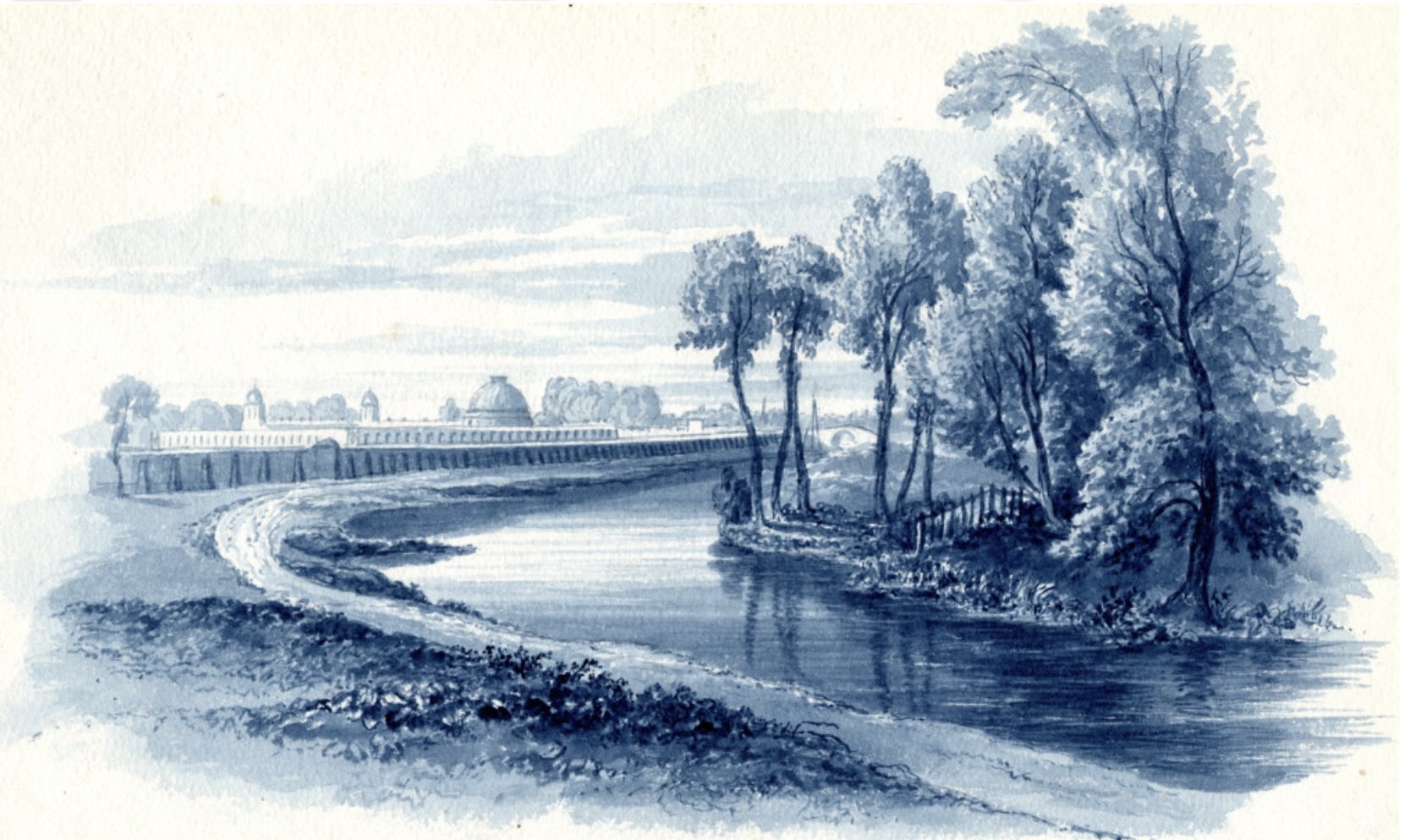
Brompton Cemetery and Kensington Canal by William Cowen
Still a teenager, in April 1875 my 3 x great grandmother Annie Wheeler gave birth to her second son, Henry Charles Noulton (pictured with a niece in later life) – or did she?
There is confusion over this birth record. Henry Charles Noulton, was baptised on 30 May 1875 in St Mary’s Church, Lambeth. His father was recorded as James Noulton, Annie’s husband.
Two entries on this record raise queries. One, the address, 17 Vauxhall Walk. Vauxhall Walk was around the corner from Annie’s home in Salamanca Street so it’s possible that she was staying there during the early days of the birth, or that her family had moved there temporarily. The second query is more baffling – the mother’s name was recorded as Elizabeth.
Annie was born Nancy. It’s possible that she was also known as Elizabeth, certainly she used that name for one of her children. The two previous baptisms that day also featured Eliza as the mothers. Maybe the vicar, George Elliot, made a mistake because he had Eliza on his mind. Annie was illiterate, so wouldn’t have noticed the error.
Henry Charles Noulton was brought up as Annie’s son. He named his first daughter Annie. Furthermore, my 3 x great grandmother’s birthing pattern suggests that she was due to give birth around the time Henry Charles was born. And, the clincher for me, the child appears to have been named after Annie’s father.
A newspaper report from October 1875 stated that fighting occurred in a house in Salamanca Street and that a large crowd gathered outside. It’s highly probable that my 3 x great grandmother Annie Wheeler was in that crowd.
The newspaper also reported that Salamanca Street was “notorious for violent assaults and riots, particularly on Saturday nights.” Two descriptions of Annie’s husband James Noulton mentioned scars, so maybe he was involved in a brawl at some point.
Courtesy of Google Maps, a modern view of Salamanca Street. Annie’s home was near the railway bridge, which appears to be the original Victorian structure.
By the autumn of 1876, my 3 x great grandmother Annie Wheeler had two young children. These newspaper reports from that time offer descriptions of life in her street, Salamanca Street.
As ever, thank you for your interest and support.
Hannah xxx
For Authors
#1 for value with 565,000 readers, The Fussy Librarian has helped my books to reach #1 on 38 occasions.
Annie Wheeler spent her childhood in Lower Fore Street, Lambeth, a street “of filthy tumbledown buildings of rancid odours and Lambeth fog…of dirt, decay and bad smells.” Cholera arrived in London via Lower Fore Street, in September 1848.
Annie’s parents were Henry Wheeler, an habitual criminal, and his second wife, widow Mary Ann Campin. Henry was sixty when Annie was born, Mary Ann was forty-one. Annie’s half-brothers, Charles and Richard, spent time in prison for larceny. Ironically, Mary Ann’s father was a policeman.
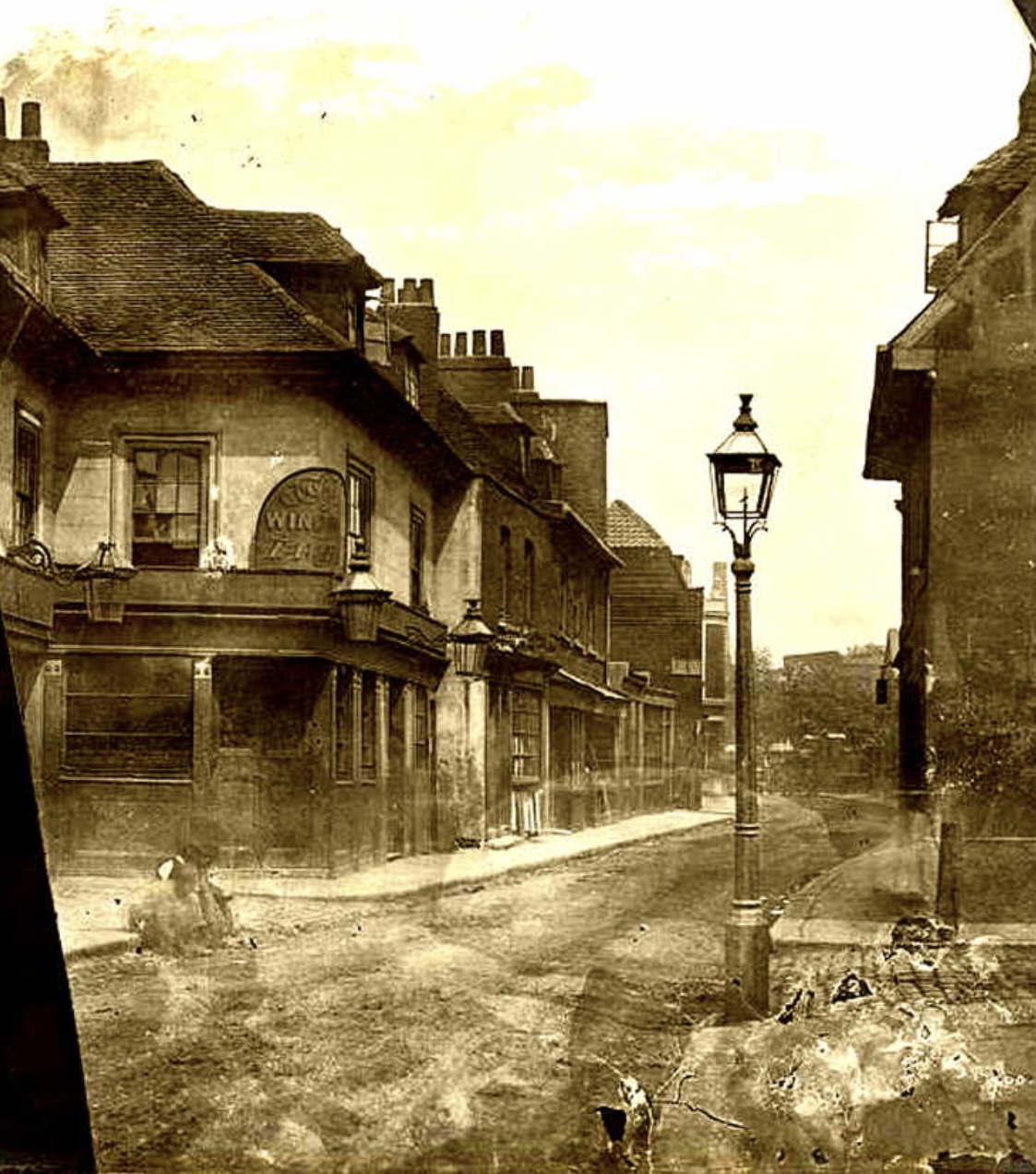
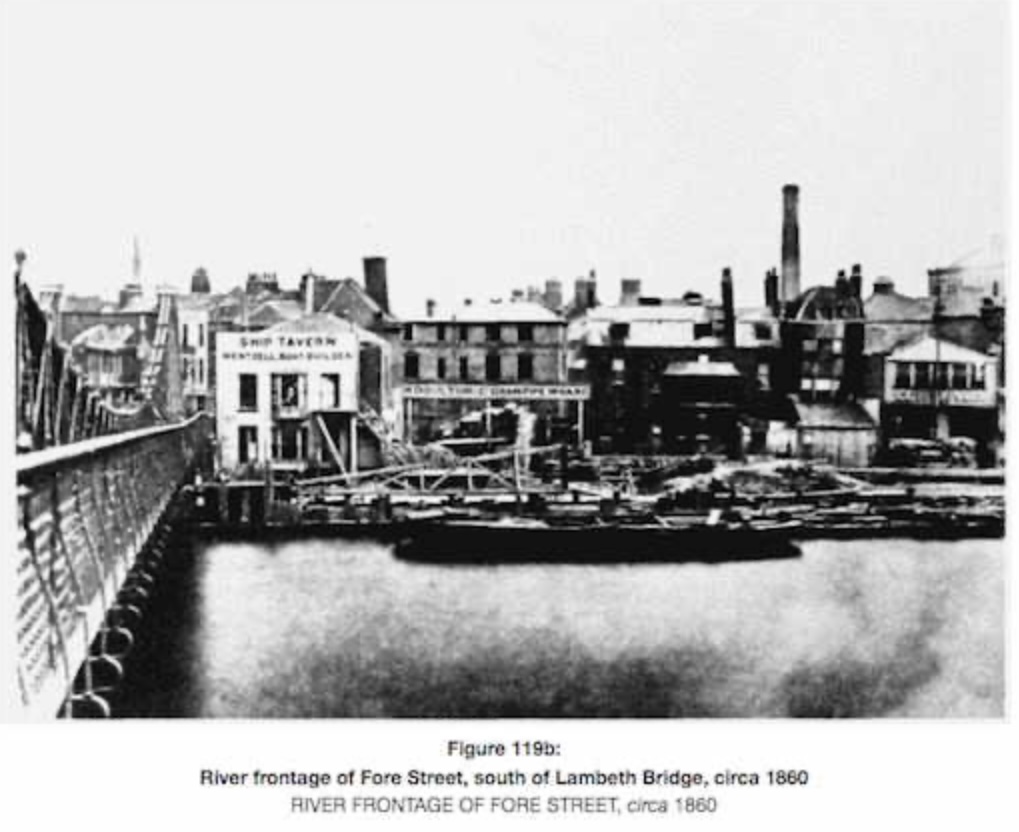
Lower Fore Street, Lambeth, London, c1860. Annie lived in Lower Fore Street throughout her childhood. She was three when this picture was taken, and it’s possible that she is one of the children in the background.
Newspaper reports from 1860. Annie was three years old. These reports offer a graphic description of her childhood.
Lower Fore Street, c1860
A serious fire in Lower Fore Street, May 1861.
The newspaper reports for Lower Fore Street continued in the same vein with fires, suspected murders, accidents and beatings. As you can see, Annie’s childhood was all about survival. Somehow, she made it through to her teenage years. What awaited her then? More next time.
As ever, thank you for your interest and support.
Hannah xxx
For Authors
#1 for value with 565,000 readers, The Fussy Librarian has helped my books to reach #1 on 38 occasions.



















 Hannah Howe