
Hell is a City
An appreciation of a neglected classic

11 February 1960, Kinematograph Weekly – handing over the finished film.
Kinematograph Weekly, 17 March 1960. The Details.

Kinematograph Weekly, 17 March 1960. The Manhunt – box office red meat.

Kinematograph Weekly, 17 March 1960. The Story – contains spoilers.
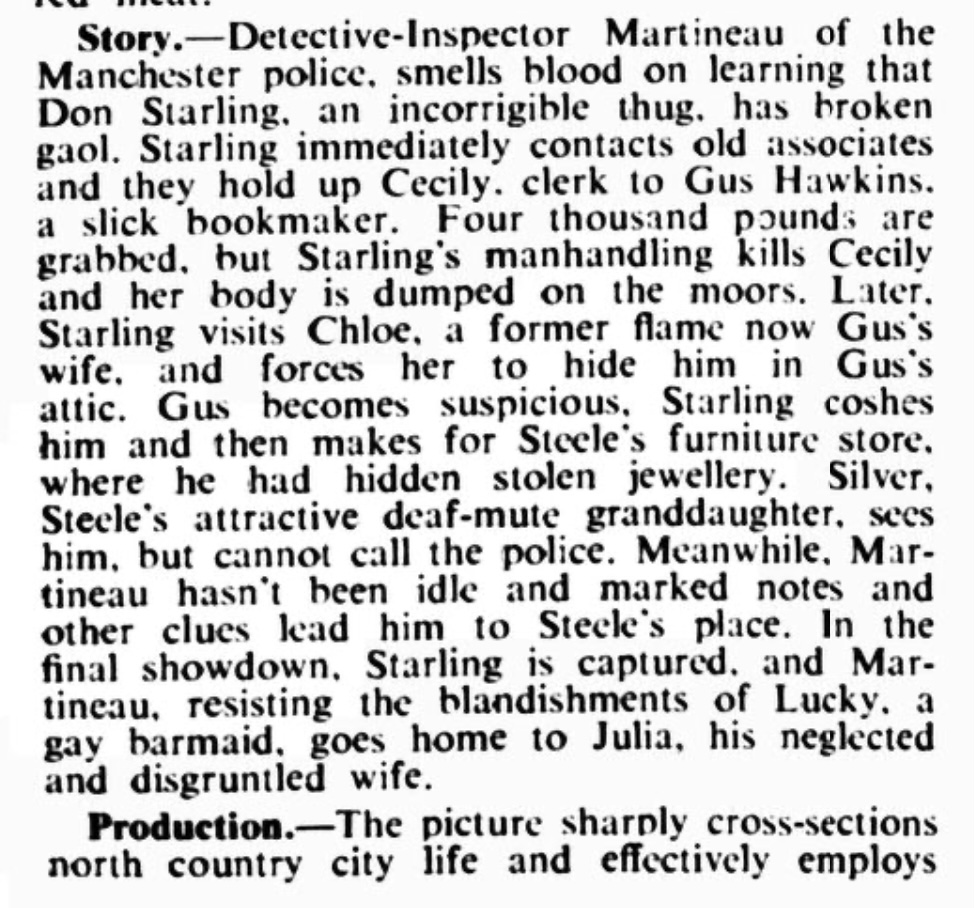
Kinematograph Weekly, 17 March 1960. The Production – more spoilers. Note that two endings were filmed. More about them as the thread develops.

The author, Maurice Procter, wrote fourteen Chief Inspector Martineau novels, between 1954 and 1968. He also wrote other books. Hell is a City was the first in the series. He was born in Nelson, Lancashire, a place I used to visit during my childhood because of family connections.

Sir Stanley Baker portrayed Martineau. I’m not into titles, but in this case the knighthood was deserved.
Stanley Baker’s father was a coal miner who lost a leg in a pit accident, but continued working in the mines. Baker grew up believing he would become a miner or boxer. He revealed the grit of real life in his performances.
There was nothing artsy of affected about Baker’s acting. Forget the hard men of Hollywood – this was the real deal. Yet, he also managed to convey a sense of Welsh melancholy and vulnerability. He was one of the greats.
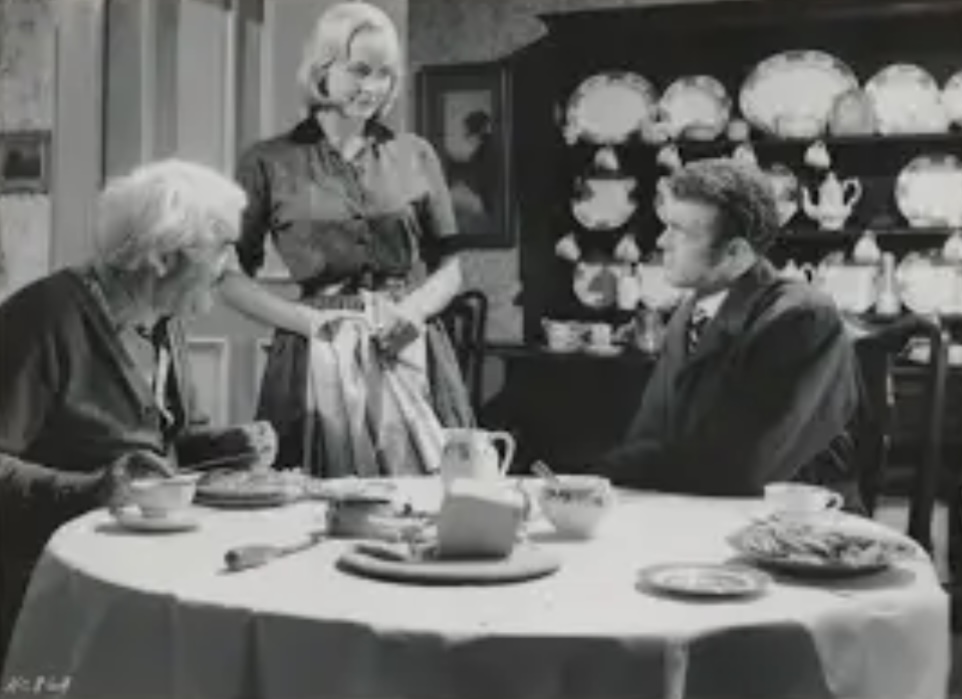
Geoffrey Frederick (right) played Martineau’s sidekick, Detective Devery. Geoffrey Frederick is now 92 years old. He appeared in a number of films including 633 Squadron, The Day the Earth Caught Fire, and The Orchard End Murder. Young and untarnished, he offered an air of optimism in Hell is a City.

John Crawford played Don Starling, the main villain in Hell is a City. Crawford enjoyed a long career, 1944 – 89. Here he’s pictured in The 3,000 Spartans. A psychopath, Starling had few, if any, saving graces, yet Martineau felt some sympathy for him.

Donald Pleasence, photographed by Allan Warren in 1973, enjoyed a career that spanned nearly sixty years. In Hell is a City, Pleasence portrayed Gus Hawkins, the victim of a robbery. Although mild mannered, there was “something of night” about this character.

Even though she only featured fleetingly, except for a crucial scene near the end, my favourite character in Hell is a City is Silver played by Sarah Branch. Silver can neither hear nor speak. Her nature is helpful and cheerful, and her purity offers a contrast to the sordid city underworld.
The crucial scene Silver featured in is a true edge of the seater – superbly played by Sarah Branch. Sarah featured as Maid Marian, opposite Richard Greene as Robin Hood, in Sword of Sherwood Forest. She married in 1961 and switched her focus to raising a family.

Maxine Audley played Julia, Martineau’s wife. It was an unsympathetic role in some respects in that while “our hero” was out there risking life and limb on the mean streets of Manchester, she was complaining that he never arrived home for dinner. Yet, there was more to her character than that.
Martineau wanted a family, she was reluctant. Was she fearful of the intimacy? Of giving birth? Of losing her independence? The strain on the relationship was a key component of the film, and it made Martineau a more rounded character. It also added to the sensual tension in the film, a main theme.

Vanda Godsell played Lucky Luske, a woman attracted to Martineau. Vanda played the part well – flirtatious without going over the top. She enjoyed a long career – 46 years – in films, television, radio and on the stage.
Sadly, Vanda was not lucky in real life – she endured more than her fair share of difficulties and sadness.

Billie Whitelaw played Chloe Hawkins, a central character in terms of the theme and main plot-line of the film. Time Out described Billie Whitelaw’s performance as “striking”, and it was certainly that – it was outstanding.
It’s worth noting how many of the main performers enjoyed long and distinguished careers. That such a cast was assembled highlights the quality of the film.
Hell is a City features a game of “Two-up”. The way this scene was written suggests that the author was familiar with the game, had probably witnessed it in his community.
The scene plays an important part in the plot. It also features the people in the local community, the buildings and landscape. As a snapshot of the time it’s an interesting piece.

Three of the classy aspects of Hell is a City. The jazz score by Stanley Black (pictured), which is understated and sympathetic to the overall story. The editing, which is fast paced, but never flashy.
The dialogue, which is also fast, and abrasive, to the point. The style created from the above, plus the Manchester locations, suggest a semi-documentary feel. This is fiction, but based on reality.
The film version of Hell is a City closely followed the book, except in the outcome for one character – Silver Steele. I think the film got this outcome right, the book badly wrong. My reasons…
Martineau was building a case against Starling. The murder of Silver Steele made this case, and the bulk of the story, redundant – Martineau could simply have arrested Starling for Silver’s murder.
At the end, Martineau showed sympathy for Starling, the murderer of a young woman who cannot speak or hear. Martineau’s empathy for Starling undermines the morality of his character. He should have saved his feelings for Silver.
At the end of the film, Devery says Silver is recovering. The cinema audience hoped for, and expected this. If Devery had announced that Silver was dead the audience would have left with a negative view of the film, damaging box office takings.
Why was Silver, and her outcome, crucial to the film? Because she was almost the only character to display any sense of purity. Even a dark film needs moments of light, characters of hope. The filmmakers recognised this and made the right decision.
That only leaves the ending. Two endings were filmed, which suggests the filmmakers were in a quandary.
The ending of Hell is a City
***Spoilers***
Cinema release ending: Starling faced the hangman, Martineau argued with his wife (again), he wandered the city at night, meeting Lucky Luske, resolving her storyline, and a prostitute, whom he rejected. Devery appeared and announced that Silver Steele was recovering. Martineau continued to wander the streets. Roll the titles.
The alternative ending: Starling hangs, Martineau argues with his wife (again), the city at night, the meeting with the prostitute, Devery says Silver is recovering, Lucky’s storyline is resolved (this is a better scene order), Martineau returns home, argues with his wife, (yet again). His wife, Julia, admits her fears, the couple resolve their differences and embrace on their marital bed. Roll the titles.
The book ending: the night streets, the prostitute, Lucky’s storyline resolved, Martineau argues with his wife (again), the couple talk in bed, resolving their differences.
My ending: I would keep the cinema release ending, but move the scenes with Martineau and Julia to the end, toning down their arguing. Julia would admit her fears and Martineau would show his understanding. They would resolve to make a new start. Roll the titles.
 Hannah Howe