When my 2 x great grandfather William Howe died on 14 May 1933 the newspapers carried the following obituary: “We regret to report the death of Mr William Howe, aged 78, of Wood View, Cornelly, who passed away on Sunday. Mr Howe was senior deacon at Cornelly Calvinistic Methodist Chapel and superintendent for many years at the Sunday School in South Cornelly. A man of Godly character and exemplary life, he was held in respect by all whom he came into contact with, and his memory will be cherish, especially by those who first learned the path of rectitude and duty at Cornelly Sunday School. He was employed for a number of years as the foreman to Mr Gaen at the quarries, and his fellow workmen were given a half day off to attend the funeral.”
The report continued with a long list of notable people who attended the funeral.
William died at Wood View, a house that remained in the family. However, he’d spent many years of his life at Lilac Cottage, South Cornelly.
For decades after William’s passing his descendants, my ancestors, continued to live at Lilac Cottage. I intend to take a snapshot of their lives, focusing on the war years, 1939-45, and tell the story of the Lilac Cottage Howes who served on the Home Front and the Frontline. It’s a tale of ordinary people, of village life, and great sacrifice. It’s a story personal to me, yet common to many people. During 1939-45, Britain was full of “Lilac Cottages” and the lives of my Howes mirrored the lives of many people who lived through this challenging time.
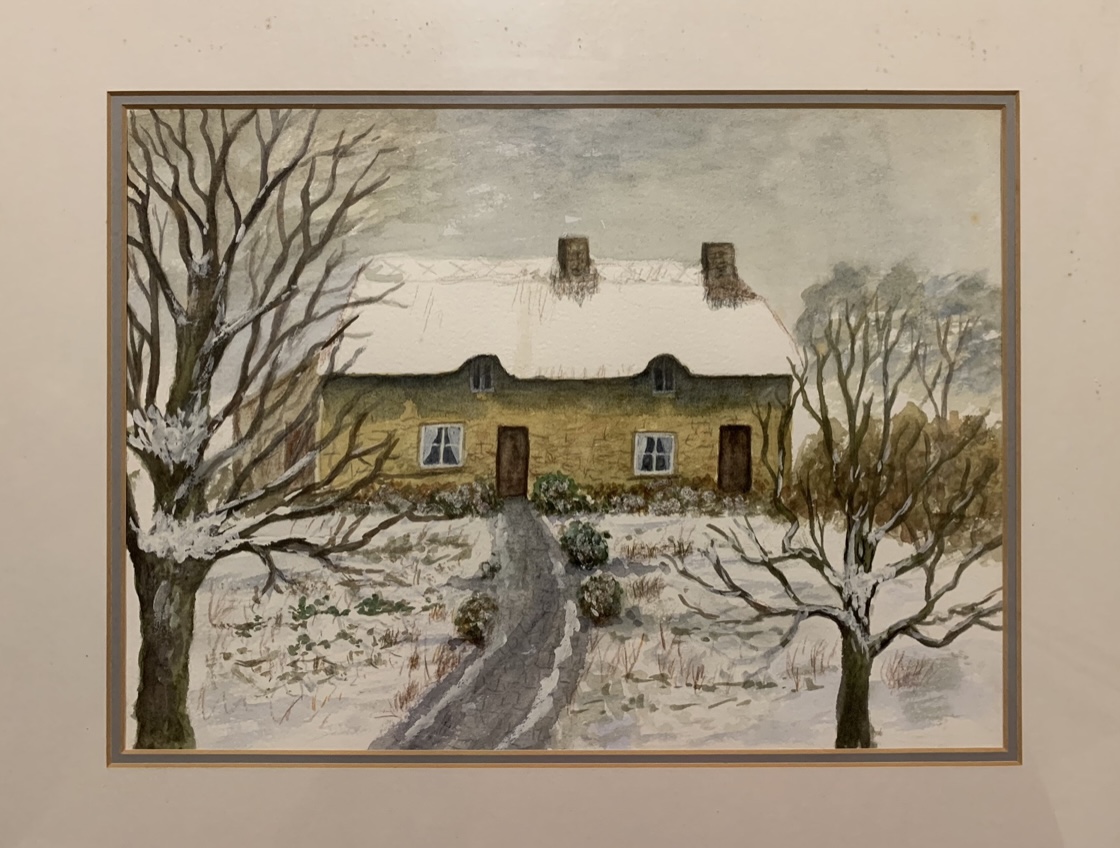
Lilac Cottage, a watercolour by Priscilla Doreen Howe
The Howes at Lilac Cottage, 1939
William David Howe – son of William Howe
Gwendolyne Thomas – wife of William David Howe
Joan Mary Howe – daughter of William David Howe
William Kenneth Howe – son of William David Howe
Clifford Roy Howe – son of William David Howe
Evan Howe – brother of William David Howe
Mary Ann Howe – sister of William David Howe
Also, Priscilla Doreen Howe – daughter of William David Howe – who in 1937 married Handel Edwards.
Living in Wood View, next door to Priscilla and Handel Edwards:
Christiana Howe – sister of William David Howe – her husband David T David, and their two children.
The cottage was divided in two with William David Howe and his family living in one part of the building and Evan and Mary Ann living in the other part.
Consider this the prologue. I will tell you more in Chapter One, next time.
For Authors
#1 for value with 565,000 readers, The Fussy Librarian has helped my books to reach #1 on 36 occasions.
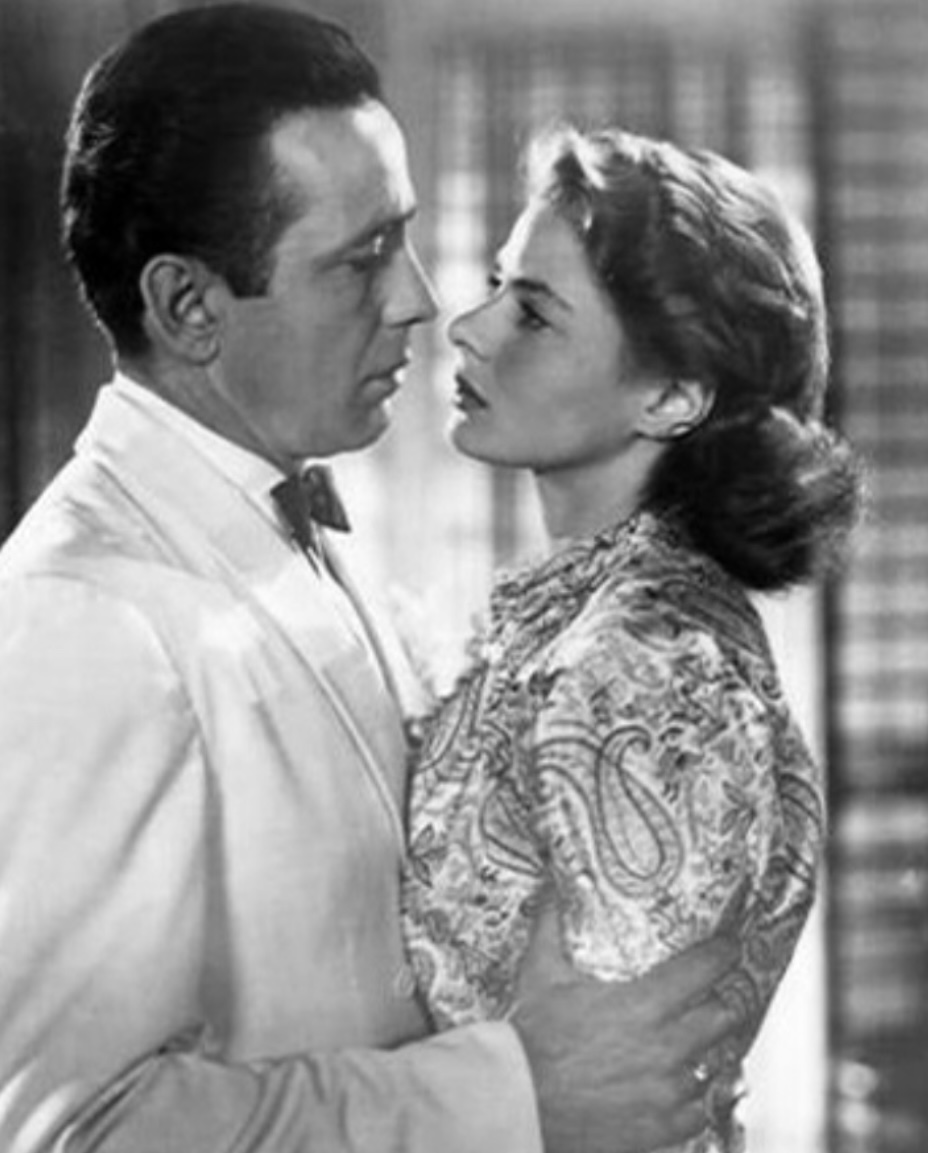
Can you name the actor, actress and this famous 1942 movie?
Answers at the foot of this post.
Movie News – March 11, 1948
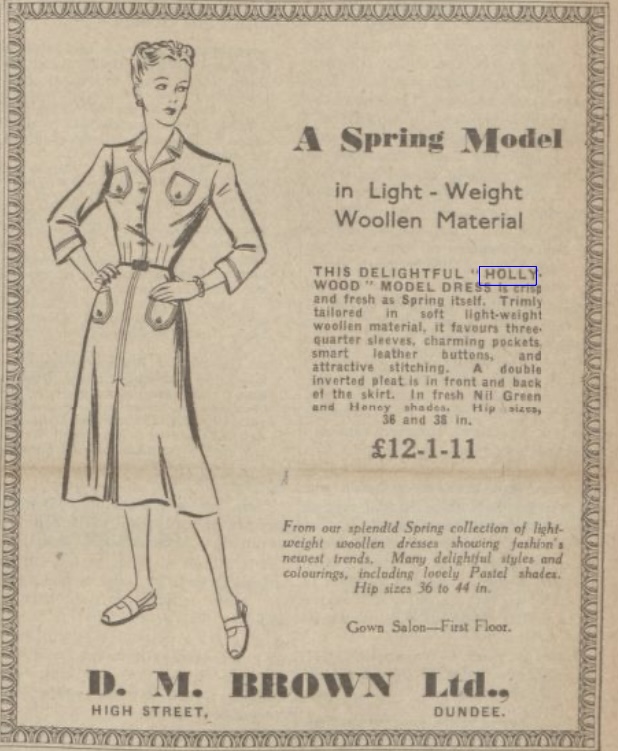
Look like a film-star in this Hollywood fashion dress.
Movie News – March 12, 1948
If you are short and would like to acquire a queenly manner, actress Priscilla Lane (pictured) recommends that you should use your clothes to add inches to your height. The secret, she says, is self-colours. “The short girl should not cut her height by wearing shoes or a hat of a different colour from her dress. By wearing a single colour from tip to toe, she can appear inches taller.”
Movie News – March 13, 1948
Cricket in Hollywood. With so many British actors finding themselves in Hollywood, cricket became a popular pastime. Furthermore, the first ever international cricket match was played between the USA and Canada in 1844, at the grounds of the St George’s Cricket Club in New York.
Movie Quiz #12
This – German-born – actress created a sensation when she adopted this pose. The year was 1931, the movie was Dishonoured. Can you name the actress.
Movie News – March 14, 1948
“British actors and actresses are losing their voices because of a lack of calcium and vitamin B3, according to Mr Walter Bickford, a voice developer, who has just returned to Hollywood from Britain. ‘Some British actors rasp out their lines as if they have sore throats,’ Mr Bickford said in the film city yesterday. ‘I could name British actors and actresses who are losing their voices, but I had better not.’”
Movie News – March 15, 1948
“With the tax dispute settled, these are some of the American films we can expect to see in British cinemas: Green Dolphin Street, Forever Amber, If Winter Comes, and Gentlemen’s Agreement. Which leaves us with the question as to whether British studios will be able to keep abreast with the rush of first-class American films.”
Movie Quiz #13
As my grandmother used to say, “They’ll catch a chill walking around like that.”
Can you name the loving couple, their characters and the actors?
Movie News – March 16, 1948
“The Loves of Carmen starring Rita Hayworth and Glenn Ford is the first film to use plastic food throughout. In accordance with the austerity trend, Columbia no longer uses real food in its pictures, except where it has to be eaten. In one scene, plastic sausage and cheese, and plaster replicas of roast fowl are used. Only a single turkey drumstick, which Miss Hayworth eats, is real.”
Movie News – March 17, 1948
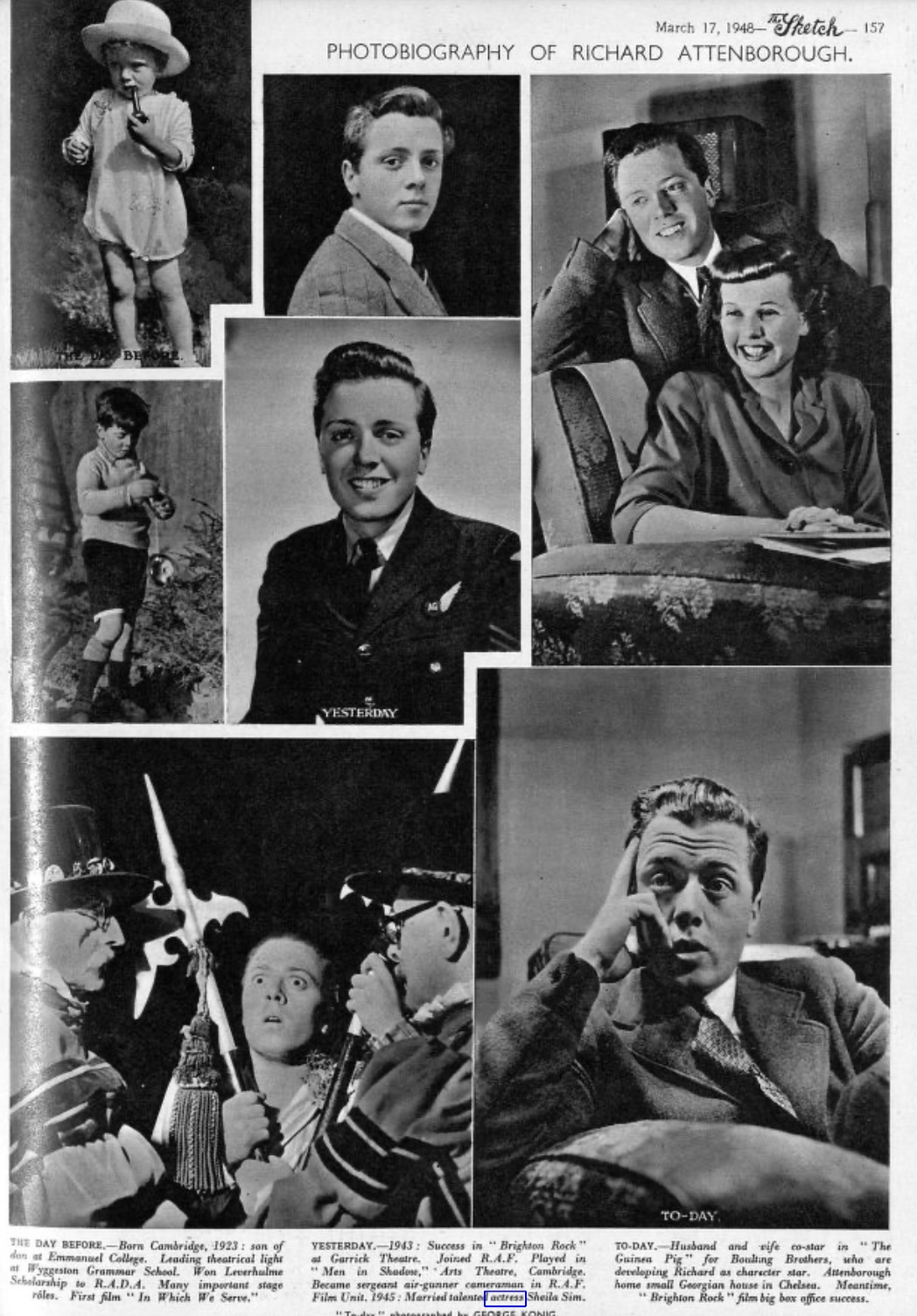
From The Sketch, a photo-story dedicated to Richard Attenborough.
Quiz #11 answer: Humphrey Bogart and Ingrid Bergman in Casablanca, 1942
Quiz #12 answer: Marlene Dietrich
Quiz #13 answer: Tarzan and Jane, Johnny Weissmuller and Maureen O’Sullivan
As ever, thank you for your interest and support.
Hannah
For Authors
#1 for value with 565,000 readers, The Fussy Librarian has helped my books to reach #1 on 32 occasions.
My latest social history project is the “Match of the Century”, the rugby union match that took place on 16 December 1905 between Wales and New Zealand. This match shaped the sporting cultures of Wales and New Zealand, and the wider sporting world.
I hope you will enjoy following this story from the build-up to the match, to the match itself, and its aftermath.
“Match of the Century”
Rugby Union: Wales v New Zealand, 16 December 1905
Part One: The Tourists Arrive
Eastern Daily Press, 9 September 1905
“The team of New Zealand footballers, which is to tour Britain this season, landed at Plymouth yesterday. The players number twenty-eight. The first match is with Devon on the 16th inst. and the last with Wales on December 16th, after which the team returns home.”
The tour actually continued into the new year, but this study will conclude with the momentous match against Wales.
The New Zealand squad with their manager George Dixon and coach Jimmy Duncan
Part Two: Tactics
Athletic News, 11 September 1905
“One doubts that the seven pack of New Zealand will be successful against the eight packs of Great Britain. One has been inclined to the view that their success has been due to the superiority of their men and not their system.”
“In the backs, the New Zealanders play a scrum half, two five-eights and three three-quarters. As a rule, the half-back sends the ball to the five-eights when the latter is moving fast, and not while he is stationary.”
The New Zealanders also had an advantage in the scrums and line-outs. In Britain, the forwards did not have specific positions – they would scrum down in the order they arrived at the scrum. Each New Zealand forward, however, had a specific role.
The New Zealanders eliminated the lottery of the line-out through practice. They used their full-back as an attacker, and were fitter because they played forty-five minutes per half, instead of the thirty-five minutes commonplace in Britain.
New Zealand captain, Dave Gallaher
Part Three: Previewing the First Match
The Pall Mall Gazette, 16 September 1905
“If the game were generally played in England with the same finesse and skill as in Wales, it is possible that there would be a rugby revival. The New Zealanders should help in this direction, for they play an open, fast, clever, and attractive game. The tour may thus gain many converts to the code.”
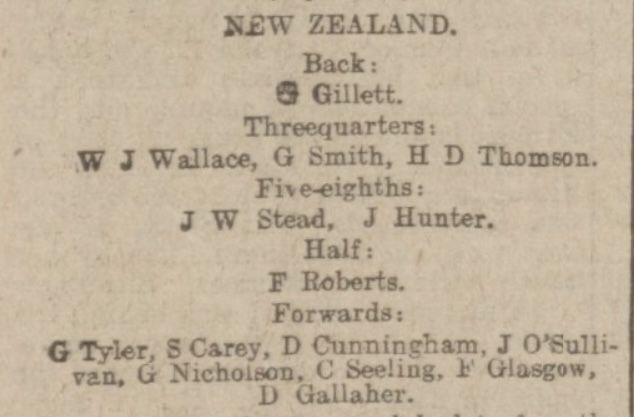
Full-back George Gillett
Part Four: The First Match
Devon 4 v 55 New Zealand
“The sensational scoring by New Zealand against Devon at the County Ground, Exeter was far beyond expectations. There is something extraordinary in the play of the Colonials. The manner in which they acquitted themselves was brilliant, their clever footwork and exceedingly good passing eclipsing anything seen previously at the County Ground.”
“The New Zealanders are an exceedingly fine lot of men, some of them being of exceptional physique. The forwards were heavier than the Devonian eight, but at the conclusion of play all were in excellent condition.”
Part Five: More Victories and a Suggestion
After their opening win against Devon, the New Zealand tourists recorded eighteen more victories against English teams, amassing 557 points with only 15 conceded. Their apparent invincibility prompted the following suggestion:
“Mr Hamish Stuart, rugby writer, has come forward with the suggestion that an Imperial team should challenge the New Zealanders. If the Colonials are to be beaten something big will certainly have to be done. A match between fifteen of England, Scotland, Ireland and Wales against New Zealand would be the very thing to rouse the Rugby Unionists not only of this country, but of the world.”
New Zealand on their way to a 23 – 0 victory over Somerset
Part Six: The First Test
Scotland v New Zealand
The New Zealanders arrived in Edinburgh for their first Test Match, against Scotland, on 18 November 1905 boasting a record of nineteen games played on tour, nineteen victories, 612 points scored and only nineteen conceded. Could the Scotland team rise to the challenge? Here’s what happened.
“It was a struggle worth many a journey to see. A sheer hard, strenuous encounter in which quarter was neither asked for nor given. The pace right through was terrific. Every man must have been trained to the hour to stand it. Half-time score: Scotland 7 points New Zealand 6 points.”
“Five minutes to go and Scotland a point ahead. Can anything more intensely dramatic be imagined or desired?”
“Two minutes to go. With beautiful judgment and speed, Smith (New Zealand, pictured) dodged Scoular by a foot, sprinted twenty-five yards and is over. The scene is something to be remembered. Of course, it is all over now. To make doubly sure, in the last second they score again near the posts from a loose rush. Then the whistle went on the most exciting game I have ever seen. New Zealand won by four tries (12 points) to Scotland one dropped goal, one try (7 points).” – “The Impressionist”, The Empire News, 19 November 1905.
Part Seven: The Second Test
Ireland v New Zealand
After their victory against Scotland, New Zealand met Ireland at Lansdowne Road, Dublin on 25 November 1905. On the Thursday before the Test Match, both teams attended the theatre together, sitting alternatively so that they could better mix. IRFU officials also took the New Zealanders out for breakfast.
As for the match itself: “Ireland’s fifteen was virtually the great side that did so well last year, and was only just beaten for the championship by Wales at Swansea. Against the New Zealanders, it was only after a splendid match that Ireland were beaten by three goals to nil, 15 – 0. The home forwards played up to their reputation, but New Zealand turned the game by their superior work outside the scrum.” – “The Referee”, 26 November 1905.
The All Blacks training by playing association football
As ever, thank you for your interest and support.
Hannah xxx
For Authors
#1 for value with 565,000 readers, The Fussy Librarian has helped my books to reach #1 on 32 occasions.
I’m researching Rita Hayworth for a forthcoming article and novel.
“I’m a good actress. I have depth. I have feeling. But they don’t care. All they want is the image.” – Rita Hayworth.
Clara Bow’s eleventh movie was Wine, produced during the spring of 1924 and released on August 31, 1924. In her first starring role, Clara played Angela Warriner, an innocent girl who develops into a “wild redhot mama”.
A bootlegger’s daughter, Angela reforms when her mother temporarily loses her sight because of bootlegged booze. Unfortunately, Wine, Clara’s eighth picture made in 1924, is now a lost film.
At the time, Clara was a “Baby Star”, one of the up-and-coming actresses in Hollywood. Fellow Baby Star Ruth Hiatt said of Clara, “She was peppy and vivacious in front of people, but when you talked with her, one on one, she was serious and sad. Clara was an awfully sweet girl, but a very lonesome sweet girl.”
Highest Grossing Movie of 1929 The Broadway Melody.
The Broadway Melodywas the first sound film to win an Academy Award for Best Picture. The movie was also notable in that it featured an early Technicolour sequence, which survives today only in black and white.
Experimentation was the name of the game, which meant set changes, long hours and re-shoots as the sound recordists tried to capture the sound. Indeed, Bessie Love’s brief ukulele-playing scene took over three hours to film.
The Broadway Melody made a profit of $1.6 million for MGM. Contemporary reviewers sang the movie’s praises. Motion Picture News said: “The direction is an amazing indication of what can be done in the new medium.”
Variety wrote: “It has…a basic story with some sense to it, action, excellent direction, laughs, a tear, a couple of great performances and plenty of sex.”
However, modern reviewers highlight the poor directing and bad acting, which the original audiences tended to forgive because of the film’s novelty.
Film director Raoul Walsh, pictured, was famous for one of Hollywood’s legendary stories. Apparently, Walsh and a friend stole John Barrymore’s body from a mortuary and seated it in Errol Flynn’s living room to greet the actor after a night on the town. Walsh’s explanation: “There was a lot of the laughing water around in those days.”
It looks like we might get some snow in Glamorgan before Christmas.
The musical White Christmas, released in 1954, was filmed in Technicolor and released in VistaVision, a widescreen process developed by Paramount. White Christmas was the first movie to appear in that format, which entailed using twice the surface area of standard 35mm film.
The movie featured seventeen songs or musical interludes, all written by Irving Berlin. The centrepiece was the title song, which first appeared in Holiday Inn in 1942.
Clara Bow Quotes: “All my illusions about Hollywood were quickly dispelled. Here was no paradise. Here was a busy little community devoted, for the most part, to the manufacture of motion pictures, a business which ranked near the top of the country’s greatest industries. Big business. Here were no princes or princesses. Charming men and women, yes; and many who were not so charming…”
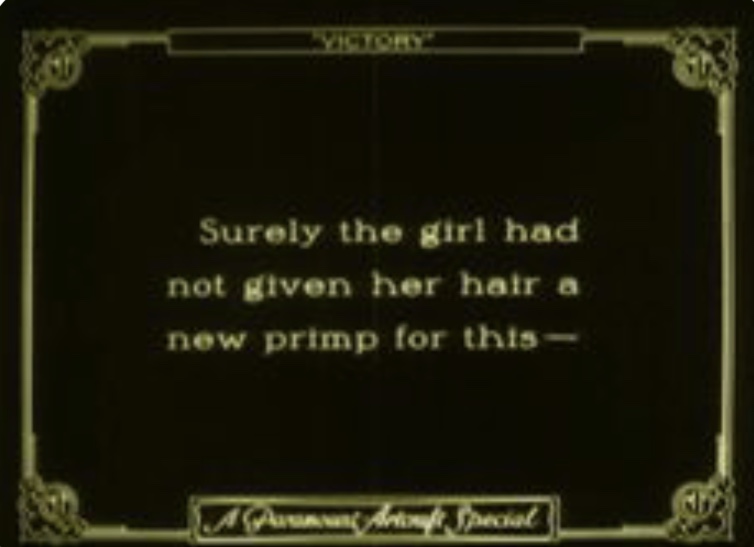
Intertitle #12
Next week, my family history research resumes.
As ever, thank you for your interest and support.
Hannah xxx
For Authors
#1 for value with 565,000 readers, The Fussy Librarian has helped my books to reach #1 on 36 occasions.













 Hannah Howe