
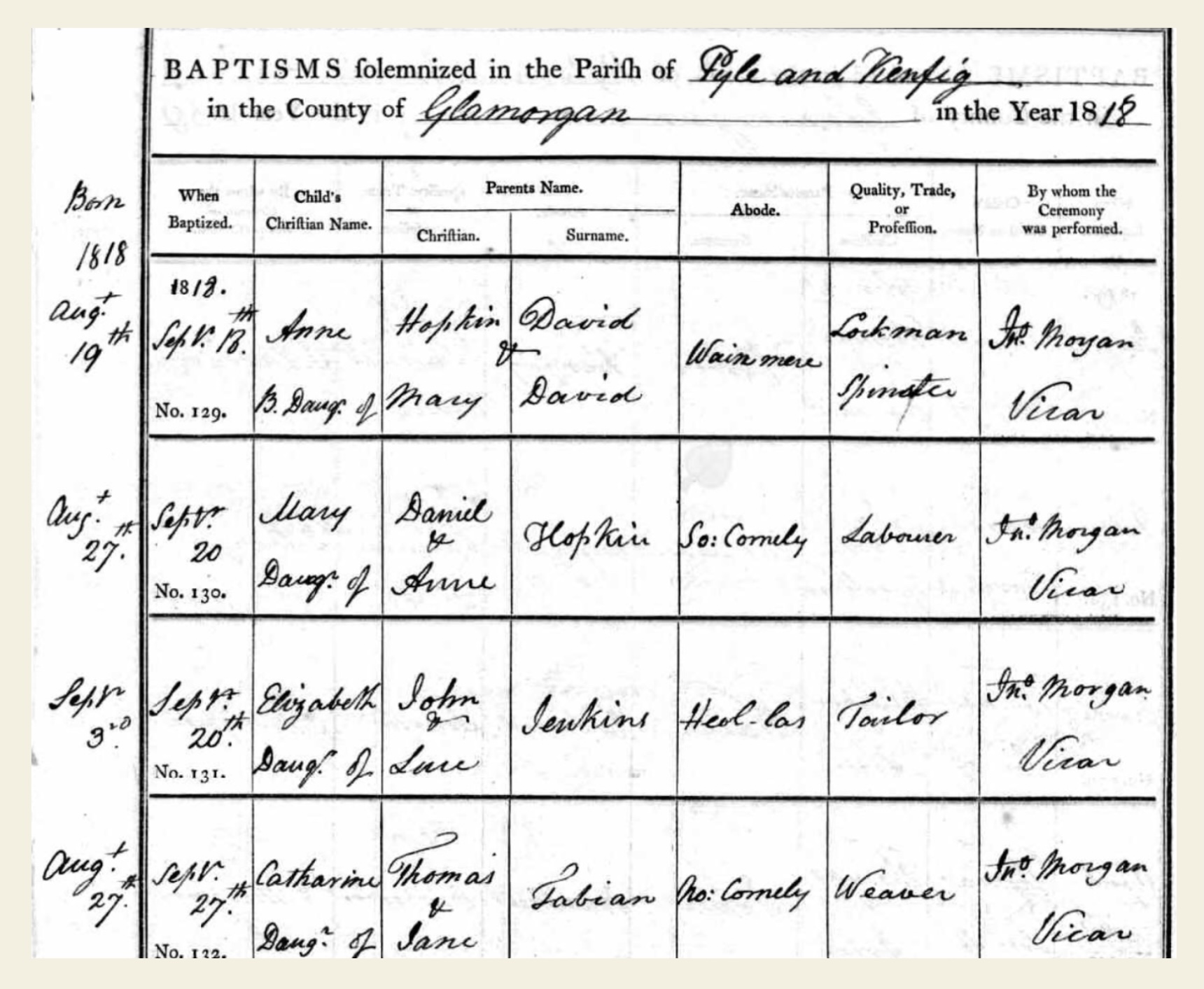
My 3 x great grandmother Mary Hopkin was born on 27 August 1818 in South Cornelly, the third child of Daniel Hopkin 1781 – 1864 and Anne Lewis 1783 – 1863, farm workers. On 20 September 1818, Mary was baptised in nearby St James’ Church, Pyle.
In 1818, South Cornelly was a small village surrounded by farmland and limestone quarries. Some of these quarries were cavernous while others were small pits. The villagers drew their water from a well. Everyone in the village knew their neighbours. Social life was centred on the local pubs and the Methodist chapel, founded in 1786.
A manor in medieval times, South Cornelly’s history runs even deeper with Viking settlements in the area – the names linger: Kenfig, Sker, Tusker Rock – and a Roman road, which is still in use today.
***
In 1802 an antiquarian, Sir Richard Colt-Hoare, visited the area and noted that ‘the houses were all neatly whitewashed’ which ‘greatly enlivened the landscape, which is in general want of trees’. Twenty years on, Mary would have recognised that description.
In September 1807 it was announced that “all the lands called Ty Maen, in Cornelly, situated in the Parish of Pyle and Kenfig, in the rich vale of Glamorgan, within a mile of the turnpike-road, where the London mail passes daily about the same distance from Newton Nottage, much resorted to in the summer as a bathing-place about five miles from the market town of Bridgend and twelve miles from the several market-towns of Cowbridge and Neath” were to be sold.
The farm consisted of exceedingly rich meadow and pasture land and the houses were in good repair. In addition, there was an unlimited Right of Common attached to the farm, upon Newton Down, and two cottages and gardens situated in Cornelly. The land was estimated to be worth at least £60 per annum and the sale was to take place, by auction, at the Wyndham Arms Inn, Bridgend, on Saturday, the 10 October between the hours of three and six o’clock, or in the meantime by private contract.
***
In 1822, work began at Cardiff Docks with the aim of transporting coal and iron. As the nineteenth century progressed, Cardiff Docks became the largest coal exporting docks in the world.
At home, in 1825, Mary welcomed a sister, Margaret into her home. Eight years later, she witnessed the passing of her brother, Hopkin. In due course, Mary would give birth and name a son Hopkin.
Meanwhile, Mary’s sister Anne married David Price and moved to Neath. However, she left her two-year-old daughter Anne behind. In 1840, the family home consisted of Mary, her sister Margaret, niece Anne and parents Daniel and Anne.
***
From the Cambrian, February 1832…TO BE LET…WINDMILL COTTAGE, fit for the reception of a small genteel family, comprising two parlours, kitchen, back kitchen, three best bedrooms, servants’ ditto together with a Croft and Garden adjoining. The above is eligibly situated within a small distance of the improving Bay of Porthcawl, and in view of the Bristol Channel and Devonshire. Further particulars may be had of Mr. J. Beynon, Cornelly.
In October 1837, Mary’s neighbour, merchant John Beynon (mentioned above) fell from his horse and died. This tragic incident made John’s daughter, eleven-year-old Anne, an orphan – her mother had died five years earlier. Taking pity on Anne, Mary’s family welcomed her into their home, where she stayed until adulthood.

The 1841 census reveals that there were fifty-eight buildings in Cornelly at the start of the decade, housing one hundred and fifty-five males and one hundred and fifty females. In total eighty families lived in Cornelly at this time, mostly along Heol-y-Sheet, Porthcawl Road, Lamb Row and Heol Las. One building was uninhabited, while two new houses were under construction, suggesting that change within the village occurred slowly, to meet the needs of individuals and their families and not because of a centralised social plan.
There were eight farmers in Cornelly, five carpenters, four shoemakers, three blacksmiths, two tailors and a stonemason. Cornelly also housed a miller, a customs official and a barrister. However, following in the footsteps of countless generations, the majority of men – thirty-three – made their living from the land as agricultural labourers. The elderly and infirm also had a place in the village with fifteen people living on their own account or receiving parish relief.
During the 1840s, the Sanders family occupied the Hall in North Cornelly. This family consisted of Edmond, the head of the household, aged forty, his wife, Ann, aged thirty, and their children, Hen, aged five, Elizabeth, aged two and Ann, who was seven weeks old when the census was taken on 6 June 1841. William Jones, aged fifty, and Hen Sanders, aged seventy-eight, also lived at the Hall along with four teenage servants, Catherine Howells, Mary Fivian, Juli Poor and John Hart.

Meanwhile, the Joseph family occupied Marlas Farm, Thomas, aged forty-four, his wife, Ann, aged forty, along with their young children, Catherine and Thomas. Edward Mart, William Thomas, Elizabeth Roberts and William Griffin worked as agricultural labourers on the farm, the youngest, William Griffin, being thirteen years old.

 Hannah Howe